Hey Friend. What if the biggest threat to your CDL livelihood isn’t a self-driving rig, but a heavy-duty cargo bike taking your spot at the curb? It’s a question many of us are asking as we watch 30 major global cities prepare to enforce strict zero-emission zones by 2026. You’ve felt the squeeze already. Idling fines are climbing, loading zones are disappearing, and urban gridlock makes hitting your delivery windows nearly impossible. The Truckermann knows that cycle logistics is no longer a niche hobby, but a direct response to the fact that watching those miles roll gets a lot harder when the last three blocks take forty minutes.
You probably agree that the current system is broken, but this shift doesn’t mean you’re being replaced. In this update, you’ll discover how this new delivery model is actually stepping in to save the trucking industry from the urban bottleneck. We’re diving into the partnership between your big rig and the new micro-hubs, explaining how these shifts protect your bottom line and your sanity. We will cover the 2026 regulatory landscape and show you exactly how the road runs through us, even when that road leads to a crowded city center.
Key Takeaways
- Stay ahead of the 2026 municipal regulations targeting idling and emissions that are set to tighten the squeeze on heavy vehicles in urban cores.
- Master the “Mother Ship” strategy where your rig acts as a mobile base for cycle logistics fleets, keeping your heavy-duty equipment out of the “curbside chaos.”
- Learn how to evaluate your route profile to see where partnering with local couriers can save you time and protect your CDL from the headaches of tight city streets.
- Explore how the Trucker Mann can transition into high-demand roles managing urban micro-hubs as the industry shifts toward smarter final-mile solutions.
What is Cycle Logistics? Defining the 2026 Delivery Landscape
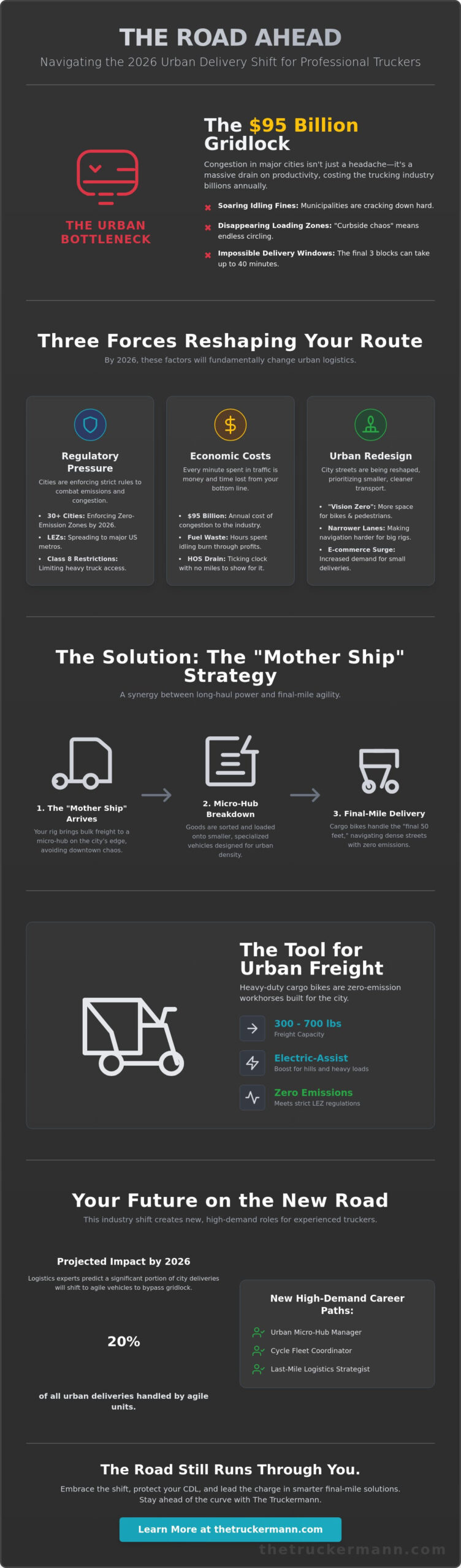
Hey Friend, if you’ve been behind that wheel for a decade, you’ve seen the city streets get tighter and the delivery windows get shorter. The road is changing fast. As we look toward 2026, the “last-mile” bottleneck has become the biggest headache for the American logistics industry, with congestion costing trucking companies nearly $95 billion annually in lost productivity. This is where What is Cycle Logistics enters the conversation. It isn’t just a buzzword; it’s a tactical shift in how we move freight through the concrete canyons of our major city centers.
To better understand how the industry is rethinking the way goods move through congested streets, watch this breakdown of urban freight challenges:
The industry is pivoting toward smaller, more agile delivery vehicles for final drops because a 53-foot trailer simply doesn’t belong on a narrow street in downtown Boston or Seattle. Professional drivers are seeing the rise of micro-hubs where heavy freight is broken down for these smaller units. The Road Runs Through Us, and staying ahead of this shift means understanding that your CDL expertise is now part of a larger, multimodal machine. We’re moving from a “one-size-fits-all” truck model to a specialized fleet approach that keeps the wheels turning even when the traffic stands still.
The Core Concept of Cycle-Based Freight
At its heart, cycle logistics is a multimodal strategy designed for high-density urban areas where traditional delivery vans and trucks face constant delays. These aren’t basic bicycles; they’re heavy-duty, electric-assist cargo bikes built to haul between 300 and 700 lbs of freight. Many fleets are now deploying these vehicles to handle the “final 50 feet” of a delivery. Cycle logistics represents the synergy between long-haul efficiency and urban agility. By 2026, many logistics experts predict that 20% of all urban deliveries will be handled by these agile units to bypass DOT-regulated hours-of-service drains caused by city gridlock.
The “Cycle Logistics” Brand vs. The Global Trend
It’s vital to distinguish between the brand and the movement. There are established carriers like Cycle Logistics Inc., a Midwest-based LTL provider that has been moving freight with traditional trucks for years. While they’ve built a solid reputation for reliability, the term has evolved in professional circles to represent “Green Logistics” as a whole. Search intent for this term is shifting. People aren’t just looking for a specific company anymore; they’re looking for solutions to the “last-mile” crisis. The Truckermann sees this as a real-life opportunity for drivers to transition into fleet management or micro-hub operations as the industry embraces zero-emission, smaller-footprint delivery models to meet 2026 environmental standards.
Driving Forces: Why Urban Logistics is Changing
Hey Friend, let’s look at the reality of the road today. We’ve all seen the surge in e-commerce volume, and it’s turned city streets into a mess of “curbside chaos.” When you’re behind that wheel, you know the drill: circling the block three times just to find a spot that won’t get you a ticket. By 2026, this isn’t just going to be a headache; it’s going to be a regulatory wall. New municipal rules are targeting idling and heavy vehicle emissions with a level of intensity we haven’t seen before. It’s a shift that every professional driver needs to watch closely.
The economic cost of sitting in traffic is eating the industry alive. Every minute you spend idling is fuel down the drain and time lost on your logs. It’s not just about the money; it’s the frustration of watching the miles roll by at five miles per hour while your clock ticks down. On top of that, “Vision Zero” initiatives are actively reshaping our city streets. Planners are carving out more space for pedestrians and smaller vehicles, which means the lanes for our rigs are getting narrower and harder to navigate. The road is changing, and we have to change with it.
Regulatory Pressure and City Access
Low Emission Zones (LEZs) are no longer just a European trend. By 2026, more American metros will implement strict access rules for Class 8 trucks to meet air quality targets. Many cities are already pushing for “off-hour” deliveries to clear the midday gridlock, but cycle logistics offers a way to keep freight moving without those time-of-day penalties. The DOT is currently funding multimodal urban freight experiments to see how cargo bikes can act as a relief valve for our congested hubs. These bikes can often roll right into pedestrian zones where our trucks are legally barred. Understanding how your carrier classification affects your access to these zones is critical, and the 2026 FMCSA rules governing interstate vs intrastate trucking will determine exactly which restrictions apply to your operation.
The Efficiency Gap in the Last Mile
When you compare the cost per drop, a standard van often loses to a cargo bike in a deadlocked city center. A bike doesn’t need a 40-foot loading zone; it can park on the sidewalk or in a small designated nook without racking up double-parking fines. In cities like New York, parking fines for delivery vehicles exceeded $500 million in a single year, which is a massive drain on any fleet’s bottom line. Research into urban supply chains confirms that 28% of total delivery cost happens in the final mile, a figure that reflects the high price of labor and logistics in congested zones.
Staying informed about these shifts is the only way to keep your business profitable as the rules change. You can find the tools you need to stay organized and efficient at thetruckermann.com. Keeping the freight moving is what we do, even if the vehicles look a little different in the future. The road runs through us, no matter what we’re driving.
The Synergy: How Trucks and Bikes Work Together
Hey friend, let’s clear the air right now. There is a common fear that cycle logistics is a threat to the professional driver’s livelihood. It is time to put that myth to bed. A cargo bike is never going to haul a 45,000-pound load of industrial steel across the Continental Divide. By 2026, the industry has realized that bikes are not replacements for trucks; they are specialized tools that act as an extension of your rig. Think of your truck as the “Mother Ship” and the cycle fleet as the small craft that handles the messy, congested work you don’t want to touch anyway.
The old “Dock-to-Door” model is evolving into a more efficient “Dock-to-Hub-to-Door” system. This shift keeps you where you belong: on the open highway, racking up miles and making money. You bring the bulk into a regional center, and the bikes take over for the final three miles of urban chaos. This synergy ensures the supply chain stays moving without forcing a Class A vehicle to navigate a street designed in the 1920s. It is a partnership that respects the power of the heavy-duty engine while acknowledging the agility of the e-cargo bike.
The Micro-Hub Revolution
The backbone of this new system is the micro-fulfillment center (MFC). These are urban consolidation points where heavy freight is broken down for local delivery. Whether you are pulling a dry van or a flatbed, your role is to serve as the primary feeder for these hubs. If you are hauling equipment or building materials into these tight zones, you’ll need the best flatbed trucking gear to ensure your load stays secure during the transition from the interstate to the hub floor. By 2026, these hubs have become the standard for 75 percent of major metropolitan deliveries, acting as the hand-off point that keeps the heavy iron out of the city center.
Benefits for the Professional Driver
The integration of cycle logistics into the supply chain offers three major wins for the man behind the wheel:
- Drastic Stress Reduction: You no longer have to worry about low-clearance bridges or “no truck” signs in downtown cores. You drop at a suburban or perimeter hub and head back out.
- Faster Turn-Arounds: Instead of fighting two hours of city traffic to make one delivery, you can hit a consolidation point, drop your trailer, and be back on the road in 30 minutes.
- Protecting Your Record: Most accidents happen in tight urban environments. By avoiding these high-risk areas, you keep your safety record clean and your insurance premiums low.
This isn’t about losing work; it’s about optimizing your day. The road runs through us, and by letting bikes handle the “last mile” headache, we ensure the trucking industry remains the powerhouse of the American economy without the unnecessary grit of city-center maneuvering.
Implementing Cycle Logistics: A Guide for Fleet Owners
Hey Friend, the Truckermann knows that watching miles roll away on the open highway is one thing, but fighting for a single curb spot in a downtown grid is a different beast entirely. As we look toward 2026, fleet owners shouldn’t see cycle logistics as a threat to the big rigs. Instead, think of it as a tactical partnership that protects your bottom line. If your route profile shows your drivers are spending 40 percent of their shift idling or circling for parking in high-density zip codes, you’re a prime candidate for a multimodal shift. By dropping a trailer at a micro-hub on the city outskirts, you let the heavy iron do what it does best while leaving the “final 50 feet” to specialized bike fleets.
Insurance and liability considerations are the first hurdles you’ll face when moving freight across different vehicle types. You need to ensure your contracts specify exactly where your liability ends and the courier’s begins. Most professional setups transition responsibility at the “gate-out” of the micro-hub. It is vital to verify that your partners carry specialized cargo insurance that covers the unique risks of urban bike delivery, such as sidewalk incidents or weather-related damage.
Selecting the Right Partners
You’ve got to vet your cycle partners with the same grit you’d use for a new hire. Look for providers who carry at least $1 million in general liability and can prove a 98 percent on-time delivery rate. Reliability is your reputation on the line. When you’re handing off freight, you need a clear digital paper trail. Ensure the courier uses ruggedized scanners that sync with your existing dispatch software. This keeps the chain of custody unbroken from the moment that freight leaves your dock until it hits the customer’s hand.
The Tech Stack for Multimodal Success
Success in 2026 depends on seeing the whole board. You need real-time GPS tracking that bridges the gap between the semi-trailer and the cargo bike. Software platforms now allow your dispatchers to see exactly when a bike leaves the hub with your load, providing a seamless view of the journey. Data-sharing is the backbone of 2026 logistics. If your systems don’t talk to each other, you’re just guessing, and guessing costs money in this industry. Look for tools that optimize the hand-off point based on live traffic patterns to ensure your trucks aren’t sitting idle waiting for a bike to arrive.
Stay ahead of the curve and keep your operation moving. Check out our latest gear and tools to help you master the modern road. The Road Runs Through Us.
The Future of the Road: Opportunities in 2026 and Beyond
Hey Friend, I know the sight of cargo bikes buzzing through city centers might feel like a sign that the industry is leaving the big rigs behind. It isn’t. The Truckermann knows that as urban centers tighten the noose on congestion, cycle logistics actually clears a path for the heavy hitters. By 2026, the division of labor will be crystal clear. Bikes handle the “last 50 feet,” while we handle the “first 500 miles.” This shift creates a massive opening for seasoned drivers to step into urban logistics management. You aren’t just a driver anymore; you’re the backbone of a multi-modal network.
The long-term outlook for heavy haul remains rock solid. While light urban freight migrates to two wheels, the demand for 80,000-pound loads isn’t going anywhere. Construction, manufacturing, and bulk food service still require the grit and power of a Class 8 tractor. We are seeing a surge in micro-hub roles where veteran drivers oversee the trans-loading process, ensuring that freight moving from a 53-foot trailer to a cargo bike is secured and accounted for. It’s a real-life opportunity to use your expertise without the constant wear and tear of 14-hour days behind the wheel.
Staying Relevant in a Changing Market
Staying ahead means watching the miles roll while keeping your eyes on the DOT’s next move. By 2026, urban freight regulations will likely require specialized certifications for entering “Green Zones.” You should focus your continuing education on these local ordinances. High-value, heavy-load niches remain the safest harbor for your career because bikes can’t touch a 20,000-pound coil or a load of structural steel. Most importantly, keep that CDL record spotless. Hub-management roles in 2026 will prioritize drivers with clean safety histories to lead their urban teams.
Conclusion: The Road Runs Through Us
The rise of cycle logistics is a partnership, not a competition. It’s about efficiency. When a bike takes a dozen small parcels off your hands, it saves you from the nightmare of tight city corners and predatory parking tickets. We need to lead this conversation. Professional drivers have the boots-on-the-ground experience to tell the suits how these hubs should actually function. Don’t let the changes catch you sleeping in the sleeper berth. Gear up, stay informed, and keep your equipment ready for the next evolution of freight. If you want to stay prepared for the heavy hauls that keep this country moving, explore the latest trucking equipment for modern freight. The Road Runs Through Us.
Gearing Up for the 2026 Urban Shift
The road isn’t getting any easier, but it’s definitely getting smarter. As we look toward 2026, data from recent DOT urban mobility reports shows a clear trend toward restricted city centers and zero-emission zones. You’ve seen the shifts in FMCSA regulatory frameworks that prioritize efficiency over idling in gridlock. Embracing cycle logistics doesn’t mean hanging up your keys; it means evolving how we hit the hub. By pairing the raw power of a Class 8 truck with the agility of electric cargo bikes, fleet owners can bypass the 30 percent congestion delays often found in metropolitan zones. This isn’t just theory from a corporate office. It’s a real-world analysis from a veteran who’s spent decades watching miles roll and knows that being prepared is the only way to stay profitable. The Truckermann is here to ensure you aren’t left behind as these hubs transform. Hey Friend, make sure your load is secure before you hit the hub; check out our top-rated flatbed gear here. Keep your eyes on the horizon and your gear tight. The road runs through us.
Frequently Asked Questions
What is the main difference between cycle logistics and traditional trucking?
The primary difference is that cycle logistics focuses on the “last-mile” grit of city streets while traditional trucking handles the heavy long-haul. You’re still the backbone of the supply chain, but you’re dropping loads at a hub instead of fighting a 53-foot trailer through a narrow alley. Research from 2023 shows bikes move 60% faster than vans in congested zones, making the hand-off a win for everyone on the road.
Can cargo bikes actually handle heavy freight loads?
Heavy-duty cargo bikes like those from Fernhay carry up to 440 pounds of freight per trip. While they won’t replace a full trailer, they handle the small and heavy parcels that usually clog up a city route. In a 2022 London trial, these bikes replaced 20% of van deliveries without losing capacity. This keeps the heavy lifting for the trucks and the nimble work for the bikes.
Is cycle logistics only for big cities like New York or Chicago?
Hey Friend, it’s not just a big city game anymore, as cycle logistics is expanding into mid-sized hubs like Seattle and Portland where congestion is rising. By 2026, over 15 US cities plan to implement Green Zones that restrict heavy vehicle access. Even in smaller hubs, using bikes for the last mile reduces idle time by 25% for the primary carrier. This keeps your truck moving and your fuel costs down.
How does cycle logistics affect DOT compliance for the primary carrier?
Cycle logistics helps protect your business by shifting the highest-risk miles away from your CDL records. Since cargo bikes aren’t regulated under FMCSA Title 49, the primary carrier avoids the Roadside Inspection Blitz risks that come with urban idling and illegal parking. The Road Runs Through Us, but it’s safer when we let specialized cycles handle the 15% of accidents that happen in tight city blocks.
Will cycle logistics lead to fewer jobs for CDL drivers?
No, this shift actually creates more high-value work for CDL drivers by removing the city driving headache. The American Trucking Association reported a shortage of 80,000 drivers in 2023, and moving city deliveries to bikes lets you stay on the highway where the money is. You’ll spend less time idling in traffic and more time watching the miles roll by. The Truckermann knows that a happy driver is one who stays out of city gridlock.
What are the environmental benefits of switching to cycle-based last-mile delivery?
Switching to bike-based delivery cuts carbon emissions by 90% compared to diesel vans according to a 2021 study by the University of Westminster. It also eliminates the noise pollution that leads to no-truck ordinances in residential zones. For the carrier, this means fewer fines and easier access to restricted delivery windows. Staying green helps us keep the roads open for the long haul without facing new government crackdowns.
How do micro-hubs work in a standard trucking route?
Micro-hubs act as a staging area where a Class 8 truck drops a specialized container for bike couriers to pick up. Instead of making 50 stops in a grid, you make one drop at a 2,000-square-foot facility or a mobile trailer. This process can shave 2 hours off a standard urban route. It’s about working smarter, not harder, so you can get back to the main line faster.
What technology is needed to track a package from a truck to a bike?
Carriers use API-integrated platforms like Bringg or Onfleet to sync truck ELD data with bike GPS trackers. Every parcel is scanned during the hand-off at the hub to ensure the chain of custody remains unbroken. This provides 100% visibility for the customer and the fleet manager from the warehouse to the doorstep. You get the credit for the delivery without having to navigate the final three blocks yourself. Understanding how your operating authority is classified is also a key piece of this puzzle; if you’re unsure whether your routes fall under interstate vs intrastate trucking regulations, the rules around FMCSA compliance and hub hand-offs can get complicated fast.
Disclaimer
The information provided on The TruckerMann is for general informational and educational purposes only. While every effort is made to ensure the accuracy and reliability of the content, trucking laws, FMCSA regulations, DOT requirements, safety standards, and industry policies can change at any time. Readers are encouraged to verify all information with official government agencies, professional advisors, or qualified industry professionals before making business, legal, financial, safety, or compliance-related decisions.
The content shared on this website reflects personal opinions, experiences, research, and commentary and should not be considered legal, financial, medical, tax, or professional advice. The TruckerMann and its owners, contributors, affiliates, or representatives are not responsible for any losses, damages, violations, penalties, or liabilities resulting from the use or misuse of information found on this website.
Some content on this website may contain affiliate links, sponsored content, or promotional material. This means we may earn a commission at no additional cost to you if you choose to purchase through certain links.
By using this website, you agree that you do so at your own discretion and risk.