Hey Friend. Did you know that the FMCSA is keeping the random testing rate at 50% for 2026 because the industry’s positive rate hasn’t dropped below the 1% threshold for two consecutive years? It feels like the target on your back just keeps getting bigger, especially when a single misunderstood prescription or a new testing rule could void your livelihood in a single afternoon. You have likely felt that spike of anxiety when the dispatcher calls you in for a dot drug test, wondering if that over-the-counter cold medicine or a simple clerical error at the lab is about to derail your entire driving career.
The Truckermann knows that your CDL is your lifeblood, and we aren’t going to let a lack of information put you on the sidelines. We are diving deep into the 2026 updates, including the addition of fentanyl to the testing panels and the full rollout of oral fluid testing as a primary option. This guide shows you exactly how to handle a Medical Review Officer call, what your rights are at the collection site, and how to keep your record clean in the FMCSA Clearinghouse. We are covering everything from the collection cup to the final report to ensure you stay behind the wheel where you belong.
Key Takeaways
- Identify the specific substances in the 2026 panels, including the addition of fentanyl, so you aren’t caught off guard by new regulations.
- Prepare for the collection site by knowing exactly what paperwork to bring and why collectors follow strict security protocols.
- Learn how to communicate effectively with a Medical Review Officer to defend your CDL if a dot drug test flags a potential issue.
- Navigate the shift toward oral fluid testing and understand how this primary testing option changes the game for drivers.
- Map out the Return-to-Duty process to ensure a single mistake doesn’t permanently end your career on the road.
What is a DOT Drug Test and Who is Watching Your Record?
A dot drug test isn’t just another box to check during your orientation or a minor annoyance at the terminal. It’s a high-stakes, federally mandated screening designed to keep the motoring public safe by ensuring every safety-sensitive professional behind the wheel is stone-cold sober. These tests are strictly governed by the FMCSA under the 49 CFR Part 40 guidelines, which dictate every single detail from how the collector seals the vial to how the lab reports the results. If you’re hauling freight across state lines, you are living under these rules every day. The Truckermann knows that your CDL is your most valuable asset, and understanding the mechanics of this process is the first step in protecting it.
Think of your record like a credit score for your career. Every time you step into a clinic, you are putting your livelihood on the line. To understand the broader context of these screenings and how they fit into public safety, you might ask, What is a Drug Test? at its core. In our world, it’s the difference between a long, profitable career and a permanent seat on the sidelines. With the implementation of fentanyl and norfentanyl testing in early 2026, the net has tightened, making it more critical than ever to stay informed.
To better understand this concept, watch this helpful video:
The Role of the FMCSA Clearinghouse
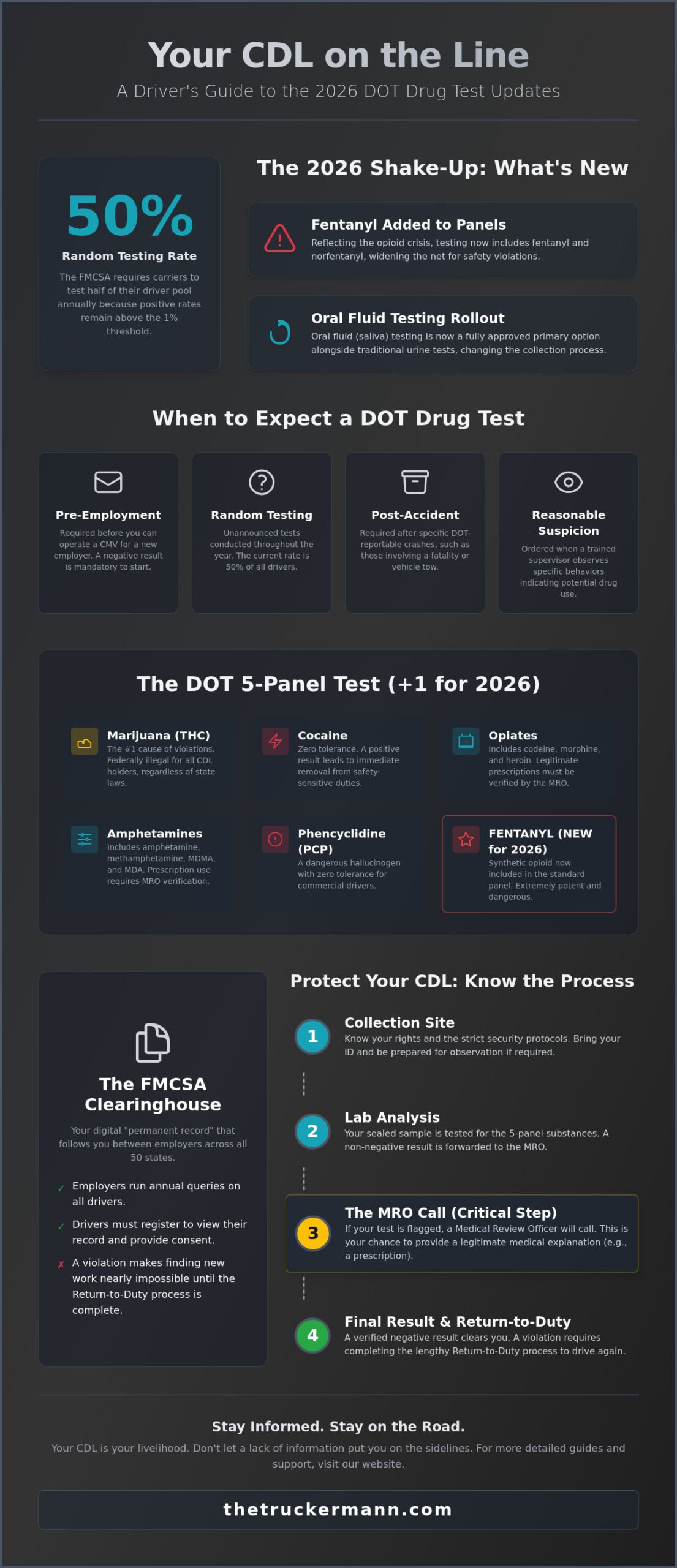
The FMCSA Drug and Alcohol Clearinghouse is the digital “permanent record” that follows you from carrier to carrier. It doesn’t matter if you change jobs or move to a different state; this database tracks violations across all 50 states in real time. Employers are required to run annual queries on every driver they employ to ensure no new violations have popped up. You must register as a driver in the Clearinghouse to view your own record or provide consent for these queries. Keeping this record clean is your primary job. Once a violation hits the system, the road back to compliance is long, expensive, and difficult.
When Are You Required to Test?
You’ll face a dot drug test in four main scenarios, and each carries its own set of pressures. Being prepared means knowing when the call is coming.
- Pre-employment: This is the first hurdle. You can’t even hook up to a trailer for a new carrier until a negative result is verified in the system.
- Random testing: For 2026, the FMCSA requires carriers to randomly test 50% of their driver pool for controlled substances. It’s a lottery no one wants to win, but it’s a constant reality of the job.
- Post-accident: If you’re involved in a crash that meets specific DOT criteria, like a fatality or a vehicle being towed from the scene, you’ll be heading to the clinic immediately.
- Reasonable suspicion: If a supervisor has a specific, articulable reason to believe you’re under the influence based on your appearance or behavior, they are legally obligated to pull you off the road for a test.
The 5-Panel Breakdown: What the Lab is Actually Testing For
When you step into that clinic, the lab isn’t just looking for “drugs” in a general sense. They’re hunting for specific chemical markers defined by the 5-panel protocol. As of early 2026, the stakes have shifted with the formal addition of fentanyl and norfentanyl to the testing panels. This change reflects the industry’s aggressive response to the opioid crisis, and it means the net is wider than ever. Marijuana remains the heavy hitter, accounting for the vast majority of Clearinghouse violations. Even as more states move toward legalization, the federal government hasn’t budged an inch. If you’re behind that wheel, THC is a career-killer.
Cocaine and PCP are treated with absolute zero tolerance. These are high-level stimulants that trigger an immediate disqualification from safety-sensitive duties. There’s no “medical explanation” for these appearing in your system, and the lab reports them directly to the Medical Review Officer (MRO) for verification. If these markers are found, your time on the road stops that day. It’s a hard reality, but it’s the standard we all live by to ensure every driver gets home safe.
For opioids and amphetamines, the situation gets a bit more complicated. The lab looks for both illegal street drugs like heroin and the misuse of prescription meds like oxycodone or Adderall. This is where your paperwork becomes your shield. If you have a valid prescription from a licensed physician, the MRO will verify it before reporting the result as negative. You can find the latest official guidance on these specific substance panels at the DOT’s Office of Drug & Alcohol Policy, which sets the gold standard for industry compliance. Don’t leave your career to chance; know what’s going into your body and keep your documentation ready.
Urine vs. Oral Fluid Testing in 2026
By 2026, oral fluid testing has become a primary tool for carriers, especially for catching recent use. While urine testing has a longer detection window, saliva tests are highly effective for identifying substances used within the last 24 to 48 hours. This method is less invasive and eliminates the “shy bladder” issues that keep drivers stuck in clinics for hours. However, full laboratory certification by HHS is the final hurdle for some providers this year. It’s a faster, cleaner process that keeps you moving toward your next load.
The Problem with CBD and Delta-8
Hey Friend, don’t let a “legal” label at a truck stop fool you. Many over-the-counter CBD and Delta-8 products aren’t regulated by the FDA, meaning they often contain higher THC levels than the label claims. If that THC shows up on your dot drug test, the MRO won’t care if it came from a gas station gummy or a joint. The result is the same: a violation on your record. If you value your CDL, steer clear of these risky supplements and check out our recommended driver resources for staying healthy and compliant on the road.
How to Navigate the Collection Site: A Step-by-Step Guide
Walking into a collection site can feel like stepping into a high-security facility, but the process is just a series of controlled steps designed to protect the integrity of your sample. When you arrive for your dot drug test, the first thing the collector will demand is a valid photo ID, typically your CDL. You’ll also need the Federal Drug Testing Custody and Control Form (CCF) provided by your employer or the site itself. Don’t be the driver fumbling through a messy cab for paperwork. Being organized shows the collector you’re a professional who knows the drill, which sets the tone for the entire encounter.
Before you even see a collection cup, you’ll be asked to leave your outer garments, like your jacket or hat, outside the testing area. The collector will then ask you to empty your pockets. They aren’t being nosy; they’re strictly following the FMCSA Drug and Alcohol Rules to ensure no adulterants or “clean” substitute samples are brought into the stall. You’ll keep your wallet, but everything else stays in a secure lockbox or a designated area. This is a standard ritual of the road, and cooperating quickly helps you get back behind the wheel faster.
Once you provide the sample, the “chain of custody” begins. You must keep your eyes on that cup until the collector has poured it into the two official vials and applied the security seals. Your signature on the CCF is your bond; it’s you certifying that the sample is yours and that it was sealed in your presence. Never look away until those seals are initialed and the paperwork is complete. This is the only way to ensure your livelihood isn’t compromised by a clerical error at the lab.
Your Rights at the Collection Site
You have the right to see the collector open a fresh, factory-sealed kit right in front of you. If the kit looks tampered with, speak up immediately. If you’re dealing with a “shy bladder” and can’t go right away, the rules are on your side. You are allowed up to three hours to provide a sufficient sample, and the collector can provide you with up to 40 ounces of fluids during that window. Don’t let a collector rush you or threaten you with a “refusal to test” if you’re following these specific timeframes. If a collector isn’t following DOT protocol, remain calm, follow their instructions to avoid a refusal, but note the discrepancy on your copy of the CCF.
Post-Collection: The Chain of Custody
Your sample is split into “Bottle A” and “Bottle B” to give you an insurance policy. If Bottle A comes back positive, you have the right to request that Bottle B be tested at a different certified laboratory. This split-sample safeguard is your last line of defense against lab errors. Staying organized during this stressful process is just as important as how you handle your load. For more tips on maintaining a professional standard while you’re out there, check out our guide on Essential Tools for Professional Cargo Securement to keep your gear as tight as your compliance record.
Handling the MRO: What to Do if Your Test is Flagged
The Medical Review Officer (MRO) is the only person standing between a laboratory flag and a career-ending mark in the FMCSA Clearinghouse. If the lab identifies a controlled substance in your sample, they don’t call your dispatcher or your safety manager first. They send the result to the MRO, who is a licensed physician with specialized training in substance abuse. This doctor acts as an independent gatekeeper. Their job is to determine if your “non-negative” result has a legitimate medical explanation or if it’s a true violation of the dot drug test protocols.
When the MRO calls you, don’t panic. This interview is your legal right and your only opportunity to defend your CDL before the result is finalized. You have to be prepared to provide proof for every medication you take. The MRO will ask for your pharmacy’s name, the prescribing doctor, and the prescription number. If you can’t provide this information during the call, the MRO will likely verify the result as positive, and your driving days are over for the foreseeable future. Treat this call with the same level of seriousness as a roadside inspection.
Valid Prescriptions vs. Prohibited Use
Having a prescription for a substance like Adderall or Percocet doesn’t automatically mean you’re in the clear. The MRO will verify that the prescription is current and was issued to you by a licensed medical professional. However, even with a valid script, the MRO may issue a “Safety Concern” letter to your employer if they believe the medication makes you unsafe to operate a commercial motor vehicle. The Truckermann’s best advice is to keep a digital folder on your phone with photos of every active prescription bottle. This allows you to provide the necessary details in seconds, rather than digging through your sleeper berth while parked at a noisy truck stop.
Requesting a Split-Sample Test
If the MRO verifies your test as positive, you have exactly 72 hours from the time of that notification to request a test of your “Bottle B” sample. This is why the split-sample collection mentioned earlier is so vital. You have the right to request that this second vial be sent to a completely different certified laboratory for analysis. While the driver or employer usually has to pay for this second test upfront, it is your last line of defense against a potential lab error or sample contamination. If Bottle B comes back negative, the entire violation is wiped out. To stay ahead of these high-stakes situations, get the latest compliance alerts from The Truckermann to ensure you never walk into a clinic unprepared.
Protecting Your Future: The Return-to-Duty Process
A failed dot drug test feels like a head-on collision with a concrete wall. Your CDL is effectively sidelined, your truck is parked, and the steady income you rely on vanishes overnight. But Hey Friend, while a violation is a massive blow to your career, it doesn’t have to be the end of the road. The FMCSA has a specific path for redemption, though it requires grit, time, and a total commitment to the process. The moment a violation is recorded in the Clearinghouse, you are legally prohibited from performing safety-sensitive functions. This means no driving, no loading, and no supervising until you complete the Return-to-Duty (RTD) process.
The first step toward getting your keys back is an evaluation by a DOT-approved Substance Abuse Professional (SAP). This isn’t just a quick chat; it’s a comprehensive assessment where the SAP determines what education or treatment you need to safely return to work. You’ll have to follow their plan to the letter. Once the SAP marks you as compliant in the Clearinghouse, you’ll need to pass a supervised return-to-duty test with a negative result. After you’re back in the cab, you’ll be subject to a minimum of six unannounced follow-up tests within the first 12 months. This vigilance can continue for up to five years, depending on the SAP’s recommendations. Your standing in the industry, including your CDL rankings and your future earning potential, depends entirely on how professionally you navigate this comeback.
The Cost of a Violation
The financial hit from a violation goes far beyond the initial lost wages. Most major carriers have internal policies that prevent them from hiring a driver with a drug violation for at least three to five years, even after the RTD process is finished. You’ll likely find yourself working for smaller outfits at lower pay rates while you rebuild your reputation. Additionally, your personal insurance rates will surge, and the cost of the SAP program itself, which can run into the thousands, usually comes out of your own pocket. Staying clean is significantly cheaper than the price of a single mistake.
Staying Compliant Long-Term
Professionalism on the road starts with a clear head and a proactive approach to your record. You should log into the FMCSA Clearinghouse at least once a quarter to ensure no clerical errors have been made on your file. Maintaining a high standard of ELD Compliance alongside a spotless drug record shows recruiters and inspectors that you’re a top-tier operator. The road is tough enough without carrying the weight of a violation. Stay vigilant, stay informed, and keep your career on the right side of the law. The road runs through us, but only if we’re fit to drive it.
Keep Your Eyes on the Horizon and Your Record Clean
Hey Friend. Protecting your CDL in 2026 requires more than just safe driving; it requires being an expert on the regulations that govern your life. We’ve covered how the addition of fentanyl to the testing panel and the rise of oral fluid testing are changing the landscape. You now know that a dot drug test is a process you can manage by staying organized with your prescriptions and keeping a vigilant eye on the FMCSA Clearinghouse. This expert advice comes from a seasoned veteran who knows that a clean record is the foundation of your future pay and hireability.
Don’t let a simple clerical error or a lack of preparation sideline your career. By following these CAM-ready compliance tips and understanding the split-sample safeguards, you’re taking control of your professional destiny. Keep your gear and your record clean by making sure you have the right support behind you. Keep your gear and your record clean-shop the best trucking tools here.
The road is long, and the challenges are many, but with the right knowledge, you’ll stay behind the wheel for years to come. The Road Runs Through Us.
Common Questions About the DOT Drug Test
How long does a DOT drug test take to come back?
Negative results for a dot drug test typically arrive within 24 to 48 hours after the lab receives your specimen. If the sample is “non-negative” and requires a Medical Review Officer (MRO) to step in, the process can take five business days or longer. The MRO is required to attempt to contact you directly before finalizing any result, so it’s vital to keep your phone on and your voicemail box clear during this window.
Can I refuse a DOT drug test if I’m off-duty?
You can generally only be selected for a random test when you’re on-duty, performing safety-sensitive functions, or immediately before or after doing so. However, if you’re notified of a selection while at the terminal, you must report to the collection site immediately. Refusing a test because you’ve already clocked out is legally treated as a refusal to test, which carries the same career-ending weight as a positive result in the FMCSA Clearinghouse.
Will a prescription for medical marijuana protect my CDL?
No, a medical marijuana card or a state-level prescription won’t protect your CDL under any circumstances. The DOT follows federal law under the Controlled Substances Act, which classifies marijuana as a Schedule I substance with no accepted medical use for transportation workers. If THC shows up in your system, the MRO is prohibited from verifying it as a negative result, regardless of state laws or medical recommendations in your home state.
What happens if I accidentally drink a poppy seed tea before a test?
It’s highly unlikely that normal consumption of poppy seeds will trigger a violation because the DOT raised the morphine cutoff level to 2,000 ng/mL in 1998 specifically to prevent false positives. If you test above this high threshold, the MRO will look for clinical evidence of opium use. However, concentrated poppy seed tea can easily exceed these limits, and “accidental consumption” is rarely accepted as a valid medical explanation by a reviewing physician.
Does the DOT test for nicotine or alcohol in the 5-panel screen?
The standard 5-panel urine screen does not test for nicotine or alcohol. While alcohol is strictly regulated under FMCSA rules, it’s checked via breathalyzer or saliva swabs rather than the urine sample used for the 5-panel drug screen. Nicotine is not a prohibited substance under current DOT regulations, so it won’t impact your compliance record or your ability to stay behind the wheel of your rig.
How long do drug violations stay on my FMCSA Clearinghouse record?
Drug and alcohol violations stay on your FMCSA Clearinghouse record for five years or until you successfully complete the return-to-duty process, whichever is later. Even after the five-year mark passes, the violation remains visible to potential employers until the Substance Abuse Professional (SAP) marks your follow-up testing plan as complete. This ensures that only fully compliant drivers are operating on our highways and sharing the road with our families.
What is the ‘Shy Bladder’ protocol during a DOT drug test?
The “Shy Bladder” protocol gives you a three-hour window to provide at least 45 milliliters of urine for your dot drug test. During this time, the collector can provide you with up to 40 ounces of fluids to help the process along. If you still can’t provide a sample after the three-hour limit, you’ll be required to undergo a medical evaluation within five business days to determine if a legitimate medical condition prevented the collection.
Can a DOT drug test detect synthetic urine or masking agents?
Yes, modern labs use specimen validity testing to detect synthetic urine, masking agents, and intentional dilution. They check for specific gravity, pH levels, and creatinine concentrations that fall outside the range of human biology. If the lab determines the sample has been tampered with, it’s reported as a “substituted” or “adulterated” result, which is a permanent violation that triggers an immediate and mandatory removal from all safety-sensitive service.
Disclaimer
The information provided on The TruckerMann is for general informational and educational purposes only. While every effort is made to ensure the accuracy and reliability of the content, trucking laws, FMCSA regulations, DOT requirements, safety standards, and industry policies can change at any time. Readers are encouraged to verify all information with official government agencies, professional advisors, or qualified industry professionals before making business, legal, financial, safety, or compliance-related decisions.
The content shared on this website reflects personal opinions, experiences, research, and commentary and should not be considered legal, financial, medical, tax, or professional advice. The TruckerMann and its owners, contributors, affiliates, or representatives are not responsible for any losses, damages, violations, penalties, or liabilities resulting from the use or misuse of information found on this website.
Some content on this website may contain affiliate links, sponsored content, or promotional material. This means we may earn a commission at no additional cost to you if you choose to purchase through certain links.
By using this website, you agree that you do so at your own discretion and risk.