The trucking industry just hit its lowest employment levels since September 2020, yet your per-mile pay is finally clawing its way back up. You know the drill; you’re out there seeing the insurance premiums climb and hearing brokers cry poor while you’re just trying to keep your wheels turning profitably. It’s a grind when the news says one thing and your settlement says another, especially with the spot market feeling more like a gamble than a business plan lately. We’re cutting through the noise to deliver the straight talk on freight rate trends for truck drivers 2026, focusing on the structural capacity crunch that’s finally putting leverage back in your hands.
With the Cass Truckload Linehaul Index up 5.6 percent and van rates averaging $2.36 per mile this May, the tide is turning for drivers who stay informed. This breakdown covers why carrier attrition is driving rates higher than demand ever could, which segments like flatbed are hitting record highs, and how to navigate new FMCSA shifts like the USDOT identifier mandate. You’ll get the metrics you need, from reefer load-to-truck ratios to J.B. Hunt capacity signals, to ensure you’re positioning your rig for maximum revenue in a tightening market.
Key Takeaways
- Understand why structural tightening, rather than just demand, is the real driver behind rates and why staying compliant is now your strongest negotiation tool.
- Learn to read J.B. Hunt’s capacity metrics like a professional “check engine” light to anticipate shifts in over-the-road demand before the brokers do.
- Identify the specific lanes where infrastructure growth and seasonal surges are pushing freight rate trends for truck drivers 2026 toward record-breaking linehaul averages.
- Master the “All-In” rate trap by calculating the real cost of deadhead miles and fuel surcharges to protect your bottom line in a volatile market.
- Discover how to leverage your ELD efficiency data and clean inspection record to bypass the spot market race-to-the-bottom and secure high-paying shippers.
The 2026 Freight Market Reality Check: Beyond the Headlines
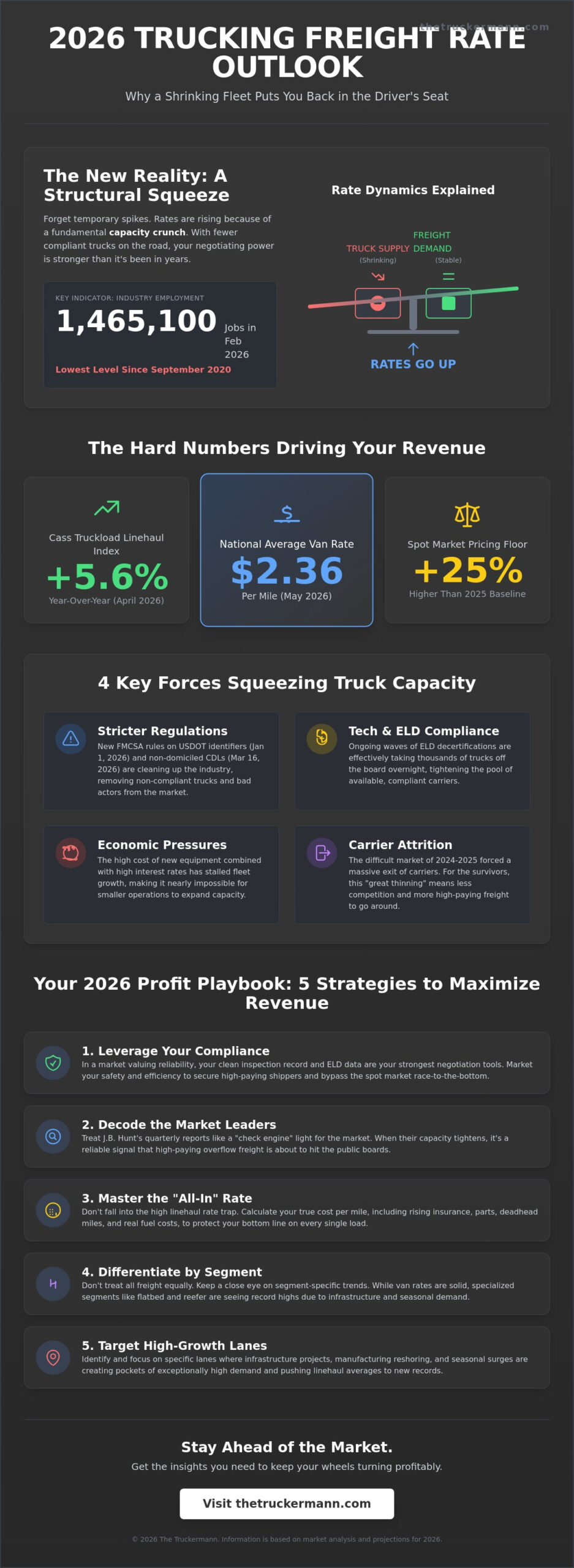
The great thinning of 2024 and 2025 wasn’t easy to watch. But for those of us still holding the wheel in 2026, the payoff is finally arriving. We aren’t looking at a temporary spike or a lucky break. Instead, we’re seeing a fundamental shift where the boom-bust cycles of the past have smoothed out into a steady, structural tightening of the market. By February 2026, industry employment hit 1,465,100 jobs, which is the lowest we’ve seen since the world shut down in 2020. This isn’t just a driver shortage headline. It’s a massive exit of capacity that has finally given the survivors some breathing room and real leverage at the negotiation table.
Understanding the core of what are freight rates and how they’re determined is crucial for navigating this year. It isn’t just about how many trailers are parked in a yard. It’s about structural capacity, which includes only those trucks that are active, compliant, and ready to roll. With the FMCSA’s March 16, 2026, rule restricting non-domiciled CDLs and the recent wave of ELD decertifications, thousands of trucks were effectively removed from the board overnight. This tightening is the primary engine behind current freight rate trends for truck drivers 2026, ensuring that even as demand stays moderate, the supply of reliable rigs remains low enough to keep prices firm.
We also have to talk about the elephant in the cab: inflation. While seeing a $3.00 per mile rate might have felt like winning the lottery in 2020, in 2026, that same number is often just what’s required to keep your business healthy. Between rising insurance premiums and the cost of parts, your purchasing power has shifted. It’s why we’re seeing such a hard push for higher rates. It isn’t greed; it’s the new cost of survival on the open road.
To better understand how these market forces are shaping the road ahead, watch this helpful video:
Spot vs. Contract Rates: The 2026 Gap
Contract rates are finally catching up to the reality of a leaner supply chain. The Cass Truckload Linehaul Index jumped 5.6 percent year-over-year in April 2026, proving that shippers are getting the message. If they want guaranteed capacity, they have to pay for it. The spot market is currently acting as a loud leading indicator. With national van rates hitting $2.36 per mile in early May, we’re seeing a pricing floor that sits roughly 25 percent higher than what we dealt with in 2025. You shouldn’t expect rates to crater back to those old levels because the cost of doing business has reset the baseline for everyone.
Capacity Tightening: The Driver Behind the Dollars
Your negotiating power with brokers hasn’t been this strong in years. Fleet growth has stalled because the cost of new equipment and high interest rates have made expansion nearly impossible for smaller outfits. Plus, the FMCSA’s shift to using the USDOT number as the primary identifier as of January 1, 2026, has made it much harder for bad actors to hide records and undercut honest operators. This digital scrutiny is effectively cleaning up the industry. It removes non-compliant capacity and leaves the high-paying freight for professionals who run a tight ship and keep their gear in top shape.
Decoding J.B. Hunt Transportation Services Capacity Rates: What They Signal for You
When a carrier the size of J.B. Hunt moves, the entire industry feels the vibration. For an independent operator or a small fleet owner, their quarterly earnings reports are more than just corporate fluff; they are the most reliable check engine light we have for the market. By watching how they deploy their assets, you can spot the next wave of freight rate trends for truck drivers 2026 before the brokers even post their loads. If J.B. Hunt reports that their internal truckload capacity is tight, it means the overflow is about to hit the public boards, usually with a much higher price tag attached.
We’re seeing a significant 2026 trend where big fleets are pivoting toward specialized capacity and dedicated contracts. They’re tired of the commodity dry van race and are moving their chips toward high-value, complex freight. This shift leaves a vacuum in general freight lanes that you can fill. By paying attention to where these giants are pulling back, you start to see the map differently. You stop chasing every cheap load and start positioning your rig where the big players are leaving gaps, ensuring your revenue per mile stays ahead of the pack.
Interpreting ‘Capacity Utilization’ in Plain English
In their quarterly calls, big fleets often talk about capacity utilization. In plain English, that just means how many of their trucks are actually loaded and moving versus sitting in a yard. When they report that utilization is high, it means they don’t have a spare truck to give a shipper. A 2% shift in big-fleet capacity can trigger a 10% jump in spot rates. This happens because shippers get desperate when their primary carrier says no, and that desperation is exactly what fuels your revenue per mile on the spot market. If you’re looking to stay ahead of these shifts, checking in with The Truckermann can help you translate these corporate numbers into road-ready strategy.
Big Fleet Benchmarks vs. The Independent Operator
You might think J.B. Hunt’s operating ratio doesn’t matter to a one-truck show, but it’s a mirror for your own expenses. If their costs for fuel and maintenance are spiking, yours are too. However, you have an agility they don’t. While they are locked into massive intermodal shifts due to diesel prices and rail efficiency, you can pivot between lanes in a single afternoon. Following the big-fleet volume helps you identify which lanes are healthy and which are being abandoned. For more expert perspective on how these macro trends affect your daily rate, check out this expert analysis on the shifting freight landscape. Understanding these benchmarks allows you to bid with confidence rather than just guessing what the market will bear.
Rate Trends by Segment: Van, Flatbed, and Reefer Outlook
General market averages are good for a bird’s eye view, but you don’t drive a “general” truck. You drive a specific rig with specific costs. Whether you’re pulling a box, an open deck, or a temperature-controlled unit, the freight rate trends for truck drivers 2026 look different depending on your equipment. According to the 2026 Trucking Industry Outlook, we’re entering a period where segment-specific demand is decoupled from the broader economy. This means some of you will see record-breaking settlements while others are just treading water.
Dry van rates have established a solid floor this year. As of May 2026, the national average spot van rate sits at $2.36 per mile. While that isn’t the moon, it’s a 25 percent jump from last year. The upside here is still tied to how much people are spending at the big box stores, but the “LTL factor” is changing the game. Shippers are increasingly breaking down large truckload orders into smaller, more frequent shipments. This eats into traditional truckload volumes, making it vital for you to watch your deadhead miles when chasing these smaller, more volatile loads.
The reefer market is currently the star of the show. With a load-to-truck ratio hitting 16.4 in early May, demand is at its highest weekly average of the year. People’s “thirst for fresh” produce and the seasonal surge from Mother’s Day have pushed reefer linehaul rates up 26 percent year-over-year. If you’re running a reefer, you’re sitting in the driver’s seat during negotiations right now.
The Flatbed Advantage in 2026
Flatbedders are seeing the most consistent gains, with average linehaul rates increasing for eight consecutive weeks as of May 9, 2026. This segment is up 27 percent year-over-year. The secret sauce is the massive buildout of infrastructure for AI data centers and a steady hum in domestic manufacturing. However, your profit isn’t just about the rate. Rising tarping and securement costs mean you have to be more selective with your loads. Having the right equipment is a non-negotiable part of that math. If you want to keep your margins high, check out The Best Flatbed Trucking Gear for Logistics & Securement in 2026 to ensure you aren’t overpaying for the tools of the trade.
Reefer and Van: Chasing the Seasonal Peaks
Success in 2026 is all about knowing where the “hot zones” are. We’re seeing a massive surge in import volumes through the Port of Los Angeles, which is putting extreme pressure on regional capacity. Interestingly, “private fleet normalization” is actually helping for-hire drivers this year. As big companies stop expanding their own fleets due to high equipment costs, they’re forced back onto the spot market to handle their overflows. There’s a growing disparity between regional and long-haul rates; currently, the money is moving toward shorter, high-frequency regional loops where you can turn more loads in a week without burning through your HOS on a single cross-country trek.
Strategy Over Speed: How to Navigate Volatile Rates in 2026
The market is tightening, but that doesn’t mean you can just put your foot down and outrun the volatility. In 2026, the drivers who are consistently profitable aren’t necessarily the ones with the highest gross on a single load. They’re the ones with a plan. Chasing the highest cents-per-mile (CPM) is a classic rookie mistake, especially in a high-fuel environment. Brokers love to dangle an “All-In” rate that looks massive on paper. If that rate doesn’t account for high diesel prices or a 200-mile deadhead to get to the next good lane, you’re just paying for the privilege of burning rubber.
Effective load selection requires doing the “Deadhead Math” before you hit “accept.” In the current environment, moving 150 miles for a $3.50 rate might actually net you less than staying put for a $2.80 load that puts you exactly where the next high-volume surge is happening. This is where broker relationships become your insurance policy. While the spot market is a leading indicator for freight rate trends for truck drivers 2026, those long-term handshakes with reliable brokers ensure you get the first call when a “must-move” load hits their desk. You want to be the person they call because they know you’re reliable. Modern AI-driven load boards can now predict rate drops before they happen, giving you a 48-hour head start to reposition your equipment before the rest of the pack catches on.
Cost Control: The Only Part of the Rate You Can Command
You can’t control what a shipper is willing to pay, but you have total authority over what leaves your bank account. Efficiency is the new high rate. Managing your downtime and keeping your rig in peak legal condition prevents those thousand-dollar “surprises” at the scales. If you’re looking to tighten up your operation, check out The Truckermann for the latest safety and compliance resources to stay ahead of the inspectors. Every hour you spend sitting because of a fixable compliance issue is a hole in your pocket that no freight rate can fill. It’s a “Smart Operator” market where the person with the lowest overhead wins.
Lane Strategy: Moving Where the Capacity Isn’t
The smartest play in 2026 is finding the lanes everyone else is ignoring. While most drivers are fighting over the high-profile cross-country hauls, the real money is often in regional “loops” that keep you within a 500-mile radius. These underserved lanes offer more consistency and let you turn three loads in the time it takes to do one long haul. Market discipline for the independent driver means having the guts to say no to a “pretty” rate that leaves you stranded in a freight desert. By using real-time data to see where capacity is drying up, you can position yourself as the only solution for a desperate broker and capitalize on the latest freight rate trends for truck drivers 2026. This isn’t just about driving; it’s about out-thinking the market.
Staying Profitable: Compliance, Gear, and the Road Ahead
You can have the best lane strategy in the country, but if your rig is sidelined by a DOT officer, your revenue per mile drops to zero instantly. In this tightening market, 2026 has become the year of the “Clean Inspection.” Shippers and brokers are under more pressure than ever to move freight safely, and they are using the FMCSA’s data to weed out the high-risk carriers. When you can show a broker a history of zero violations, you aren’t just another truck in the database; you’re a low-risk asset that deserves a premium rate. Staying on top of the latest freight rate trends for truck drivers 2026 requires more than just watching the boards. It requires maintaining a professional operation that commands respect at the scale house and the loading dock.
Your ELD isn’t just a compliance burden; it’s a piece of business intelligence. Smart drivers are using their logging data to prove their efficiency to high-paying shippers. If you can show that you consistently have hours available and a history of on-time deliveries, you have the leverage to bypass the “steering wheel holders” who are just looking for the next quick buck. This level of professionalism is what separates the survivors from the statistics in 2026. The market is finally rewarding those who treat this trade like the specialized career it is.
Compliance as a Profit Center
Clean MVRs and DOT records translate directly into “Preferred Carrier” status. This status often grants you access to “dark” freight—loads that never even hit the public boards because brokers save them for their most reliable partners. With the CVSA International Roadcheck scheduled for May 12-14, 2026, focusing on cargo securement and ELD tampering, now is the time to tighten up. One bad inspection during a peak rate week can cost you thousands in lost opportunity. To make sure your tech is up to par, check out our guide on ELD Compliance in 2026: The Driver’s Guide to Electronic Logging Devices. Staying ahead of the inspectors keeps your wheels turning when the rates are at their highest.
The Right Tools for the 2026 Market
High-quality gear reduces “accessorial friction.” If you’re a flatbedder, having top-tier securement tools means you get loaded faster and spend less time fighting with worn-out equipment. This efficiency directly impacts your daily profit margin. You can find the latest flatbed securement tools at Mytee Products to ensure you’re ready for any load the broker throws your way. For those specialized hauls that require heavy-duty assistance, visit Truck n Tow for recovery gear that keeps you moving. Investing in your equipment is a clear signal to the market that you are a professional who values the cargo and the schedule. As we move through 2026, the drivers who invest in their compliance and their gear will be the ones who master the freight rate trends for truck drivers 2026 and come out on top.
Master the Shift: Your Roadmap to 2026 Profits
The road through 2026 is finally looking up for the drivers who stayed the course through the lean years. We’ve seen that freight rate trends for truck drivers 2026 are being fueled by a massive capacity tightening rather than just a surge in consumer spending. By keeping a close eye on J.B. Hunt’s intermodal shifts and maintaining a spotless inspection record, you can move from just taking what’s offered to dictating your own terms. This year belongs to the professional operator who uses data to pick their lanes and high-quality gear to minimize downtime.
We’re dedicated to being your sentinel on the road by providing veteran-led industry insights, real-time regulatory updates, and practical gear recommendations from the field. Don’t let a bad tarp or a faulty sensor pull money out of your pocket during a peak rate week. It’s time to treat your rig like the business asset it truly is.
Stay ahead of the 2026 market—get the gear that keeps you profitable at Mytee Products. Keep your head up and your wheels turning; the best miles of 2026 are still ahead of you.
Frequently Asked Questions
Will truck driver pay increase in 2026?
Yes, per-mile pay is trending upward as a direct result of the massive capacity reduction seen over the last two years. While the industry lost thousands of carriers in 2024 and 2025, those who survived are now seeing spot rates approximately 25 percent higher than they were a year ago. This isn’t just a temporary spike; it’s a structural shift that puts more power back into the hands of professional drivers who have survived the “great thinning.”
What are the predicted freight rates per mile for 2026?
Current data shows a national average spot van rate of $2.36 per mile as of May 2026, with reefer and flatbed rates climbing even higher. Flatbed linehaul rates reached their highest recorded levels for early May, following eight consecutive weeks of increases. While these numbers vary by region, the overall floor for the market has stabilized well above 2025 levels, providing a more predictable income for owner-operators who know their math.
How do J.B. Hunt capacity rates affect independent owner-operators?
J.B. Hunt’s metrics serve as the primary check engine light for the entire industry. When a fleet of that size reports high capacity utilization, it means their trucks are full and they can’t take on new orders. This forces shippers to move their overflow freight onto the public load boards. Even a minor 2 percent tightening in their fleet can trigger a double-digit jump in the spot rates available to you on the boards.
Which trucking segment will pay the most in 2026: Van, Flatbed, or Reefer?
Flatbed and Reefer are currently the top earners, with both segments seeing year-over-year linehaul increases of over 26 percent. Reefer demand is being driven by a thirst for fresh produce and seasonal surges, while flatbed is riding the wave of massive infrastructure projects for AI data centers. Dry van remains steady, but it hasn’t seen the same aggressive price jumps as the specialized equipment categories that require more hands-on securement.
Is the 2026 freight market better for spot or contract rates?
Contract rates are finally responding to the leaner supply, but the spot market remains the best place for agile drivers to find quick profit. The Cass Truckload Linehaul Index rose 5.6 percent in April, proving that shippers are willing to pay more for guaranteed coverage. However, the volatility caused by produce seasons and regulatory shifts means the spot market often offers higher immediate payouts for those who can pivot fast between high-demand regions.
How can I find high-paying freight lanes in 2026?
Focus on regional loops and underserved manufacturing hubs rather than fighting for over-saturated cross-country routes. Use real-time data to identify hot zones where truck posts are dropping, such as lanes impacted by the recent import surge through the Port of Los Angeles. Many high-paying lanes are currently found in the Southeast and Midwest where infrastructure buildouts are creating a constant need for flatbed and specialized hauling that big fleets can’t always cover.
What does ‘structural capacity tightening’ mean for my trucking business?
It means the total number of legal, active trucks on the road has dropped, which naturally pushes prices higher. This tightening is a major factor in freight rate trends for truck drivers 2026 because it’s driven by regulations like ELD decertifications and new CDL restrictions rather than just consumer demand. For your business, this means less competition and more leverage when you’re negotiating with brokers who are desperate for reliable, compliant equipment.
Should I buy a new truck in 2026 given current rate trends?
Only if your current rig’s maintenance costs are higher than a potential monthly note, because equipment prices and interest rates remain historically high. While freight rate trends for truck drivers 2026 are looking positive, the cost of expansion is steep. Most veterans are choosing to invest in their current equipment and high-quality securement gear to maximize their profit margins without taking on the burden of massive new debt in a volatile economy.
Disclaimer
The information provided on The TruckerMann is for general informational and educational purposes only. While every effort is made to ensure the accuracy and reliability of the content, trucking laws, FMCSA regulations, DOT requirements, safety standards, and industry policies can change at any time. Readers are encouraged to verify all information with official government agencies, professional advisors, or qualified industry professionals before making business, legal, financial, safety, or compliance-related decisions.
The content shared on this website reflects personal opinions, experiences, research, and commentary and should not be considered legal, financial, medical, tax, or professional advice. The TruckerMann and its owners, contributors, affiliates, or representatives are not responsible for any losses, damages, violations, penalties, or liabilities resulting from the use or misuse of information found on this website.
Some content on this website may contain affiliate links, sponsored content, or promotional material. This means we may earn a commission at no additional cost to you if you choose to purchase through certain links.
By using this website, you agree that you do so at your own discretion and risk.