What if you never actually cross a state line, but the FMCSA still classifies your rig as an interstate carrier? It’s a scenario that catches thousands of drivers off guard every year, leading to massive fines and avoidable hits to their safety scores. You probably already know the stress of a roadside inspection when the officer starts asking about the “intent” of your cargo. The confusion surrounding interstate vs intrastate trucking FMCSA rules is real, especially when the legal definition of commerce depends more on the bill of lading than the pavement under your wheels.
We’re here to help you lock down your compliance and protect your livelihood. You will gain a clear understanding of your legal status and a definitive checklist of the documents required for your specific haul. We are diving into the 2026 updates, including the $15,900 maximum penalty for ELD violations and the July 7 deadline for replacing revoked devices. From new UCR fee tiers to the $750,000 minimum liability for general freight, this guide ensures you’re prepared for whatever the DOT throws your way during your next inspection.
Key Takeaways
- Learn how the “Continuous Stream of Commerce” doctrine can turn a local haul into an interstate shipment based on the cargo’s origin rather than your route.
- Master the interstate vs intrastate trucking FMCSA rules to ensure you have the correct Operating Authority (MC number) and avoid costly misclassification errors.
- Compare the financial trade-offs between higher insurance liability requirements and the more lucrative freight rates found in interstate commerce.
- Follow a clear roadmap for updating your MCS-150 form to transition your operation type while keeping your safety record and CDL clean.
- Discover why upgrading your securement gear from local standards to interstate-grade equipment is your best defense against roadside violations.
Understanding the Line: Interstate vs Intrastate Trucking Definitions
Welcome back to the seat, driver. Before you drop the hammer on your next load, you need to know exactly whose rules you’re playing by. The line between these two types of commerce isn’t just a line on a map; it’s a legal boundary rooted in the U.S. Constitution’s Commerce Clause. The Truckermann has seen plenty of seasoned pros get sidelined during a roadside inspection because they misjudged the nature of their freight. Getting this wrong doesn’t just mean a slap on the wrist. It impacts your insurance premiums, your safety rating, and ultimately, the survival of your business.
The FMCSA keeps a hawk-eye on these distinctions for two main reasons: safety and tax revenue. When you’re hauling across state lines, you’re part of a national network that requires uniform standards to keep everyone safe. If you’re purely local, the feds often step back and let the state troopers handle the details. However, the moment you touch a load that’s destined for another state, you’ve entered the big leagues of federal oversight. Understanding the interstate vs intrastate trucking FMCSA rules is the only way to keep your CDL clean and your rig on the road.
To better understand this concept, watch this helpful video:
What is Intrastate Trucking?
Intrastate trucking means you stay within the borders of a single state from the moment you pick up the load until the moment you drop it off. You aren’t crossing state lines, and your cargo isn’t part of a larger journey to a different state. Many drivers prefer this for the simpler life it offers. You might deal with state-specific hours-of-service rules or different age requirements for drivers. Common examples include gravel hauling for local construction, city-wide food delivery, or moving logs from a forest to a local mill. While you avoid some federal headaches, you’re still bound by your state’s DOT requirements.
What is Interstate Trucking?
Interstate trucking is the backbone of the American economy. It involves moving goods across state lines, through a foreign country, or even between two points in the same state if the truck passes through another state along the way. The “crossing the line” rule is absolute. Even if you only drive one inch over the border into a neighboring state, your entire operation shifts into the interstate category. This status brings the strictest FMCSA oversight, requiring higher insurance minimums and full compliance with federal ELD mandates. It’s more complex, but for the entrepreneurial driver, it’s where the highest-paying freight usually lives.
The FMCSA Rules: What Does It Mean When My Cargo is Interstate?
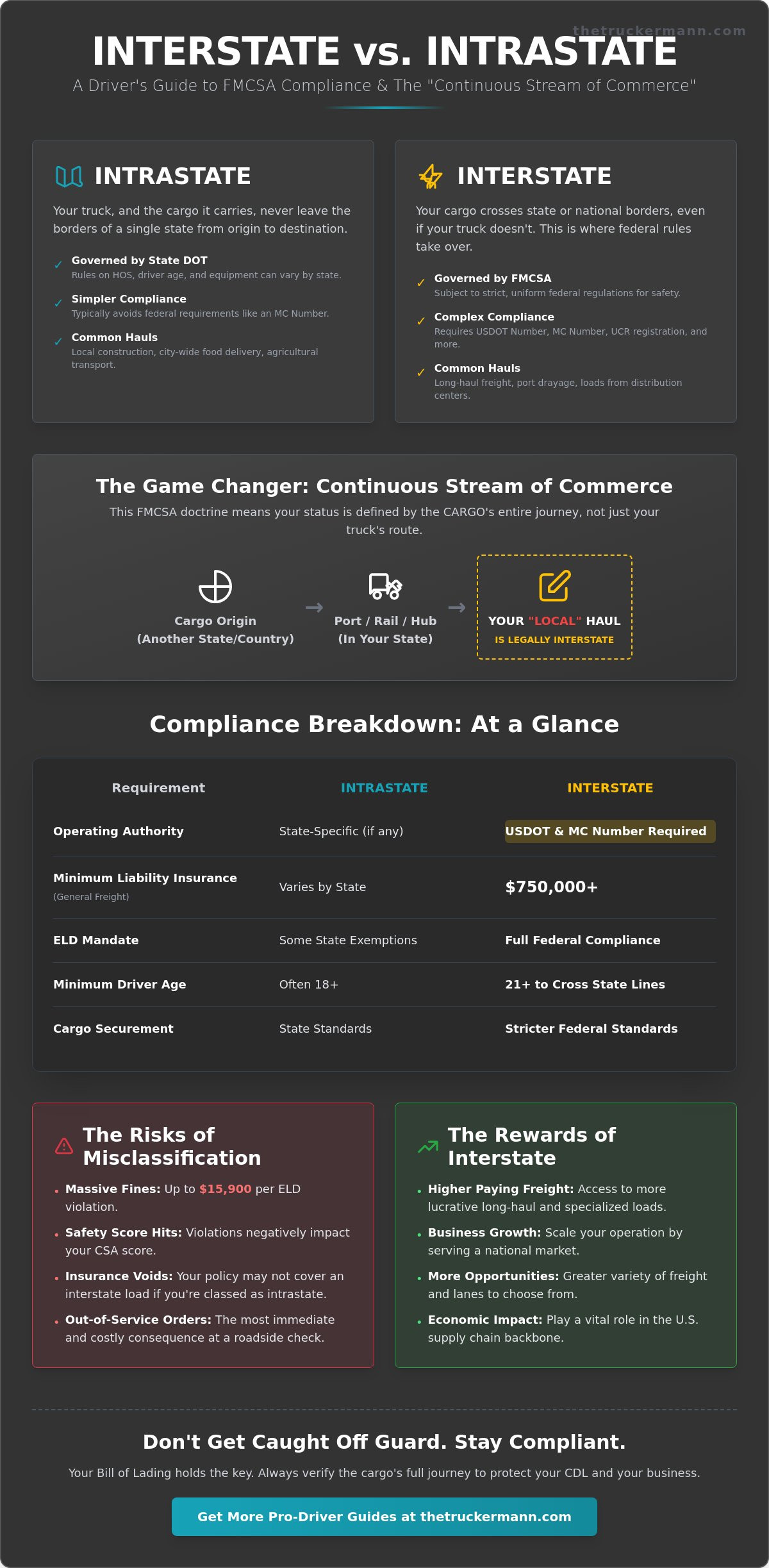
Imagine you’re picking up a container at a major port facility. You’re only hauling it across town to a local warehouse, and your tires never leave the state’s roads. On paper, it looks like a purely local job, but the FMCSA sees it differently. Because that container originated in another country or state and is part of a “Continuous Stream of Commerce,” your short trip is legally classified as an interstate move. To stay on the right side of interstate vs intrastate trucking FMCSA rules, you have to look past your specific route and focus on the cargo’s entire journey from the point of origin to the final consumer.
The feds prioritize the movement of goods over the movement of the vehicle itself. If a shipper in another state intended for that freight to reach its final destination via your truck, you are operating under federal jurisdiction. This is a common trap for drayage drivers and local logistics partners who assume their limited radius protects them from federal oversight. In reality, the moment you handle freight that has crossed a state line as part of a single transaction, you are bound by the same standards as a long-haul driver on an extended cross-country route. If you primarily run local routes and want to understand exactly how state-level regulations apply to your operation, our complete guide to intrastate trucking rules for local drivers in 2026 breaks down the key distinctions you need to know.
The Intent of Commerce Rule
Your Bill of Lading (BOL) is the most powerful piece of evidence in your cab. It outlines the shipper’s “intent,” which is the deciding factor in any DOT audit. Intent of commerce is the shipper’s original plan for the cargo to cross state lines. If your paperwork shows an out-of-state pickup point or a final destination in another state, the FMCSA considers you an interstate carrier. During 2026 digital audits, inspectors are cross-referencing these documents with carrier registration data to ensure every truck has the proper authority for the freight they’re moving.
Common Misconceptions About Local Hauls
Don’t let the “I stay in-state” myth lead you into a costly violation at a rail yard or port. In 2026, DOT enforcement is leveraging real-time data to identify misclassified carriers who are trying to avoid higher insurance requirements. You can find more details on how to navigate these choices in our Interstate vs. Intrastate Trucking: The 2026 Guide. Transparency is your best friend when the lights start flashing. If you aren’t 100% sure where your operation stands, it’s time to review your compliance profile and get your paperwork in order before your next load.
Compliance Comparison: Operating Authority, Insurance, and ELDs
Staying legal in 2026 requires more than just a clean logbook; it demands a deep dive into the paperwork that defines your business. While every commercial driver needs a USDOT number, the real divide happens with the Motor Carrier (MC) number. If you’re hauling for-hire across state lines, that MC number is your ticket to the game, and it comes with a non-refundable $300 application fee per authority type. Intrastate drivers often skip this step, but the moment you engage in interstate vs intrastate trucking FMCSA rules by picking up a “stream of commerce” load, that missing MC number becomes a magnet for DOT fines.
Insurance is where the financial rubber meets the road. For interstate carriers hauling non-hazardous freight in vehicles over 10,001 lbs, the FMCSA mandates a minimum of $750,000 in public liability coverage. If you’re moving oil or certain hazmat, that number jumps to $1,000,000 or even $5,000,000 for high-level explosives. Intrastate minimums vary by state and are often lower, but under-insuring your rig is a fast track to bankruptcy if a major accident occurs. Beyond insurance, you must also handle your Unified Carrier Registration (UCR) for 2026. If you operate 0-2 vehicles, the fee is $46. For those running 3-5 vehicles, expect to pay $138 to keep your interstate status active.
ELD and HOS Requirements
The 2026 enforcement landscape is unforgiving. If you cross state lines for more than 8 days in any 30-day rolling period, you must use a registered Electronic Logging Device. The FMCSA has been aggressive lately, revoking several ELD models that failed to meet performance standards. If you’re using a revoked device, you have until July 7, 2026, to replace it or face a maximum penalty of $15,900 per violation. Intrastate drivers often enjoy “short-haul” exemptions, such as the 150 air-mile radius rule, which allows for paper logs or no logs at all. Beyond device compliance, understanding how the 11, 14, and 70-hour clocks interact is critical to avoiding violations — get the full breakdown in our guide to FMCSA hours of service rules explained for 2026. However, you can learn more about the latest tech requirements in our guide to ELD Compliance in 2026.
IFTA and Registration
Interstate travel also brings the joy of the International Fuel Tax Agreement (IFTA) and the International Registration Plan (IRP). These programs ensure that fuel taxes and registration fees are shared fairly between the states you travel through. Instead of a standard base plate, interstate rigs sport IRP plates that allow for multi-state travel without buying individual trip permits. Keeping up with your quarterly IFTA filings is a chore, but it’s the only way to avoid the heavy-handed audits that the FMCSA is prioritizing this year. Make sure your 2026 UCR filings are completed before the deadline to avoid registration suspensions that could park your fleet indefinitely.
Making the Switch: How to Transition Between Intrastate and Interstate
Switching gears from local hauls to running the lower 48 is a massive step for your business. It’s a move that separates the local delivery drivers from the true road warriors. While the administrative side can feel like a mountain of paperwork, the financial rewards of interstate freight are often worth the climb. Before you jump in, you need to weigh the higher insurance premiums against the rising per-mile rates we’re seeing in 2026. Mastering the interstate vs intrastate trucking FMCSA rules isn’t just about crossing lines; it’s about aligning your business structure with federal law. If you’re ready to scale your operation, explore our carrier growth strategies to hit the ground running.
The feds don’t move fast. Expect a waiting period of at least 21 days for your MC number to go active after your insurance and process agent filings are in. During this time, you must update your MCS-150 form with the FMCSA. This document is your official declaration of operation type, and changing your status from “Intrastate” to “Interstate” is the first domino in the process. Your medical card and CDL self-certification must also match this new status. You’ll need to visit your local DMV to update your self-certification to “Non-excepted Interstate” (NI). If your paperwork says you’re local but your logbook says you’re in another state, you’re handing the DOT a reason to shut you down.
Step-by-Step Authority Update
Navigating the FMCSA Registration system in 2026 requires patience and precision. Once you’ve paid your $300 application fee for the MC authority, you must ensure your insurance agent files the BMC-91 or BMC-91X form. This is the only way the feds will verify you have the required $750,000 in liability coverage. Don’t forget to set up your IFTA account and order your IRP plates before you take that first cross-border load. Running a single mile into another state without these in place can lead to heavy fines and impounded equipment.
Operational Readiness
Moving to interstate work often means longer hauls and more diverse cargo. You need to audit your gear to ensure you’re ready for the long haul. This is especially true for flatbed work, where interstate securement standards are often stricter than local “short-haul” practices. You might need to upgrade your chains, binders, and straps to meet federal standards. Check out our list of the Best Flatbed Trucking Gear 2026 to make sure your kit is up to code. Training yourself on state-specific weight and length laws, like the various bridge formulas, will also save you from a headache at the weigh station.
Gear Up for the Long Haul: Essential Tools for Every Route
Your rig is your office, your home, and your biggest investment. Don’t let a frayed strap or a flickering tail light be the reason a DOT officer decides to dig into your paperwork. Once you’ve mastered the interstate vs intrastate trucking FMCSA rules, your physical equipment becomes your first line of defense against violations. In 2026, with the FMCSA moving toward automated inspections and digital audits, a simple equipment failure can trigger a full-scale review of your authority and ELD compliance. If you’re stepping up from local work to the long haul, you’ll find that “good enough” for town isn’t going to cut it at the state line.
Flatbedders know this better than anyone. Local “short-strapping” might fly when you’re moving lumber across a small county, but interstate-grade securement requires a different level of grit. Federal standards demand specific working load limits that often exceed what state-level inspectors look for. If you’re hauling through multiple jurisdictions, you need chains and binders that can handle the vibration and stress of a thousand-mile run. The Truckermann has seen too many good drivers get hit with “failure to secure” violations because they used worn-out gear that should have been retired months ago.
Must-Have Securement Gear
For high-mileage interstate work, you need hardware that won’t quit when the weather turns south. Whether you’re fighting a crosswind in Wyoming or a downpour in the Delta, your tarping system and straps are all that stand between a successful delivery and a massive insurance claim. We recommend checking out the heavy-duty options at Mytee Products for gear that meets the toughest federal securement standards. Investing in Grade 70 transport chains and high-tenacity polyester straps ensures that your load stays put, no matter how many state lines you cross.
Inspection Readiness Tools
Level 1 DOT inspections are the ultimate test of your professionalism. In 2026, safety standards are higher than ever, and having a dedicated roadside kit can be the difference between a “clean” inspection and a costly delay. You need reliable safety lighting, high-visibility gear that meets current ANSI standards, and a complete set of triangles and extinguishers. You can find everything you need for a professional-grade inspection kit at Truck n Tow. Being prepared shows the inspector that you take your role as a professional seriously, which often sets a positive tone for the rest of the interaction.
As you navigate the shifting landscape of 2026, remember that compliance is a lifestyle, not a chore. Stay vigilant, keep your gear in top shape, and never stop learning the nuances of the trade. The road is volatile, but with the right knowledge and the right tools, you can master any route. Stay safe out there, and keep the shiny side up.
Master the Road and the Rules
Navigating the interstate vs intrastate trucking FMCSA rules is about more than just avoiding a ticket; it’s about building a business that can handle the long haul. You now know that the shipper’s intent defines your legal status and that your insurance and registration must match the reality of your cargo’s journey. With the 2026 updates in full effect, from the $15,900 ELD penalties to the shifting UCR fee tiers, staying informed is your only path to long-term profitability.
We’ve shared expert advice from a veteran driver and up-to-date 2026 FMCSA regulatory insights to ensure you’re never caught off guard. When you combine this knowledge with trusted gear recommendations used by pros, you create a shield of compliance around your rig. Ready to secure your next load with confidence? Check out the latest flatbed securement gear at Mytee Products to stay DOT-compliant on every haul! You’ve got the grit and the expertise to master these regulations. Keep your eyes on the horizon, your paperwork in order, and your rig moving toward that next big payout.
Frequently Asked Questions
What does it mean when my cargo originates out of state but I never leave my home state?
This is legally considered interstate commerce because the cargo’s journey is continuous. Even if you only handle the final leg of a trip from a warehouse to a retail store, the FMCSA views you as part of the stream of commerce. If the bill of lading shows an origin outside your state, you must comply with federal regulations regardless of your actual mileage.
Can I use an intrastate-only CDL to drive a commercial vehicle interstate?
You cannot drive across state lines if your CDL has an intrastate-only restriction. To go interstate, you must visit your local driver’s licensing office and update your medical self-certification to “Non-Excepted Interstate.” This process removes the “K” restriction from your license, allowing you to legally haul freight through multiple jurisdictions under federal oversight.
Do I need an ELD if I only drive intrastate?
Whether you need an ELD for intrastate work depends entirely on your home state’s specific laws. While the FMCSA sets the national standard, many states have adopted these rules for local carriers to maintain safety funding. However, if you’re a local hauler staying within a small radius, you might still qualify for state-level paper log exemptions that don’t exist for interstate drivers.
How much insurance coverage is required for interstate vs intrastate trucking?
Interstate carriers must carry at least $750,000 in liability insurance for general freight in vehicles over 10,001 lbs. Intrastate requirements are often much lower, sometimes dipping to $300,000 depending on the state and vehicle weight. Always check your specific state’s DOT website, as miscalculating these interstate vs intrastate trucking FMCSA rules can lead to an immediate shutdown during an inspection.
What happens if I accidentally cross state lines without interstate authority?
Crossing a state line without proper authority usually results in an immediate out-of-service order at the first weigh station you hit. Inspectors will park your rig until you obtain emergency authority or have the load transferred to a legal carrier. You’ll also face civil penalties that can reach thousands of dollars, which will put a massive dent in your quarterly profits.
Is IFTA required for intrastate-only carriers?
IFTA is not required if you stay within your home state’s borders. The International Fuel Tax Agreement is a system for distributing fuel tax revenue among the states where you actually burn the diesel. Intrastate-only carriers simply pay the tax at the pump and don’t have to deal with the quarterly filing headaches or the record-keeping required for interstate travel.
How do I change my DOT number from intrastate to interstate?
You must update your operation type on the FMCSA portal by filing an updated MCS-150 form. This transition usually requires applying for a Motor Carrier (MC) number and paying the $300 application fee. You’ll also need your insurance provider to file proof of your increased coverage limits before your interstate authority is officially granted and active.
Does the 150-air-mile radius exemption apply to interstate commerce?
The 150-air-mile exemption does apply to interstate commerce, but the rules are very narrow. You can stay exempt from ELD requirements if you remain within that 150-mile radius of your work reporting location and return there within 14 consecutive hours. If you step outside that bubble or exceed the time limit, you must switch to a digital log for that day. To fully understand how these clock rules interact with your daily driving, review our complete guide to FMCSA hours of service rules explained for interstate and intrastate drivers.
Disclaimer
The information provided on The TruckerMann is for general informational and educational purposes only. While every effort is made to ensure the accuracy and reliability of the content, trucking laws, FMCSA regulations, DOT requirements, safety standards, and industry policies can change at any time. Readers are encouraged to verify all information with official government agencies, professional advisors, or qualified industry professionals before making business, legal, financial, safety, or compliance-related decisions.
The content shared on this website reflects personal opinions, experiences, research, and commentary and should not be considered legal, financial, medical, tax, or professional advice. The TruckerMann and its owners, contributors, affiliates, or representatives are not responsible for any losses, damages, violations, penalties, or liabilities resulting from the use or misuse of information found on this website.
Some content on this website may contain affiliate links, sponsored content, or promotional material. This means we may earn a commission at no additional cost to you if you choose to purchase through certain links.
By using this website, you agree that you do so at your own discretion and risk.