What if you never crossed a single state line this year but the DOT still hammered you for violating federal interstate regulations? It’s a frustrating reality for many local pros who think their route defines their legal status. You likely feel that as long as you stay within your home borders, you’re strictly an intrastate operator. However, the federal government looks at the “fixed intent” of the cargo. This means a load coming from a rail yard or a port can turn your local day cab into an interstate vessel in the eyes of the law, regardless of where your tires are spinning.
We understand the headache of trying to keep up with shifting state rules while looking over your shoulder for an inspection officer. This guide is your roadmap to mastering those critical differences so you can stay compliant and maximize your local driving career in 2026. You’ll get a clear look at specific HOS variations in states like Texas, the mandatory ELD updates in California, and the insurance minimums you must carry. We’re providing the compliance checklist you need to roll with confidence and keep your hard-earned money in your pocket.
Key Takeaways
- Learn how to identify the specific cargo triggers that can strip away your intrastate status even if you never cross state lines.
- Master state-specific Hours of Service (HOS) rules that often provide more flexibility than the standard federal 11/14/70 limits.
- Discover how to legally bypass complex ELD logging requirements using the 150-air-mile short-haul exception.
- Compare the lifestyle benefits of local routes, such as guaranteed daily home time, against the unique physical demands of high-frequency stops.
- Identify the essential high-visibility and heavy-duty gear required to handle the grit and constant movement of a professional local driver.
Defining Intrastate: More Than Just Staying in One State
Intrastate trucking is the movement of goods that never cross a state or national boundary. On the surface, it sounds simple. You pick up a load in Dallas and drop it in Houston; you stay in Texas, so you assume you’re a local operator. However, this distinction is the bedrock of your legal standing as a driver. It dictates everything from the class of your CDL to your insurance premiums and how you log your hours. If you get this wrong, you’re looking at heavy fines or even a shut-down order at the scale house during a surprise inspection.
The legal split comes down to the Commerce Clause of the U.S. Constitution. This constitutional piece gives the federal government the power to regulate “interstate” trade, while leaving intrastate matters to the individual states. In the trucking world, this creates two different sets of rulebooks. While the FMCSA sets the baseline, states have the authority to tweak those rules for drivers who stay within their borders. This means your compliance depends on knowing exactly which flag you’re flying under.
To better understand this concept, watch this helpful video:
Intrastate vs. Interstate: The Core Differences
The real difference isn’t just where your tires are; it’s where the cargo is going. Interstate commerce happens when you cross state lines, or when you haul freight that’s part of a continuous journey from another state or country. Intrastate is strictly local from the shipper’s point of view. If a load starts and ends its entire journey within one state, you’re likely in the clear. For a deeper dive into which path fits your lifestyle and career goals, check out our Interstate vs. Intrastate Trucking Guide.
Common Intrastate Misconceptions
One of the biggest myths on the CB is that staying in one state means you don’t need a DOT number. That’s a dangerous assumption that can lead to a very expensive roadside chat with an officer. In 2026, the reality is that most states require a USDOT number for intrastate operations if your vehicle meets certain weight thresholds. Organizations like the California Highway Patrol (CHP) or the Texas Department of Transportation (TXDOT) are vigilant about this. They have their own state-specific agencies to enforce these rules, and they don’t care if you never see a state line. You’re still a commercial operator, and you still have a target on your back if your paperwork isn’t tight.
The ‘Fixed Intent’ Trap: How Your Cargo Changes Your Status
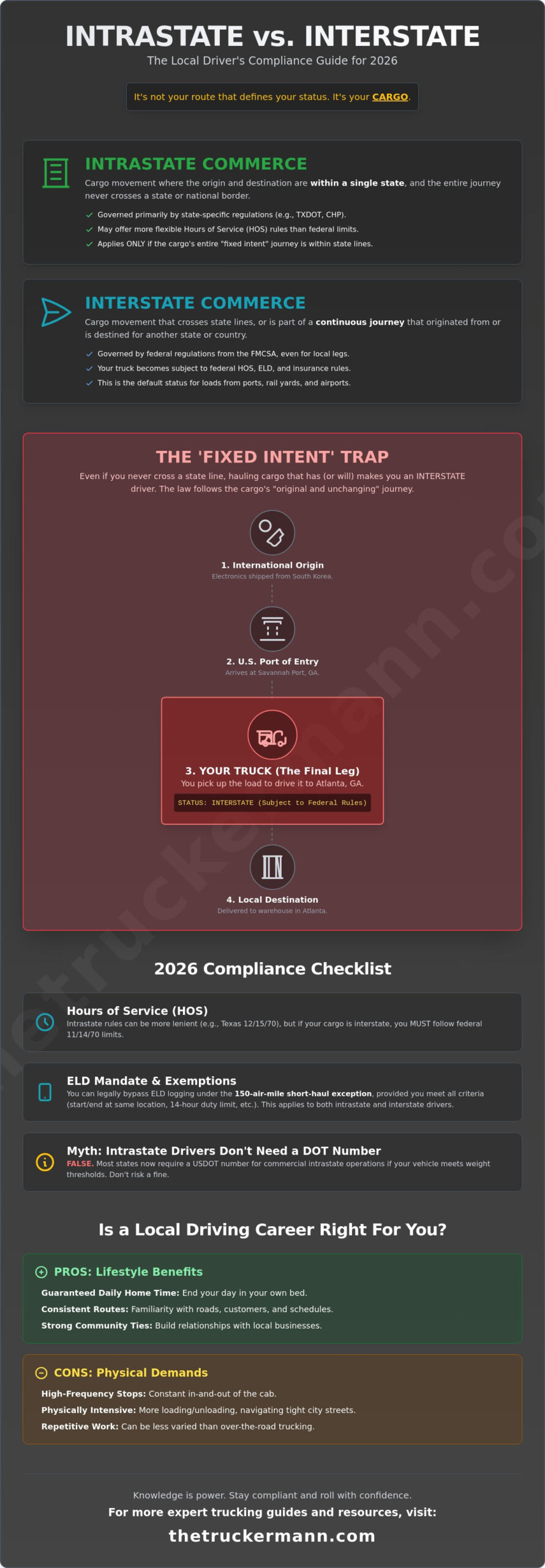
Imagine you’re hauling a load of electronics from a rail yard in Savannah to a warehouse in Atlanta. You never leave Georgia. You think you’re operating under intrastate rules. Then, a DOT officer pulls you over and asks for your logbook. If those electronics started their journey in South Korea, you’re likely in a world of trouble. This is the “Fixed Intent” trap, and it’s the most common way local drivers accidentally break federal law. You’re following your state’s rules, but the cargo is playing by federal ones.
The status of your haul isn’t determined by your truck’s GPS coordinates. It’s determined by the original intent of the shipment at the moment it first started moving. If the shipper intended for that freight to cross a state or national border, every single leg of that journey is considered interstate commerce. It doesn’t matter if you only drive the last five miles. The federal government sees that cargo as being on one long, continuous thread that you just happen to be holding at the end. Understanding this is what separates a veteran from a rookie who’s about to get a heavy fine.
The Continuous Journey Rule
The law looks for “original and unchanging” destinations. If a crate of engine parts is shipped from Michigan to a distribution center in your state, and you pick it up to deliver it to a local mechanic, you are an interstate driver. Your intrastate status only applies if the journey “breaks” at the warehouse. This usually requires the cargo to be processed, repacked, or added to a general stock rather than just sitting on a cross-dock waiting for the next truck. If you’re just a link in a chain that crossed a border, federal HOS rules apply to you, not your state’s more lenient versions. Staying in one state doesn’t protect you if the freight didn’t start there.
Identifying Interstate Cargo on Your BOL
Your Bill of Lading (BOL) is your first line of defense against a compliance nightmare. You need to look past the “Ship To” address. Check for “Port of Entry” notations or original manufacturing origins that are out of state. If you see a customs seal or a container number, that’s a massive red flag. Knowing your customer’s supply chain is part of being a professional. If you aren’t sure where the freight started, ask. It’s better to look like a pest at the dispatch office than to look like a target at a weigh station. For those looking to sharpen their regulatory knowledge, enrolling in a professional compliance course can keep your career on the right side of the law.
Compliance and Regulations for Intrastate Drivers in 2026
Staying compliant in 2026 means balancing federal baselines with state-specific perks that can actually make your life easier. For instance, if you’re pulling intrastate loads in Texas, you can drive for 12 hours within a 15-hour window. This gives you a bit more breathing room than the federal 11/14 limits used by long-haulers. However, don’t get too comfortable; you still need that 34-hour restart after hitting 70 hours in 7 days. Even if your state is more lenient, you must self-certify your CDL status and keep a current medical certificate on file. If you’re in California, remember that as of January 1, 2024, all local commercial drivers are required to use ELDs. There’s no escaping the digital eye in the Golden State anymore.
Compliance isn’t just about avoiding a ticket; it’s about protecting your livelihood in an industry where operating costs are rising. Federal random drug testing rates are holding steady at 50% for the 2026 calendar year, and alcohol testing is at 10%. These apply to you if you’re subject to federal rules, which happens more often than most intrastate drivers realize. If you’re strictly local, your insurance minimums also vary by region. Texas general freight carriers need $500,000 in liability, while states like Mississippi and Oregon require $750,000. These numbers aren’t just suggestions; they are the gatekeepers of your authority.
The Short-Haul Exception Explained
The 150-air-mile short-haul exception is a lifesaver for local pros. If you stay within that radius and return to your home terminal every night, you don’t need a complex ELD setup. You do, however, need to record your “time in” and “time out” to prove you haven’t exceeded the 14-hour limit. It’s a simpler life, but the paperwork has to be perfect. For a deeper look at the fine print of these regulations, check out our guide on FMCSA Hours of Service Rules Explained.
Vehicle Maintenance and Inspections
Roadside inspections aren’t just a federal hobby. State agencies are amping up enforcement in 2026, especially regarding English proficiency and CDL documentation. Whether you’re paying registration fees in Kentucky, which can hit $1,440, or Michigan, where they range up to $1,992, your equipment needs to be as clean as your paperwork. Maintaining a solid maintenance log is your best defense against a Level 1 inspection. To make sure your rig is ready for the scales, use a professional DOT Inspection Level 1 Checklist. It’s the difference between a quick “thank you” and a long, expensive afternoon on the shoulder.
Is an Intrastate Career Right for You? Pros and Cons
Choosing an intrastate path is often a decision about quality of life and reclaiming your time. While OTR drivers are counting miles and hunting for parking in overcrowded rest areas, you’re backing into your own driveway every night. It’s a different kind of grind. You swap the variety of the open road for the predictability of a local route. You’ll eventually know every pothole, every shortcut, and which shippers actually have their paperwork ready when you arrive. It’s about being a fixture in your community rather than a ghost on the interstate.
The money reflects this shift in lifestyle. As of May 2026, the average annual salary for an intrastate driver in the United States is approximately $56,348. Your location matters significantly; for instance, Texas drivers see an average of $52,497, while those in Georgia average around $47,579. Most local jobs pay by the hour rather than the mile. This means you get paid for the reality of city driving: the traffic jams, the slow loading docks, and the complex maneuvers. It’s a steady paycheck that isn’t dependent on how many state lines you can cross before your clock runs out.
Don’t mistake “local” for “easy,” though. You’ll be climbing in and out of the cab dozens of times a day. You’re constantly wrestling with liftgates, pallet jacks, and tight urban alleys that weren’t built for modern rigs. It’s physically demanding work that requires a high level of situational awareness. You aren’t just a driver; you’re often the face of the company to the customer, handling the “last mile” where the most friction occurs.
The Shift Toward Cycle Logistics
Last-mile delivery is exploding as urban centers evolve. This shift toward “cycle logistics” and hub-and-spoke networks means there’s a massive demand for professional drivers who can handle high-frequency stops. If you want to see how these shorter, tighter loops are changing the game for the next generation of pros, read more about Cycle Logistics in 2026.
Mastering the Local Hustle
Success in this sector is about building a reputation with the folks on the docks. When you know the receivers by name and understand their specific delivery windows, your day moves faster. Your best asset isn’t just your CDL; it’s your local knowledge of low bridges and weight-restricted residential zones that GPS units often miss. Specialized hauling, like fuel, concrete, or flatbed work, offers even more growth for those who want to master their specific corner of the world. If you’re looking to sharpen your professional edge and master these local regulations, consider enrolling in a professional driver certification program to stay ahead of the competition.
Essential Gear for the Intrastate Professional
Your gear is an extension of your hands, and in the local circuit, that extension needs to be tougher than a Sunday shift. While the OTR driver spends hours staring at the white lines of the interstate, you’re constantly jumping in and out of the cab, wrestling with cargo, and navigating the tightest loading docks in the city. This high-frequency movement means your equipment takes ten times the abuse. You don’t have the luxury of slow, methodical setups. You need gear that’s accessible, durable, and built for the “hustle” of intrastate routes where every minute at the dock counts against your clock.
Safety in these environments isn’t just a box to check for a DOT officer; it’s about coming home in one piece. High-visibility clothing is your primary badge of identity in a crowded yard. Between the forklift traffic and other rigs backing into tight slots, being seen is your best defense. The Truckermann’s top picks for daily-use logistics equipment always prioritize visibility and speed. You want a vest that breathes during a humid July afternoon but has enough pockets to keep your BOLs and handheld scanner within reach at all times. It’s about being a professional who’s prepared for the grit of the field.
Securement Gear for High-Frequency Stops
If you’re running a local flatbed route, your day is a series of sprints. You might be tarping and untarping four or five times before lunch. Cheap ratchets will seize up after a month of that kind of salt and road grime. You need fast-acting, heavy-duty ratchets and straps that won’t fray after a few dozen uses. Quality matters when your livelihood depends on how fast you can secure a load and get back on the pavement. For the most reliable, professional-grade securement gear on the market, we recommend checking out the selection at Mytee Products. They build tools for drivers who actually work for a living.
Personal Protective Equipment (PPE) for Local Routes
Your hands are your paycheck, so don’t skimp on the gloves. Local intrastate work involves a lot of “hands-on” time with chains, straps, and greasy liftgates. You need a pair that offers a balance of grip and protection against all weather conditions. Beyond your hands, you have to think about weatherproofing your cargo. Local wear and tear on tarps is brutal because of the constant folding and unfolding. To stay ahead of the game, read our breakdown of The Best Flatbed Trucking Gear. For everything else, from reliable roadside tools to emergency securement supplies, Truck n Tow is our go-to source for gear that stands up to the daily grind.
Take Command of Your Local Career
You now know that being an intrastate driver is about more than staying within state lines; it’s about understanding the journey of the freight you haul. By mastering the “fixed intent” rule and staying ahead of state-specific HOS updates, you protect your CDL and your paycheck from unnecessary DOT interference. You’ve seen how the lifestyle rewards of local work come with unique physical demands and a need for deep local knowledge. This career path offers the stability of daily home time, but it demands a professional who is always prepared for the grit of the field.
Success in the local hustle requires a veteran’s mindset and equipment that won’t quit when the pressure is on. Whether you’re navigating urban alleys or managing high-frequency stops, having the right tools makes every shift safer and more efficient. Gear up for your next local haul with professional-grade tools at Truck n Tow. Their field-tested securement gear and compliance-ready logistics tools are recommended by veteran drivers who know what it takes to survive the daily grind. They understand that your equipment is your livelihood.
The road ahead is yours to own. Take these insights back to the cab, stay sharp, and keep those wheels turning safely.
Frequently Asked Questions
Do I need a logbook if I drive intrastate?
Yes, you must maintain a record of your duty status unless you qualify for a specific exemption like the short-haul rule. Even if you never leave your home state, you are required to prove you are operating within the legal hours of service limits. Failing to produce a logbook or time record during a roadside inspection is one of the fastest ways to earn a fine and a negative mark on your safety record.
Can I drive intrastate with a K restriction on my CDL?
Yes, a K restriction is specifically designed to limit a driver to operating only within their state of license issuance. This restriction usually appears if a driver does not meet federal medical requirements but has been cleared by their state’s medical examiners. While you can drive locally, you must ensure your cargo is not part of an interstate journey, or you will be in violation of your license terms.
What happens if I accidentally haul interstate cargo on an intrastate-only authority?
You face heavy civil penalties and the possibility of having your vehicle placed out of service immediately. If a DOT officer determines the cargo has a “fixed intent” for another state, they will hold you to federal standards regardless of your physical location. Operating without the required federal authority or medical certification can also lead to your carrier’s DOT number being flagged for increased enforcement and higher insurance premiums.
Is a DOT number required for intrastate trucking?
Yes, the majority of states require a USDOT number for commercial vehicles even if they never cross state lines. In 2026, state agencies use these numbers to track safety data and ensure local carriers are meeting insurance and maintenance requirements. You should check with your state’s Department of Transportation, as weight thresholds for this requirement can vary depending on whether you are hauling general freight or hazardous materials.
How many hours can an intrastate driver drive?
Your driving limit depends on your specific state’s intrastate regulations, which can be more flexible than federal rules. For example, Texas allows for 12 hours of driving within a 15-hour duty period. However, in states like California, the rules align more closely with the federal 11-hour driving limit. You must always verify your local statutes to ensure you don’t exceed the daily or weekly caps allowed in your region.
What is the difference between intrastate and interstate commerce for tax purposes?
The primary difference is that intrastate carriers generally do not participate in the International Fuel Tax Agreement (IFTA) or the International Registration Plan (IRP). Instead of filing complex quarterly reports to distribute taxes across multiple states, you pay fuel taxes at the pump and registration fees directly to your home state. This significantly reduces your administrative paperwork but limits your operations to the borders of your specific jurisdiction.
Do I need an ELD for local driving under 150 miles?
No, you are typically exempt from the Electronic Logging Device mandate if you operate within a 150-air-mile radius of your work reporting location. To use this “short-haul” exception, you must return to your home terminal and be released from duty within 14 consecutive hours. You are still required to maintain accurate time records showing when you started and ended your shift, but you don’t need the expensive hardware required for long-haul routes.
Disclaimer
The information provided on The TruckerMann is for general informational and educational purposes only. While every effort is made to ensure the accuracy and reliability of the content, trucking laws, FMCSA regulations, DOT requirements, safety standards, and industry policies can change at any time. Readers are encouraged to verify all information with official government agencies, professional advisors, or qualified industry professionals before making business, legal, financial, safety, or compliance-related decisions.
The content shared on this website reflects personal opinions, experiences, research, and commentary and should not be considered legal, financial, medical, tax, or professional advice. The TruckerMann and its owners, contributors, affiliates, or representatives are not responsible for any losses, damages, violations, penalties, or liabilities resulting from the use or misuse of information found on this website.
Some content on this website may contain affiliate links, sponsored content, or promotional material. This means we may earn a commission at no additional cost to you if you choose to purchase through certain links.
By using this website, you agree that you do so at your own discretion and risk.