Highway signs are a driver’s second set of eyes; ignoring them is a choice to gamble with your CDL. Whether you are navigating the tight turns of a historic downtown or the punishing grades of the Rockies, your career depends on your ability to read the road in real-time. You are constantly scanning the horizon, often left wondering, exactly what does the truck sign mean when the symbols seem to change at every state line? It is a lot to manage while you are keeping your eyes on the road and your hand on the wheel, especially as new digital displays roll out across the country.
We know the road is your office, and a single missed marker can jeopardize your livelihood in an instant. Here at The Truckermann, we act as your companion on the pavement, helping you decode every commercial vehicle sign to stay compliant, avoid costly DOT violations, and keep your rig safe. This guide provides a full breakdown of regulatory markers, steep grade warnings, and those tricky state-level variations so you can roll through your route with total confidence.
Key Takeaways
- Identify signs instantly by color and shape, from yellow warnings to orange work zones, so you never have to second-guess a move in heavy traffic.
- Master the technical breakdown of weight and height restrictions to understand exactly what does the truck sign mean for your specific axle configuration and gross weight.
- Develop a pro-level descent strategy by decoding steep grade percentages and brake check requirements before you hit the peak of a mountain pass.
- Navigate weigh station requirements and electronic Pre-Pass signals with precision to keep your record clean and avoid unnecessary downtime at the scales.
- Integrate real-time signage awareness with your ELD compliance and specialized securement gear to stay safe during high-wind alerts and regulatory blitzes.
Decoding the Language of the Road: Color and Shape Coding
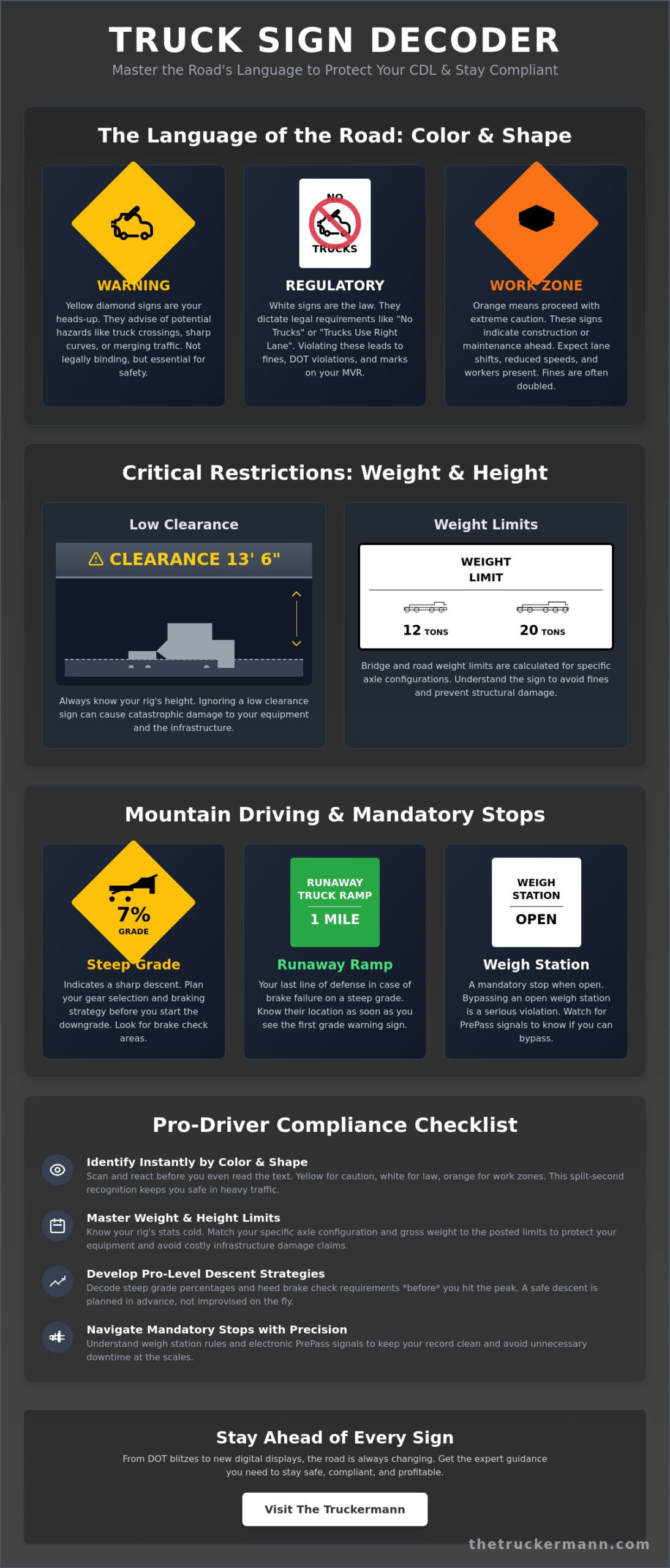
Every seasoned pro knows the road speaks a specific language. It’s not just about the words printed on the metal; it’s about the shape and the shade of the sign itself. When you’re rolling through a new state or a tight urban corridor, you might ask yourself, exactly what does the truck sign mean when that black silhouette appears on a bright yellow diamond? That silhouette is the universal shorthand for your rig, but its meaning shifts fundamentally depending on the background it sits on. Understanding the standardized system of Road signs in the United States is your first line of defense against a bad day on the job.
To better understand this concept, watch this helpful video:
The diamond shape is the universal herald for caution in the world of logistics. It’s designed to grab your eye from a distance, even when the sun is hitting your mirrors or the rain is coming down in sheets. Yellow signifies a warning, white marks a regulation, and orange tells you that you’re entering a work zone where fines often double. By May 2026, digital overhead displays have become the new standard for real-time alerts. These aren’t just for traffic jams anymore. They’re now integrated with weather sensors and weight-in-motion systems to give you instant feedback on road conditions or lane restrictions before you even reach the next exit.
The Yellow Warning Signs (W-Series)
Yellow signs are advisory, but treating them as optional is a rookie mistake. The W11-10 Truck Crossing sign is a critical alert. It tells you that slow-moving vehicles are entering the flow, which means you need to check your braking distance immediately. If you see a “Trucks Entering Highway” marker, it’s time to shift your lane position to give your brothers and sisters enough room to merge safely. These signs often come with advisory speed limits. While they aren’t technically the legal limit, ignoring them on a tight cloverleaf is a fast way to end up on your side.
Regulatory White Signs: The Law of the Land
White signs are the heavy hitters. These are the regulatory markers that dictate your legal boundaries. When you see a “No Trucks” (R5-2) sign, it’s not a suggestion to find a better route; it’s a hard boundary. Entering that zone is a ticket waiting to happen. The same goes for “Trucks Use Right Lane” rules. Violating these can land a hefty mark on your MVR report. During a DOT Level 1 inspection, an officer won’t care if you missed the sign. They only care that you broke the law of the land, and the consequences for your career can be permanent.
Weight and Height Restrictions: Protecting Your Rig and the Infrastructure
Your rig is a powerhouse, but even the strongest steel has its limits when it meets an aging bridge or a restricted residential street. When you approach these zones, the markers you see are the final word on whether your truck belongs on that pavement. You might find yourself squinting at a fading board, wondering exactly what does the truck sign mean when it starts listing specific tonnage for different axle counts. These markers are governed by the Manual on Uniform Traffic Control Devices (MUTCD), and they are designed to protect both the infrastructure and your equipment from catastrophic failure.
If you realize you are overweight or over-height after seeing the sign, do not gamble. Pull over safely on the shoulder or a side street and consult your atlas or a dispatcher for an alternate route. Low hanging cable warnings are another trap for the unwary, often found in older industrial areas where utility lines haven’t been raised to modern standards. Catching a line can pull down a pole and lead to a massive liability claim that no driver wants on their record. Staying vigilant is the only way to protect your CDL and your rig from these avoidable incidents.
Navigating Weight Limit Signs
Bridge signs often feature multiple silhouettes with different tonnages next to them. This isn’t a math quiz; it is a breakdown of how much weight each axle configuration can legally put on the deck. While the federal interstate limit is 80,000 pounds, local bridges often have much tighter tolerances. You also have to watch for seasonal shifts. For example, on April 23, 2026, Michigan lifted its spring weight restrictions for state trunklines south of the Mackinac Bridge, but north of the bridge, reductions of up to 35% remained in effect. Gross Vehicle Weight (GVW) is the total weight of the vehicle and its load as it sits on the bridge deck.
Height Restrictions and Low Bridges
Low clearance warnings (W12-2) are the “can-openers” of the trucking world. Never trust your GPS over the physical sign on the side of the road. A sign might say 13-6, but if the road was recently repaved without being milled down, that clearance could actually be 13-4. Look at the diamond sign arrows; arrows pointing up and down indicate vertical clearance. If you realize you are too tall after it’s too late to turn, stop immediately, put on your hazards, and call for a police escort to help you back out. For more tips on keeping your equipment in top shape, check out the resources at The Truckermann.
Mountain Driving: Steep Grades and Runaway Truck Ramps
Descending a mountain pass with a full load is the ultimate test of a driver’s skill. The mountain doesn’t care about your schedule; it only cares about gravity. When you see that yellow diamond with a truck angled downward, you need to know exactly what does the truck sign mean for your immediate descent strategy. It is not a suggestion to tap your brakes; it is a signal to have your rig under control before the first curve hits. Ignoring these markers is a fast track to brake fade, smoke in the mirrors, and a situation that can turn deadly in seconds.
A “Brake Check Area” sign is your last chance to breathe. Skipping this is a classic rookie mistake on any grade over 6%. Use this pull-off to verify your air pressure, check for overheating hubs, and ensure your slack adjusters are doing their job. According to the Texas Commercial Driver’s Handbook, proper speed control and gear selection are the only ways to prevent a runaway situation. If you wait until you’re halfway down the hill to look for a lower gear, you’ve already lost the battle. The “Trucks Use Lower Gear” sign is a mandatory instruction, not a tip for the fuel-conscious.
The Science of the Steep Grade Sign
A 6% grade means the road drops 6 feet for every 100 feet of forward travel. That sounds small until you realize 80,000 pounds is trying to accelerate that entire time. A 10% grade is significantly more aggressive and requires extreme caution. You must rely on your engine brake, but keep an eye out for “Trucks Turn Off Engine Brake” signs near residential areas. These noise ordinances are common, but your safety always comes first. If you’re in a situation where you need that Jake brake to keep the rig on the road, you use it. Before you even start your trip, running through a solid cdl pre trip inspection checklist ensures your braking system is actually mountain-ready.
Using Runaway Ramps Safely
Runaway truck ramps are your final lifeboat. If your pedal goes soft and the smell of burning lining fills the cab, you must commit to the ramp immediately. Don’t hesitate. Look for the “Runaway Ramp __ Miles” markers to plan your move. There are two main types you’ll encounter on the road. Sand or gravel arrester beds are designed to swallow your tires and stop you through pure friction. Gravity ramps use a steep uphill incline to kill your momentum. Once you hit the pit, stay in the cab and wait for help. You will need a heavy-duty tow to get out, and you must have a full mechanical inspection before that rig ever sees the highway again. It’s a hard hit to the ego, but it’s better than the alternative.
Mandatory Stops: Weigh Stations and Inspection Signs
Nothing spikes a driver’s heart rate quite like seeing a flashing “Open” sign a mile before a scale house when you’re running tight on time. You’ve got to make a split-second decision. If you’re wondering, exactly what does the truck sign mean when it says “All Trucks Must Enter,” the answer is almost always “you.” Unless your GVWR is under the state’s specific threshold, usually 10,001 pounds or 26,000 pounds; you are legally required to pull in. Ignoring that sign is an invitation for a chase car and a roadside inspection that will definitely take longer than the scale line would have.
Electronic Pre-Pass signals have changed the game, but they also add a layer of confusion. If your transponder gives you a green light but the physical highway sign says “All Trucks Must Enter,” the transponder usually takes precedence. However, if that red light flashes on your dash, you head for the ramp immediately. In May 2026, during the CVSA International Roadcheck from May 12-14, you can bet those “Follow Directions” signs will be lit up more often than usual. These three days focus heavily on cargo securement and ELD tampering, so being prepared for the scale house is non-negotiable for your career longevity. Understanding the broader economic picture, including the latest freight rate trends for truck drivers 2026, can help you make smarter decisions about which loads and lanes are worth your time when compliance costs are factored in.
Weigh Station Protocol
Managing lane changes in heavy traffic while aiming for the scale ramp requires foresight. Don’t wait until the last 500 feet to bully your way into the right lane. If the electronic signal tells you to “Bypass Scale,” you can keep rolling, but remember that your bypass is still logged. To stay ahead of the game, using professional safety documentation ensures your paperwork and vehicle are ready for the scrutiny that comes when signs indicate a mandatory inspection. A clean inspection report is a badge of honor in this industry and keeps your company’s CSA score in the green.
Hazmat and Specialized Routing
Navigating restricted tunnels or urban centers requires a sharp eye for specialized markers. The “HM” circle sign indicates an authorized Hazardous Materials route. If you see a similar sign with a red slash through it, you are looking at a hard “No Hazmat” zone. These are often found near water sources or major tunnels where a spill would be catastrophic. “No Thru Trucks” signs are another common sight; these usually mean you can only enter if you have a confirmed delivery or pickup on that specific street. When you’re in an unfamiliar city, “Truck Route” signs are your best friend. They are the only way to ensure you don’t end up wedged under a bridge or stuck on a residential corner. For more advice on navigating these tricky urban corridors, stay connected with the community at The Truckermann.
Compliance and Gear: Staying Ahead of the Signs in 2026
The industry is shifting faster than a 13-speed on a downhill run. By now, you know that missing a marker isn’t just a mistake; it’s a threat to your career. But in 2026, the game has changed. You aren’t just relying on your eyes anymore. Your cab is becoming a command center. As you glance at your dashboard, you might still find yourself asking, exactly what does the truck sign mean when it conflicts with your GPS? The answer lies in how you integrate your physical surroundings with your digital tools. Staying compliant today means marrying your old-school road smarts with the latest tech to ensure you never miss a beat or a bridge height.
Modern eld compliance systems are now designed to pull data from smart infrastructure, giving you a heads-up on restricted routes before you even see the physical metal. This is critical when you’re hauling specialized loads. For example, when overhead signs start flashing high-wind warnings, having the right flatbed trucking gear isn’t just about securement; it’s about survival. If those signs tell you to park it or reduce speed, your tarps and straps need to be top-tier to prevent a disaster. A veteran tip that still holds true: if in doubt, get out and look. GOAL applies to reading faded signs in a tight alley just as much as it does to backing into a dock.
The Future of Highway Communication
Vehicle-to-Infrastructure (V2I) technology is the new standard. While physical signs won’t become obsolete this year, they are now broadcasting digital signatures directly to your ELD. This reduces the “signage fatigue” that hits after ten hours on the 10. However, tech can fail. You still need to maintain perfect visibility. Clean mirrors and high-quality wipers are your most basic safety tools. If you can’t see the “what does the truck sign mean” silhouette through a smeared windshield, all the V2I tech in the world won’t save you from a low-clearance bridge.
The Truckermann’s Final Word on Safety
Your MVR is your resume. Protecting it requires a habit of scanning the horizon, looking for those yellow and white markers at least fifteen seconds ahead. The 4-wheelers around you are distracted; you cannot afford to be. You are the professional sentinel of the highway. To stay ahead of the curve and master the economic shifts of the road, join the conversation and stay updated with the latest insights from Craig Fuller and FreightWaves. We are all in this together, navigating the same miles and the same challenges. Keep your eyes up, your gear tight, and your mind sharp. We’ll see you at the next stop.
Mastering the Road Ahead
The highway is a living environment that demands your constant attention and respect. We’ve decoded the essentials of color coding, the hard reality of bridge weight limits, and the life-saving mechanics of runaway ramps. Understanding exactly what does the truck sign mean in every context is the difference between a smooth delivery and a career-altering DOT violation. You are the backbone of the economy, and staying prepared is how you stay profitable in this volatile industry. Knowing where the market stands on freight rate trends for truck drivers 2026 is just as important as knowing your route, because profitability and compliance go hand in hand when you’re running a tight operation.
As you head back out, make sure your equipment is as ready as your mind. You need tools that work as hard as you do, from veteran-approved securement to DOT-compliant safety essentials. Don’t leave your compliance to chance when the stakes are this high. These products are trusted by professional flatbedders who know that quality gear is the only gear worth having on the deck when you’re facing high winds or a steep mountain pass.
Grab the best safety gear to keep your rig compliant and road-ready at Mytee Products. Keep your eyes on the horizon, stay vigilant, and roll safe out there. We are proud to be your companion on every mile of the journey.
Frequently Asked Questions
What does the yellow diamond sign with a truck symbol mean?
This is a warning sign that alerts you to potential hazards specifically affecting large vehicles on the road ahead. If you see this and wonder, exactly what does the truck sign mean, you should look for supplemental plaques nearby that provide more detail. These markers often warn of upcoming steep grades, low clearances, or sharp curves that require you to adjust your speed or gear selection immediately to maintain control of your rig.
Is a “No Trucks” sign legally binding on all commercial vehicles?
Yes, a “No Trucks” sign is a regulatory command that carries the weight of the law for any vehicle meeting the state’s definition of a commercial truck. Unlike yellow warning signs, these white regulatory signs are strictly enforced by local and state authorities. Violating a “No Trucks” restriction can result in significant fines and negative points on your CDL, unless you have a specific, documented delivery or pickup on that restricted route.
How do I know if a weight limit sign applies to my empty trailer?
Weight limit signs apply to the actual weight of your vehicle at the moment you encounter the sign, including your empty trailer and tractor. If the sign specifies a Gross Vehicle Weight (GVW) limit and your “bobtail” or empty configuration exceeds that number, you cannot legally cross. Always check your current scale weights against the axle or gross limits posted on the bridge or roadway to ensure you stay within the legal boundaries of the infrastructure.
What should I do if I miss a weigh station sign?
If you realize you missed a mandatory weigh station entrance, do not attempt to back up on the highway or the shoulder under any circumstances. Your best course of action is to continue to the next safe exit, turn around, and return to the station if it is safely accessible. Alternatively, contact your dispatcher immediately to document the oversight. Law enforcement often monitors bypasses, and proactive communication is always better than waiting to be pulled over.
Does a “Truck Route” sign mean I am required to take that road?
No, a “Truck Route” sign indicates a path that has been vetted for commercial vehicle clearances and weights, but it is not always a mandatory requirement. These signs are designed to keep you on roads that can safely handle your dimensions. While you aren’t always legally forced to stay on the designated route, straying onto non-vetted streets in urban areas often leads to low-clearance traps or tight turns that your rig cannot navigate.
What does the “Trucks Prohibited” sign with a red circle and slash mean?
This sign is a universal regulatory prohibition that strictly forbids commercial trucks from entering the designated roadway or lane. The red circle and slash are international symbols for “No,” and ignoring this marker is a certain way to get a ticket during a roadside inspection. It is often used in residential neighborhoods, historic districts, or on specific highway lanes where truck traffic is banned for safety, weight, or noise reasons.
Can I get a ticket for ignoring a yellow “Advisory Speed” sign on a curve?
You can be cited for “speed too fast for conditions” if you ignore an advisory speed and lose control or cause an accident. While the yellow sign itself isn’t the statutory speed limit, it represents the maximum safe speed determined by engineers for a vehicle of your size. If you tip your trailer or cross the center line, that yellow sign becomes the legal benchmark for your negligence in the eyes of an officer.
What is the difference between a Truck Crossing and a Trucks Entering sign?
A “Truck Crossing” sign warns you that vehicles may be crossing your path perpendicularly, while a “Trucks Entering” sign means they are merging into your flow from a side road. Both require you to be vigilant and ready to adjust your speed. When you see these markers and ask, what does the truck sign mean for my safety, it means you should expect slow-moving traffic to disrupt your momentum and check your braking distance.
Disclaimer
The information provided on The TruckerMann is for general informational and educational purposes only. While every effort is made to ensure the accuracy and reliability of the content, trucking laws, FMCSA regulations, DOT requirements, safety standards, and industry policies can change at any time. Readers are encouraged to verify all information with official government agencies, professional advisors, or qualified industry professionals before making business, legal, financial, safety, or compliance-related decisions.
The content shared on this website reflects personal opinions, experiences, research, and commentary and should not be considered legal, financial, medical, tax, or professional advice. The TruckerMann and its owners, contributors, affiliates, or representatives are not responsible for any losses, damages, violations, penalties, or liabilities resulting from the use or misuse of information found on this website.
Some content on this website may contain affiliate links, sponsored content, or promotional material. This means we may earn a commission at no additional cost to you if you choose to purchase through certain links.
By using this website, you agree that you do so at your own discretion and risk.