QuickBooks might be the gold standard for your local coffee shop, but it is often a dead end for a driver trying to calculate a true cost per mile. You didn’t get into this business to become a full-time bookkeeper, yet you’re likely still wrestling with a shoebox of fuel receipts or trying to force generic software to understand IFTA reporting. It’s frustrating when your tools don’t recognize the difference between a maintenance reserve and a simple expense. Finding the best accounting software for owner operators means looking for a platform that treats your truck like the mobile enterprise it is, not just another small business.
I know the weight of that quarterly IFTA deadline and the anxiety of not knowing your exact profit after deadhead miles. This guide cuts through the noise to show you exactly which tools will help you master your margins in 2026. We will look at specialized solutions like My Tee, TruckingOffice, and Rigbooks that track every cent and every odometer reading. You’ll learn how to automate your record keeping, maximize your $80 daily per diem, and finally see the real-time health of your business without the headache of manual workarounds.
Key Takeaways
- Move beyond generic software to find specialized tools that calculate your true Cost Per Mile (CPM) without the need for manual workarounds.
- Discover how to automate IFTA reporting and analyze load profitability before you ever hit “accept” on a broker’s offer.
- Evaluate the best accounting software for owner operators in 2026, including specialized platforms like My Tee that are built specifically for the road.
- Learn to integrate your ELD and fuel cards into a “holy trinity” of data that protects your business from regulatory audits and settlement errors.
- Master the “Sunday Afternoon Rule” to keep your finances organized and your maintenance reserves full without sacrificing your limited home time.
Why QuickBooks Isn’t Enough: The Real Cost of General Software
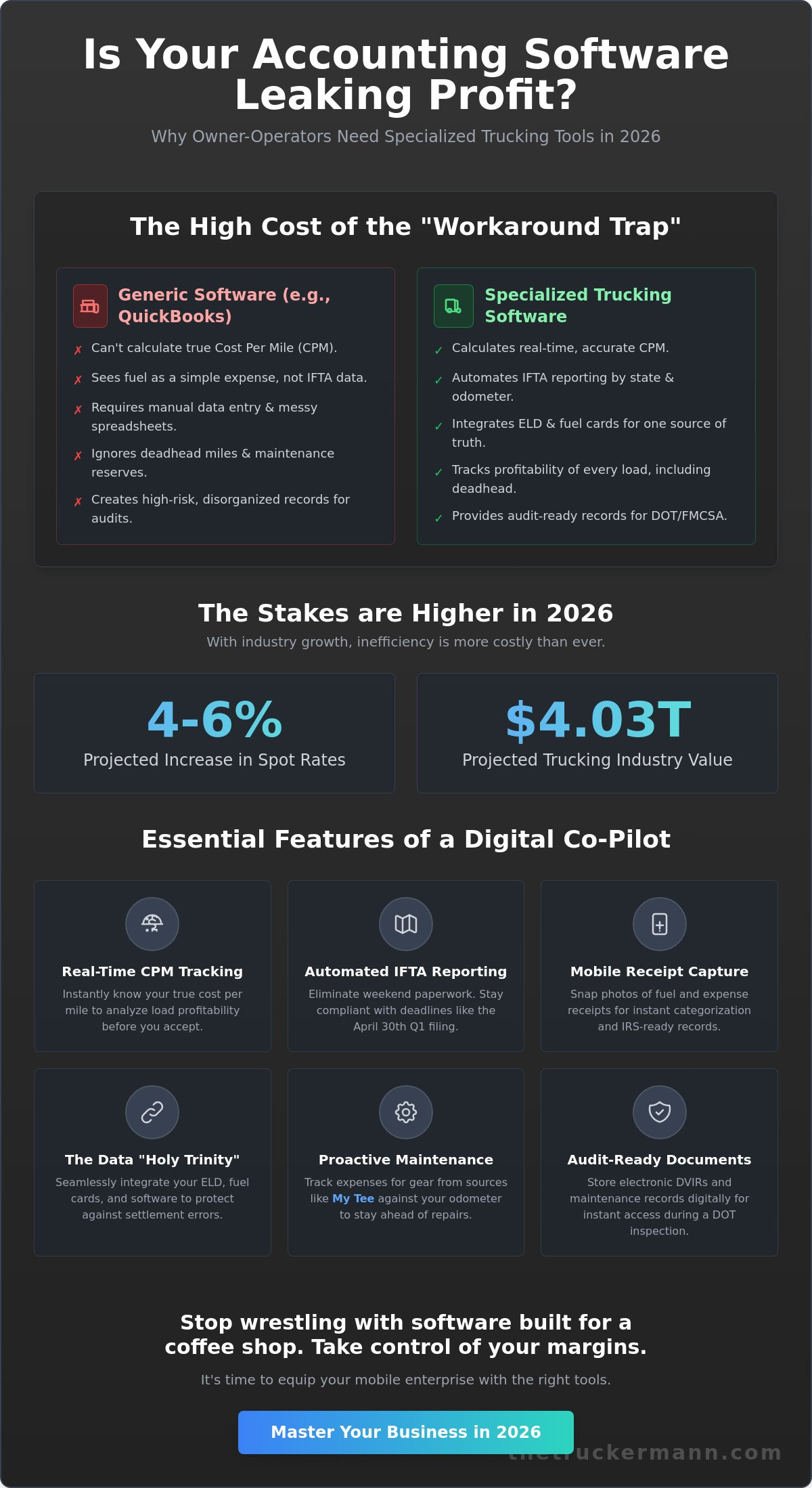
Hey Friend, let’s talk about why that generic green software might be leaking your profit. You might have started with QuickBooks because it’s what every small business uses, but for a pro driver, it’s like trying to haul a flatbed load with a minivan. Most general Accounting software is built on a “General Ledger” system. It tracks what you spend and what you earn, but it has no idea how many miles you ran to make that money. Without knowing your Cost Per Mile (CPM), you are flying blind down a steep grade with no Jake brake.
To better understand this concept, watch this helpful video:
The “Workaround Trap” is a massive drain on your limited home time. You probably spend hours every weekend exporting data from your ELD and fuel cards into messy spreadsheets just to calculate IFTA. By the time you’re done, you’ve wasted the few hours you had for family doing what the best accounting software for owner operators should do automatically. In 2026, with spot rates projected to increase by 4% to 6% and the industry value reaching $4,032 billion, you can’t afford to lose money on inefficient bookkeeping. Specialized data tracking is no longer a luxury; it’s a survival requirement for your authority.
The Miles vs. Dollars Dilemma
Generic software sees a $500 fuel bill as just another line item. Specialized trucking software sees it as a tax-deductible IFTA data point that needs to be tied to a specific state and odometer reading. If you aren’t tracking deadhead miles accurately, you’re missing the true cost of your operation. You need a system that integrates with equipment resources like My Tee while keeping your maintenance reserves calculated by the mile. Missing a per-mile maintenance reserve means you won’t be ready when an unexpected overhaul hits your bottom line.
Audit Protection and the DOT Factor
A Level 1 inspection is stressful enough without worrying about your paperwork being out of order. Specialized software keeps your maintenance records and electronic DVIRs ready for an FMCSA audit at a moment’s notice. Following the February 19, 2026, rule confirming electronic DVIRs can be legally maintained and signed digitally, your software needs to handle document storage flawlessly. Your accountant will actually thank you for using a trucking-specific tool. Instead of a shoebox of receipts, you’ll hand over a clean, industry-standard report that reflects the grit and reality of the road.
Essential Features Every Owner-Operator Needs in 2026
Choosing the best accounting software for owner operators isn’t just about finding a place to log your income. It’s about finding a digital co-pilot that alerts you to a bad load before you ever hook the trailer. In 2026, the margin for error is thinner than the tread on a junk casing. You need features that speak the language of the road, not the language of a boardroom. For the solo driver, this means moving beyond simple bookkeeping and into real-time business intelligence that keeps your authority profitable.
Mobile receipt capture is a non-negotiable tool for the modern driver. Fumbling with thermal paper at a fuel island is a recipe for lost deductions and audit anxiety. A quality app lets you snap a photo of that receipt and immediately categorize it according to IRS record-keeping requirements, ensuring your Schedule C is bulletproof come tax season. When you’re outfitting your rig with gear from My Tee, you want those expenses tracked against your odometer automatically to keep your maintenance scheduling proactive.
IFTA and Fuel Tax Compliance
IFTA automation is the single biggest time-saver for any driver with their own authority. With the 2026 deadlines approaching, like the Quarter 1 filing on April 30, you can’t afford to spend your weekend with a calculator and a stack of trip sheets. The best accounting software for owner operators will integrate directly with your ELD to track state-line crossings in real time. By synchronizing your fuel cards, the software eliminates manual entry and generates quarterly reports that are ready to file with a few clicks. This level of automation protects you from the 50% random drug testing rate pressures by giving you back the time needed to manage your compliance requirements effectively.
Profitability and Cost Per Mile (CPM)
Knowing your numbers is the difference between owning a business and just having a high-stress job. You need to see your fixed costs, like insurance and truck payments, balanced against variable costs like fuel and tires. Your Cost Per Mile is the true heartbeat of your trucking business, pulsing with every rotation of your tires to tell you if you are actually making money or just trading dollars. Most general tools ignore the specific tax needs of the solo driver, such as the $80 daily per diem or the massive $2,560,000 Section 179 deduction limit for 2026. If you want to master these metrics and keep more of your hard-earned settlement, you can find more professional guidance at The Truckermann.
The Best Accounting Software for Owner Operators in 2026
Selecting the best accounting software for owner operators in 2026 requires more than just checking boxes for tax preparation. You need a platform that understands the rhythm of the road and the volatility of fuel prices. While many educational resources highlight essential features in accounting software, they often miss the vital connection between your logbook and your ledger. In a year where spot rates are projected to climb 4% to 6%, your software choice determines if those gains stay in your pocket or disappear into administrative overhead.
TruckingOffice remains the heavyweight champion for those who want a full Transportation Management System (TMS) integrated with their books. Starting at $20 per month for 1-2 trucks, it handles maintenance and dispatch with a level of detail generic tools can’t touch. If you prefer a simpler approach focused strictly on your margins, Rigbooks is a powerful alternative. With tiers ranging from $19 for basic entry to $49 for independent owner-operators, it specializes in tracking your Cost Per Mile (CPM) without the clutter of unnecessary features. For the driver who runs their entire life from a smartphone, TruckLogics offers a mobile-first suite that makes invoicing and document management seamless from the cab.
QuickBooks is still a contender, especially with its 2026 pricing at $15 for the Self-Employed plan and $20 for the revamped Solopreneur tier. However, you’ll need to bridge the gap between its general ledger and your trucking data. Many drivers use QuickBooks for tax filing while relying on specialized tools or equipment logs from My Tee to track the physical reality of their hauls. This combination ensures your accountant is happy while you keep a firm grip on your operational costs.
Top 3 Specialized Trucking Platforms Compared
The real difference between these platforms in 2026 is how they handle the recent wave of ELD decertifications from late 2025. You need a platform that offers stable, verified integrations so your hours-of-service data flows directly into your IFTA reports. TruckingOffice excels at maintenance integration, while Rigbooks provides the most transparent CPM breakdown for solo drivers. For the independent flatbedder, having a system that tracks specialized equipment from My Tee alongside your fuel spend is the only way to ensure you aren’t underbidding on difficult loads.
Mobile-First Solutions for the Modern Road
In 2026, scanning apps have evolved into full accounting suites that live in your pocket. These tools now feature robust offline modes, which are essential when you’re parked in remote areas with no signal. Security is also a top priority; the best accounting software for owner operators now includes enterprise-grade encryption to protect your financial data on public truck stop Wi-Fi. Whether you’re uploading a receipt for a new set of straps from My Tee or checking your quarterly profit, these mobile solutions ensure you’re never more than a tap away from your business vitals.
Choosing Your Rig: Matching Software to Your Hauling Style
Finding the best accounting software for owner operators depends heavily on how you choose to run your business. A solo driver with their own authority has vastly different needs than a driver leased onto a major carrier. If you are independent, your software must be a command center for IFTA automation and real-time Cost Per Mile (CPM) tracking. With the Quarter 1 IFTA deadline hitting on April 30, 2026, you can’t afford a system that doesn’t automate state-line crossings. You need to know if that high-paying load to the Northeast is actually profitable after you factor in tolls and the return deadhead miles.
Leased-on drivers often make the mistake of relying solely on carrier settlements. While your carrier handles the big stuff, they aren’t tracking your non-reimbursed expenses or the depreciation on your securement gear. When you buy new straps or chains from My Tee, those costs need to be logged immediately to offset your tax liability. You should also use your software to verify every settlement. Errors happen. Having your own records of miles and fuel is the only way to ensure you’re getting every cent you earned.
Solo vs. Small Fleet Needs
If you’re an aspirant looking to add a second truck in 2026, you need software that scales with you. It’s much harder to switch platforms once you have multiple drivers and settlements to manage. At this stage, dispatch features and maintenance logs become just as important as the general ledger. Your operational records, including your CDL Pre Trip Inspection Checklist, should be easily accessible within your system to keep your fleet audit-ready. Tracking driver settlements for a second hand requires a level of detail that basic spreadsheets just can’t provide without massive risks of error.
Leased-On Specific Strategies
For the leased driver, the focus shifts to tracking hidden costs like bobtail insurance, permit fees, and escrow accounts. These small subtractions eat a hole in your profit if you aren’t vigilant. Use your software to track equipment depreciation, especially if you’ve invested in the Best Flatbed Trucking Gear to protect your loads. By matching your gear purchases from My Tee against your revenue, you’ll see exactly how your equipment investments impact your bottom line. Balancing a monthly subscription cost against the hours saved is a simple math problem. If the software saves you just two hours of paperwork a month, it has already paid for itself. You can find more strategies to master your business at The Truckermann.
Setting Up for Success: The Truckermann’s Blueprint
Even the best accounting software for owner operators won’t save your business if you only open it once a quarter. Success on the road requires a steady rhythm, what I call the “Sunday Afternoon Rule”. Take thirty minutes before your next run starts to reconcile your loads and clear your digital desktop. By integrating your ELD and fuel cards directly into your platform, you create a holy trinity of data that works while you sleep. This setup is your best defense against the fallout from the ELD decertifications seen in late 2025 and early 2026, ensuring your hours-of-service and mileage data remain audit-proof and accurate for your IFTA filings.
Remember that software is just a tool; a trucking-specific CPA is your strategist. They understand the nuances of this industry that general accountants often miss, like how to properly handle the 80% deduction limit for drivers subject to DOT hours-of-service regulations. While the best accounting software for owner operators tracks your daily expenses, a pro CPA helps you navigate the massive $2,560,000 Section 179 deduction limit available in 2026. Don’t let messy bookkeeping be the reason you hang up the keys. Master these tools so you can focus on what you do best: moving freight and building a legacy.
Data Hygiene on the Road
Data hygiene starts in the cab, not at the end of the month. Use your mobile app to snap photos of receipts the moment you get them. If you’re picking up recovery gear from TrucknTow or specialized equipment from Mytee Products, log those digital receipts immediately. This simple habit prevents the frantic scramble for lost thermal paper that has faded under the sun on your dashboard. In 2026, cloud storage is the standard for a reason. It keeps your records safe even if your hardware fails, ensuring your equipment from My Tee is properly depreciated over time.
Preparing for Tax Season All Year Long
When tax season rolls around, you shouldn’t feel a pit in your stomach. A “Tax-Ready” report should take under ten minutes to generate if you have been consistent with your data entry. Your software should automatically track the $80 daily per diem rate for travel within the continental U.S., which remains effective through September 30, 2026. By staying on top of these numbers, you can see your true profit margins in real time rather than waiting for a year-end surprise. Hey Friend, grab the right tool today, sync your accounts, and get back to watching those miles roll with total peace of mind.
Take the Wheel of Your Financial Future
You didn’t start this journey to spend your life hunched over a desk. Mastering your margins is the only way to stay in the game while others are forced off the shoulder. By ditching generic ledger software for a system that understands IFTA and true Cost Per Mile, you are protecting your livelihood from the volatility of the 2026 market. This guide was built by a veteran driver who knows the grit of the road. It focuses entirely on real-world profitability and the latest 2026 FMCSA regulations rather than just corporate bookkeeping.
Choosing the best accounting software for owner operators ensures you are ready for every audit and quarterly tax deadline. Whether you are outfitting your rig with equipment from My Tee or analyzing your latest settlement, having accurate data is your greatest asset. Don’t let paperwork be the reason you lose your momentum. Grab the right tools, lock down your data, and keep those wheels turning toward a more profitable future.
Ready to master your books? See the Truckermann’s top-rated gear and tools here.
Frequently Asked Questions
Is QuickBooks or TruckingOffice better for owner operators?
TruckingOffice is better for drivers with their own authority, while QuickBooks is often preferred by leased-on drivers who have less complex IFTA needs. TruckingOffice functions as a full Transportation Management System that handles dispatch and maintenance alongside your books. QuickBooks is a general ledger tool that requires you to manually track miles and fuel taxes in a separate system.
What is the best free accounting software for truckers?
Wave Accounting is the best free option available, though it lacks trucking-specific features like IFTA reporting or per-mile calculations. Using a free tool usually means you’ll spend significantly more time in a spreadsheet manually calculating your Cost Per Mile. For most pros, the time lost doing manual entry is more expensive than a paid monthly subscription.
How do owner operators track their expenses on the road?
Pro drivers track their expenses using mobile apps that offer instant receipt capture and cloud synchronization. This ensures that every purchase, from a major engine repair to a small piece of gear from My Tee, is logged before the thermal paper fades. Digital tracking eliminates the messy shoebox method and keeps your tax records audit-ready at all times.
Does trucking accounting software integrate with my ELD?
Most specialized platforms integrate directly with your ELD to automate the tracking of state-line crossings and total mileage. This integration is critical for accurate IFTA reporting without the headache of manual trip sheets. With several ELDs being decertified in late 2025 and early 2026, it is vital to ensure your software remains compatible with your current, compliant hardware.
Can I use a simple spreadsheet for my trucking taxes?
You can use a spreadsheet, but it lacks the automation and audit protection found in the best accounting software for owner operators. Spreadsheets are prone to manual entry errors and don’t provide real-time business intelligence like load profitability or proactive maintenance alerts. Using specialized software often pays for itself by catching missed deductions and preventing costly IFTA filing mistakes.
What are the most important tax deductions for owner operators in 2026?
The $80 daily per diem and the $2,560,000 Section 179 deduction limit are the most critical tax breaks for drivers in 2026. You can also deduct maintenance costs, insurance premiums, and any securement equipment you buy from My Tee. Keeping these records organized throughout the year ensures you don’t leave hard-earned money on the table during tax season.
How much does trucking-specific accounting software usually cost?
Trucking-specific accounting software typically costs between $19 and $50 per month for a solo owner-operator. Pricing usually scales based on the number of trucks you operate or the depth of the dispatch features you need. Basic plans focus on bookkeeping and IFTA, while premium tiers include full maintenance management and load board integrations.
Do I need an accountant if I have specialized trucking software?
You still need a specialized accountant for high-level tax strategy even if you use software to manage your daily bookkeeping. Software is excellent for tracking data, but a CPA who understands the trucking industry helps you navigate complex IRS regulations and audits. Think of the software as your dashboard and the accountant as your navigator for the long haul.
Disclaimer
The information provided on The TruckerMann is for general informational and educational purposes only. While every effort is made to ensure the accuracy and reliability of the content, trucking laws, FMCSA regulations, DOT requirements, safety standards, and industry policies can change at any time. Readers are encouraged to verify all information with official government agencies, professional advisors, or qualified industry professionals before making business, legal, financial, safety, or compliance-related decisions.
The content shared on this website reflects personal opinions, experiences, research, and commentary and should not be considered legal, financial, medical, tax, or professional advice. The TruckerMann and its owners, contributors, affiliates, or representatives are not responsible for any losses, damages, violations, penalties, or liabilities resulting from the use or misuse of information found on this website.
Some content on this website may contain affiliate links, sponsored content, or promotional material. This means we may earn a commission at no additional cost to you if you choose to purchase through certain links.
By using this website, you agree that you do so at your own discretion and risk.