Hey Friend, accepting a load without knowing your exact overhead is like driving through a mountain pass at night with your headlights off. You might feel like you’re moving forward, but you’re one blind curve away from a total financial wreck. We’ve all been there, watching diesel hit $5.351 per gallon while broker rates seem stuck in the mud, making it harder than ever to see the profit at the end of the haul. It’s frustrating to put in the windshield time only to realize the money is leaking out through hidden costs you didn’t see coming.
The Truckermann is here to tell you that mastering how to calculate cost per mile for trucking is the only way to protect your livelihood in 2026. This guide will show you how to account for everything from your $421 monthly insurance premium to the $0.30 per mile you need for maintenance on an older rig. You’ll walk away with a simple, repeatable formula and the confidence to turn down losing loads, because on this road, the math has to work before the wheels start turning. The road runs through us, so let’s make sure it pays.
Key Takeaways
- Stop guessing your profits and learn the master formula for how to calculate cost per mile for trucking to see the real truth behind every load.
- Uncover the “deadhead trap” and learn why factoring in every non-revenue mile is the difference between a thriving business and a breakdown.
- Gain the upper hand in load negotiations by calculating your exact break-even point, giving you the confidence to say no to bad rates.
- Learn how small adjustments to your speed and route choices can save you thousands in fuel and engine wear over the course of a year.
Beyond the Odometer: Why Your Cost Per Mile is Your Business Radar
Hey Friend, let’s get your numbers straight before the road gets the better of you. In the cab, your odometer tells you how far you’ve gone, but your Cost Per Mile (CPM) tells you if you’re actually getting anywhere. Simply put, CPM is your total business expense divided by every mile you drive. Mastering how to calculate cost per mile for trucking is essential in 2026, especially with diesel sitting at a national average of $5.351 per gallon as of April 27, 2026. Guessing your profit margin is now a fast track to a “For Sale” sign on your rig.
Think of your CPM as a high-definition BS detector. When a broker throws a rate at you, knowing your numbers allows you to see through the fluff and identify the real factors in freight transportation costs that determine if a load is worth your time. Without this math, you’re just a steering wheel holder hoping there’s money left in the account at the end of the month. You need to know exactly what it costs to keep that wheel turning before you ever sign a rate confirmation.
To better understand this concept, watch this helpful video:
Fixed vs. Variable Costs: The Foundation of Your Math
Fixed costs are the bills that hunt you down even when your truck is parked. This includes your $421 monthly general liability insurance premium or your scheduled truck payments. Variable costs, on the other hand, are the expenses that surge the moment you drop the clutch. Fuel, tires that can cost up to $12,000 a set, and maintenance are all variable. If you confuse these two, you might think a $2.00 per mile load is profit because it covers your fuel, forgetting that your fixed costs are eating your lunch in the background.
The Professional Stake of Financial Clarity
Knowing your CPM turns the slow season from a panic-inducing mystery into a manageable business cycle. When you understand your break-even point, you stop making desperate decisions that lead to DOT violations or deferred maintenance. Financial health is directly tied to safety; a driver who isn’t stressed about a $0.20 per mile maintenance reserve is a driver who keeps their equipment in top shape. This level of clarity is why learning how to calculate cost per mile for trucking is the best investment you can make in your career. It shifts your mindset from surviving the road to mastering it.
The Trucking Cost Per Mile Formula: A Step-by-Step Walkthrough
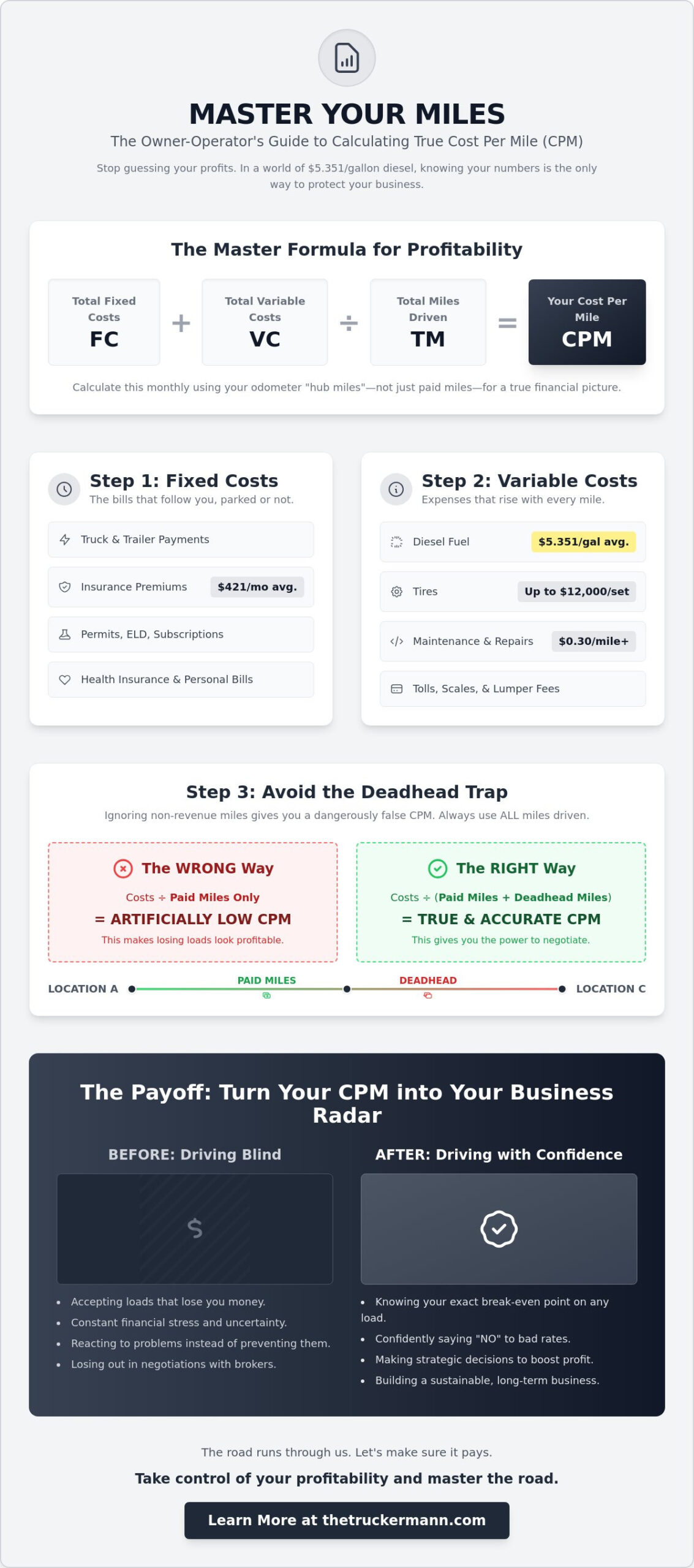
Getting your math right is the difference between running a business and just expensive hobby. To find your true north, you need the master formula: (Total Fixed Costs + Total Variable Costs) / Total Miles = CPM. Cost Per Mile (CPM) is the quotient of a trucking company’s total operating expenses divided by the sum of all miles recorded on the truck’s odometer during a set period. While some drivers look at their numbers quarterly, a monthly review is the gold standard for accuracy in a market where fuel prices and freight volumes shift by the week. When you dive into how to calculate cost per mile for trucking, always use your “hub miles” from the odometer rather than just the paid miles from the broker. If you only count paid miles, you’re ignoring the expense of every deadhead mile that ate into your profit.
Step 1: Auditing Your Fixed Monthly Expenses
Fixed costs are the weights you carry every day, whether the wheels are turning or not. Start by listing your truck and trailer payments, ELD subscriptions, and permits. For annual expenses like your $421 monthly average insurance premium or registration fees, divide the yearly total by 12 to get a true monthly impact. Don’t forget the “hidden” fixed costs that keep your life moving, such as health insurance and personal retirement contributions. These are non-negotiable business expenses that must be covered before you can claim a single cent of actual profit. You can find a detailed step-by-step cost per mile calculation to help organize these line items into a clean spreadsheet.
Step 2: Tracking Every Cent of Variable Spending
Variable costs are the fuel for your fire. This category is dominated by diesel, which sat at a national average of $5.351 per gallon in late April 2026, but it also includes DEF, additives, and tolls. You must also account for the wear and tear on your equipment. This includes replacing the best flatbed trucking gear and securement straps that wear out over time. A smart owner-operator also sets aside a maintenance reserve. Based on March 2026 data, you should budget between $0.12 and $0.30 per mile depending on whether your rig has passed the 500,000-mile mark. This “rainy day” fund ensures a blown turbo doesn’t end your career.
Step 3: The Final Calculation and Result Interpretation
Once you have your totals, perform the division. If your total monthly expenses are $12,000 and you ran 10,000 hub miles, your CPM is $1.20. In the 2026 market, a healthy CPM for a solo owner-operator often ranges between $1.50 and $2.10, depending on your niche and debt load. If you’re running a team, your variable costs like driver pay will surge, but you’ll have more miles to spread those fixed costs over, often lowering your overall CPM. Knowing this number gives you the power to negotiate. If a load pays $1.80 and your CPM is $1.75, you’re barely making enough to buy a sandwich. Before hitting the road again, consider checking out our latest industry alerts to see how current regulations might shift these numbers. Mastering how to calculate cost per mile for trucking is how you stop being a victim of the market and start being a master of it.
Analyzing Variable Costs: Fuel, Maintenance, and the Deadhead Trap
Variable costs are the shifting sands of your business. Unlike your truck payment, these expenses change every time you drop the hammer, making them the hardest numbers to pin down. Fuel remains the undisputed heavyweight champion of your variable expenses. With the national average diesel price sitting at $5.351 per gallon as of April 27, 2026, even a minor dip in fuel economy can slash your take-home pay by hundreds of dollars a week. If you want to master how to calculate cost per mile for trucking, you have to look past the pump price and see how every minute of idling or every heavy foot on a grade is eating your margin.
Maintenance is the other major variable, but the most successful owner-operators treat it as a proactive investment. Industry data from March 2026 shows that every dollar spent on preventive maintenance can save between $5 and $50 in emergency repairs and lost revenue. Staying ahead of the curve starts with a disciplined cdl pre trip inspection checklist to catch a leaking wheel seal or a frayed belt before it turns into a roadside service call. Beyond the big repairs, you must track the “profit leeches” like lumper fees, scale tickets, and tolls. These small charges might seem like pocket change, but over 100,000 miles, they can easily add $0.05 to $0.08 to your total CPM.
Managing the Fuel Beast and Market Fluctuations
Smart drivers use their IFTA data for more than just tax compliance. By comparing your fuel spend across different regions, you can see the massive impact of state taxes. For example, as of February 2026, California’s IFTA rate was $0.9710 per gallon while Texas was only $0.2000. Choosing your fuel stops based on the “net price” (pump price minus state tax) is a veteran move that keeps more cash in your pocket. Additionally, reducing idle time is the easiest raise you can give yourself. An engine idling for one hour burns approximately one gallon of fuel, which is a $5.351 mistake you can’t afford to repeat daily.
The Deadhead Mile Trap: Accounting for Unpaid Distance
Deadhead miles are the silent killer of trucking businesses. Many drivers make the mistake of only looking at their “Revenue Per Mile,” which only accounts for the distance the trailer is loaded. To find the truth, you must calculate your “Cost Per All Miles.” If you take a load paying $2.50 per mile for 500 miles, but you had to deadhead 200 miles to get it, your actual revenue drops significantly. When you understand how to calculate cost per mile for trucking across every hub mile, you realize that a lower-paying load with zero deadhead is often more profitable than a “hot” load that requires a long, unpaid trek. Better load planning isn’t just about the rate on the paper; it’s about keeping the wheels earning every time they turn.
Actionable Strategies to Reduce Trucking Overhead
Knowing how to calculate cost per mile for trucking is only half the battle. Once you’ve identified that your CPM is, for example, $1.85, the real work begins in trimming the fat without compromising your safety or equipment. Your route choice is often the largest lever you can pull. Deciding between interstate vs intrastate paths isn’t just about the scenery; it’s about dodging high-cost tolls and expensive state permits that can spike your variable costs by 10% overnight. Every bridge toll and weight-distance tax is a direct hit to your bottom line, so planning your path around these expenses is essential for protecting your profit.
The “5-Mile-Per-Hour Rule” is another veteran secret for protecting your margin. Dropping your cruising speed from 70 mph to 65 mph can improve your fuel economy by as much as 0.5 to 1.0 mile per gallon. With diesel averaging $5.351 per gallon in April 2026, that small adjustment can save a long-haul driver over $5,000 a year in fuel alone. Beyond the pump, slower speeds reduce heat and friction, extending the life of those $12,000 tire sets and delaying the need for a $20,000 engine overhaul. It’s about playing the long game, not just getting to the receiver twenty minutes early. You should also look at reducing admin overhead by using digital logbooks and automated billing, which cuts down on the hours spent chasing paperwork instead of miles.
Leveraging Technology for Route and Fuel Optimization
The Truckermann knows that modern tools are the best defense against rising overhead. Using a data-driven ELD and a specialized trucking GPS helps you avoid “out-of-route” miles, which typically account for 3% to 5% of an owner-operator’s total distance. Pair this with a robust fuel card program that offers deep discounts at the pump. These programs often shave $0.30 to $0.50 off the retail price, which significantly lowers the variable side of your math when you look at how to calculate cost per mile for trucking at the end of the month. Data-driven dispatching also ensures you aren’t just taking the first load you see, but the one that fits your fuel and toll strategy perfectly.
Smart Maintenance and Equipment Selection
Don’t fall into the “if it ain’t broke” trap. Predictive maintenance, like oil sampling and regular alignment checks, catches small issues before they become “nuclear” repair bills. Investing in high-quality securement gear and aerodynamic fairings might cost more upfront, but they lower your per-mile replacement frequency. Plus, upgrading your equipment often provides immediate tax advantages, allowing you to deduct the full cost of the purchase under Section 179. For the best results on the road, get the right tools for your rig to ensure you’re operating at peak efficiency. Every dollar you don’t spend on a preventable breakdown is a dollar that stays in your pocket.
Mastering the Road: Using Your CPM to Negotiate Better Rates
Once you’ve mastered how to calculate cost per mile for trucking, you hold the most powerful bargaining chip in the logistics industry. You’re no longer just asking for a rate; you’re stating a business requirement. Knowing that your operating cost is $1.82 per mile means a $1.85 offer isn’t an opportunity. It’s a trap. Every load has a break-even point where you aren’t actually making money; you’re just trading your truck’s life and your own time for a break-even check. To thrive in 2026, you must use your CPM data to draw a line in the sand that you refuse to cross.
When dealing with direct shippers, your CPM data acts as a professional resume. Instead of complaining about fuel prices, which hit $5.351 per gallon on April 27, 2026, you can present a line-item justification for your rates. Shippers value reliability and transparency. When you show them that your $421 monthly insurance premium and your $0.30 per mile maintenance reserve ensure their freight is on a safe, well-maintained rig, you move from being a commodity to a partner. Professional pride comes from knowing your worth and having the math to back it up.
Knowing Your Walk-Away Number with Brokers
Hey Friend, the hardest part of this job isn’t the 11-hour drive; it’s the 30-second silence after you tell a broker no. Use a simple script: “My operating cost is $1.85, and I require a 20% margin to keep my equipment running safely. I can’t move this for less than $2.22.” This removes the emotion from the conversation. If they can’t meet it, you walk away. This is especially vital in “hot zones” where market volatility might tempt you to take a quick load. If the math doesn’t work, the wheels don’t turn. Saying “no” to a bad load is often the most profitable move you’ll make all week.
Long-term Growth and the Entrepreneurial Mindset
Tracking your numbers moves you from survival mode into thriving mode. When you understand how to calculate cost per mile for trucking with precision, you can finally plan for the future. Whether you’re looking at fleet expansion or moving into specialized HAZMAT hauling, where insurance can surge to $1,181 per month, your CPM is your roadmap. The Truckermann believes that financial mastery is the ultimate form of professional respect. We aren’t just driving; we’re building legacies. The Road Runs Through Us, but only if we keep the business side as sharp as the chrome.
Take the Wheel of Your Financial Future
Hey Friend, you’ve now got the tools to stop guessing and start growing. By mastering how to calculate cost per mile for trucking, you’ve moved from being a victim of market swings to a driver who knows exactly when to shift gears. We’ve covered the importance of tracking every hub mile and the reality of diesel prices sitting at $5.351 per gallon as of April 2026. These numbers are your radar. They help you spot a bad load from a mile away and give you the confidence to demand the rate you deserve.
The road is always changing, but you don’t have to navigate it alone. The Truckermann provides up-to-date 2026 regulatory guidance and industry-leading gear reviews written by real drivers for real drivers. To keep your operation lean and your equipment ready for the long haul, check out the latest tools and gear to keep your overhead low at The Truckermann. Stay vigilant, keep your math sharp, and remember that financial mastery is the ultimate form of professional pride. The Road Runs Through Us.
Frequently Asked Questions
What is a good cost per mile for an owner-operator in 2026?
A healthy cost per mile for a solo owner-operator in 2026 typically falls between $1.50 and $2.10. This range depends heavily on your equipment age and your specific niche. For example, if you are hauling HAZMAT, your monthly insurance premium might hit $1,181, which naturally pushes your CPM higher than a dry van driver. Knowing your specific number is the first step in learning how to calculate cost per mile for trucking to ensure your business remains profitable.
Does trucking cost per mile include driver pay?
Yes, you must include a fair market wage for yourself in your CPM calculation. Many owner-operators make the mistake of only counting truck expenses, which means they are essentially working for free. Treat your salary as a fixed cost if you pay yourself a flat weekly rate, or a variable cost if you take a percentage of each load. This ensures that the “profit” left over is actually business growth capital, not just your missing paycheck.
How do I factor deadhead miles into my cost per mile?
You factor in deadhead miles by using your total odometer miles, often called hub miles, as the divisor in your formula. If you only divide your expenses by paid miles, you’ll get a false sense of security. Every mile your truck moves costs you money in fuel and tire wear, whether you have a load behind you or not. Using your total hub miles ensures that your “real-world” overhead is fully covered in every broker negotiation.
What is the difference between fixed and variable costs in trucking?
Fixed costs are the bills that stay the same regardless of your mileage, while variable costs fluctuate based on how much you drive. Your $421 average monthly insurance premium and your truck payments are fixed because they don’t change if you park the rig. Variable costs include diesel, which averaged $5.351 per gallon in April 2026, and maintenance reserves. Understanding this split is vital for how to calculate cost per mile for trucking with total accuracy.
How often should I recalculate my trucking cost per mile?
You should recalculate your cost per mile at least once a month to stay ahead of market shifts. Waiting until tax season to see your margins is a dangerous game in an industry where fuel prices and freight volumes change weekly. A monthly audit allows you to adjust your “walk-away” price with brokers. This is especially important if your truck has passed the 500,000-mile mark, where maintenance costs often jump to $0.30 per mile.
Can I use an app to track my trucking expenses and CPM?
Absolutely, using specialized software or a mobile app is the most efficient way to keep your data organized on the road. Many modern ELDs now integrate with accounting tools to pull your hub miles and fuel spend automatically. This technology reduces the administrative burden and provides a real-time look at your financial health. Digital tracking also makes it easier to identify “profit leeches” like excessive idling or high-cost fuel stops before they sink your month.
What are the most common hidden costs in trucking math?
The most common hidden costs are lumper fees, scale tickets, and the per-mile maintenance reserve. Many drivers forget to budget for the recommended $15,000 to $25,000 annual maintenance fund required for a truck running 100,000 miles. Other sneaky expenses include state-specific weight-distance taxes and the cost of replacing securement gear. These small, unrecorded charges can easily add $0.10 to your total CPM if you aren’t watching the pennies every single day.
How does fuel price volatility affect my CPM calculation?
Fuel price volatility has a massive impact because diesel is your largest variable expense. When the national average sits at $5.351 per gallon, a sudden $0.20 spike can increase your operating cost by nearly $0.04 per mile if your rig averages 5 MPG. This volatility is why the Truckermann recommends choosing fuel stops based on net price rather than the pump price. Frequent recalculations are the only way to ensure your rates keep up with the shifting cost of energy.
Disclaimer
The information provided on The TruckerMann is for general informational and educational purposes only. While every effort is made to ensure the accuracy and reliability of the content, trucking laws, FMCSA regulations, DOT requirements, safety standards, and industry policies can change at any time. Readers are encouraged to verify all information with official government agencies, professional advisors, or qualified industry professionals before making business, legal, financial, safety, or compliance-related decisions.
The content shared on this website reflects personal opinions, experiences, research, and commentary and should not be considered legal, financial, medical, tax, or professional advice. The TruckerMann and its owners, contributors, affiliates, or representatives are not responsible for any losses, damages, violations, penalties, or liabilities resulting from the use or misuse of information found on this website.
Some content on this website may contain affiliate links, sponsored content, or promotional material. This means we may earn a commission at no additional cost to you if you choose to purchase through certain links.
By using this website, you agree that you do so at your own discretion and risk.