What if the bone-deep exhaustion you feel at the fuel island isn’t a sign that you’ve lost your grit, but a predictable reaction to the most high-pressure regulatory environment we’ve ever seen? Between the FMCSA pulling nine ELD models off the market this February and the new Broker Financial Responsibility Rule tightening the screws on every load, it’s no wonder you feel like you’re constantly under the gun. You know the feeling; it’s that heavy realization that the road doesn’t feel like freedom anymore, just a series of HOS clocks and digital checkboxes. If you’re wondering how to deal with trucking industry burnout without handing in your keys, you aren’t alone in the sleeper berth.
I’ve been in those boots, and I can tell you that surviving 2026 requires more than just ‘toughing it out.’ This guide is your tactical briefing on reclaiming your career. We’re going to break down how to identify your specific burnout level before it hits a breaking point, and we’ll look at the gear and routine shifts that actually reduce physical strain. From mastering the new electronic DVIR workflows to selecting equipment that saves your joints, you’ll learn how to turn the cab back into your office rather than your cage. It’s time to stop being a number to dispatch and start operating like the professional veteran you are.
Key Takeaways
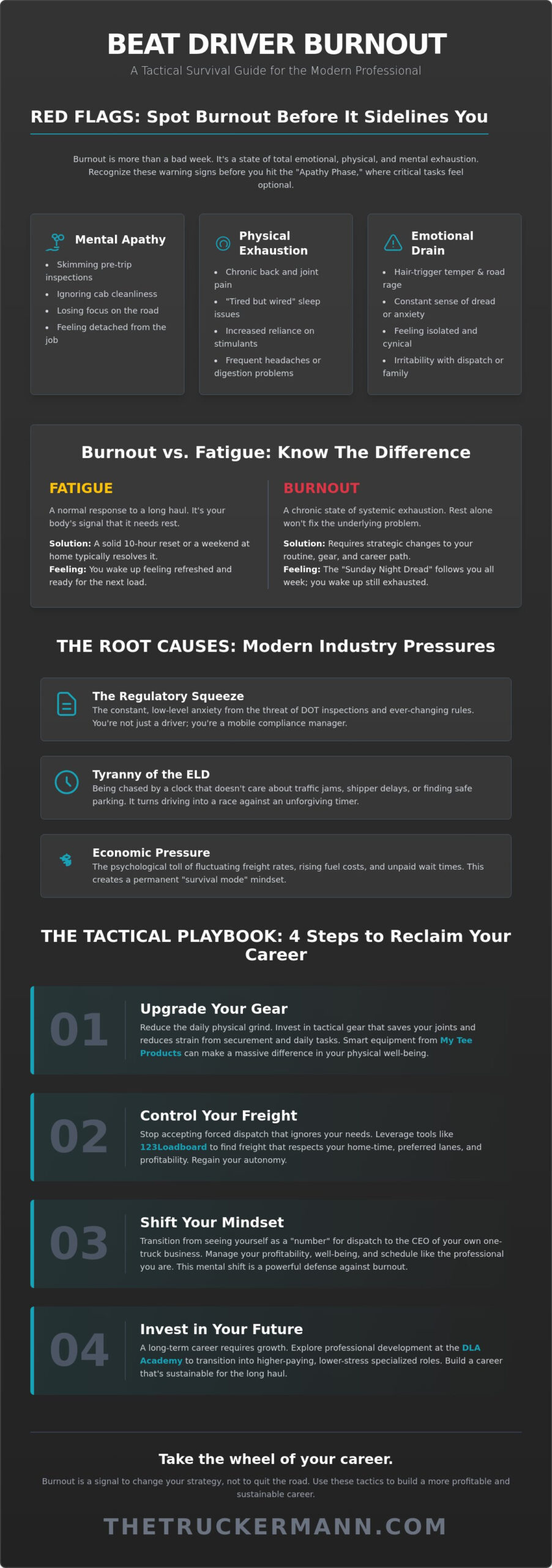
- Spot the “Apathy Phase” where routine tasks like your pre-trip inspection start to feel optional, signaling a dangerous level of mental fatigue.
- Learn how to deal with trucking industry burnout by upgrading to tactical gear from My Tee Products that reduces the physical strain of daily securement.
- Break the cycle of forced dispatch by leveraging 123Loadboard to find freight that respects your need for home-time and specific lanes.
- Shift your perspective from being a “number” to a business manager who controls their own profitability and mental well-being.
- Explore career-saving professional development opportunities at the DLA Academy to transition into higher-paying, lower-stress specialized roles.
Recognizing the Warning Signs of Driver Burnout in 2026
Trucking isn’t just a career; it’s a relentless grind that can wear down even the most seasoned gears in your mental drivetrain. When we talk about Occupational Burnout, we aren’t just describing a bad day or a rough week. It is a state of total emotional, physical, and mental exhaustion caused by excessive and prolonged industry stress that leaves you feeling drained and useless. Understanding how to deal with trucking industry burnout begins with admitting that your mind is just as prone to wear and tear as your tires. If you feel like you’re running on empty even after a full reset, you’re likely facing more than just simple fatigue.
You’ll know you’ve hit the “Apathy Phase” when the small, life-saving details start to feel like optional suggestions. Maybe you’re skimming your CDL pre-trip inspection checklist instead of actually checking the slack adjusters, or perhaps you’ve stopped caring about the cleanliness of your cab. Your body sends loud signals too. Chronic back pain that won’t quit, sleep disturbances that leave you “tired but wired,” and an increasing reliance on stimulants just to hit your next appointment are major red flags. Emotionally, you might find yourself on a hair trigger, experiencing road rage or a crushing sense of dread the moment your ELD starts the clock for the day. Learning how to deal with trucking industry burnout is about recognizing these red flags before they sideline you permanently.
To better understand this concept, watch this helpful video:
Burnout vs. General Fatigue: Knowing the Difference
Fatigue is what happens after a long haul. A solid 10-hour reset or a weekend at home usually clears the fog and gets you ready for the next load. Burnout is a different animal altogether. It’s the “Sunday Night Dread” that follows you even when you’re already parked in the sleeper berth. You could take a week off and still wake up feeling like you’ve been dragging a heavy flatbed uphill. When the mental fog gets so thick that safety violations feel inevitable, you’ve reached the point where grit alone won’t save your CDL.
The 2026 Economic Impact on Mental Health
The 2026 market has introduced a unique set of pressures that haven’t existed in previous years. With fluctuating freight rates and fuel costs that move faster than a scale house bypass, many drivers have slipped into a permanent survival mode mindset. The psychological toll of deadheading for hundreds of miles or sitting through unpaid wait times at shippers creates a constant, low-level anxiety. This year requires a different mental approach. You can’t just outwork a bad market; you have to outsmart the stress it creates by reclaiming your autonomy on the road.
The Root Causes: Why the Modern Industry Pushes Drivers to the Brink
Burnout doesn’t happen in a vacuum. It is the result of a thousand small cuts that eventually lead to a total system failure. The modern driver is caught in a “Regulatory Squeeze” where the constant threat of a DOT inspection level 1 creates a baseline of low-level anxiety that never truly goes away. You aren’t just driving; you’re managing a mobile compliance center. When you combine this with the tyranny of the ELD, you get a situation where you’re constantly chased by a clock that doesn’t care about a three-hour backup on I-95 or the fact that you didn’t sleep well in a noisy rest area. Understanding these external pressures is the first step in learning how to deal with trucking industry burnout effectively.
The Anxiety of Compliance
Autonomy used to be the biggest draw of the road, but that feeling is disappearing. Between ELDs, inward-facing cameras, and real-time GPS tracking, it feels like dispatch is sitting right in the passenger seat. This level of monitoring erodes the trust that used to define the industry. Maintaining a clean MVR is harder than ever in 2026, especially with increased roadside enforcement and the new English proficiency rules being strictly applied. These “Inspection Jitters” before a CVSA Roadcheck aren’t just nerves; they’re a physiological stress response to a system that often feels designed to catch you failing rather than help you succeed. If you want to stay ahead of the game, keeping a sharp eye on your pre-trip routine is essential.
The Isolation of the Long Haul
The “brotherhood” of the road has taken a hit. Modern cab life is lonelier than it was twenty years ago; drivers are more likely to stay in their sleepers with a tablet than share a meal at a truck stop counter. This social isolation is a major factor in mental decline. According to University of Arkansas research on driver burnout, the lack of social support and the constant strain of missing family milestones can lead to severe psychological distress. When you add the lack of quality food and zero space for exercise, your cab can start to feel like a prison cell. Finding a community of like-minded professionals who understand how to deal with trucking industry burnout is one of the best ways to reclaim your mental health while OTR.
Physical friction also plays a massive role. Using outdated or damaged gear adds hours of unnecessary, back-breaking labor to every single load. Every time you struggle with a rusted binder or a heavy, torn tarp, you’re burning through the limited energy you need to finish your shift safely. We often overlook how much physical strain contributes to mental exhaustion. If you’re feeling the weight of the road, consider checking out more of our tactical driver guides to streamline your daily operations and protect your health.
Fighting Physical Fatigue with Tactical Gear Upgrades
If you’re wrestling with a 100-pound frozen tarp in a rainstorm while your HOS clock ticks down, your mental health is going to tank. We often talk about burnout as a purely mental game, but your brain and your body are connected. An NIH study on truck driver health and burnout highlights that physical strain and long hours are direct catalysts for psychological distress. Every minute you spend fighting a rusted winch or a tangled strap is a minute stolen from your rest. Learning how to deal with trucking industry burnout requires a shift in how you view your tools; they aren’t just equipment, they’re your primary defense against exhaustion.
Investing in high-quality gear from My Tee Products reduces the “grunt work” that leads to total depletion. While many fleets provide the cheapest possible options, that budget gear often costs you your health in the long run. Ergonomics matter when you’re doing this every day. Utilizing the best flatbed trucking gear, such as lightweight tarps and easy-crank winches, can shave significant labor off your week. When you stop fighting your equipment, you start saving the mental energy you need to navigate the 2026 regulatory landscape with a clear head.
Securement Without the Strain
The tie-down process shouldn’t feel like a wrestling match. Using straps and chains from My Tee Products ensures that your gear works with you rather than against you. Properly maintained My Tee Products edge protectors save time and prevent frustrating load shifts that require mid-trip adjustments. Fighting your gear is the fastest way to blow out your back and your mood before you even hit the highway. When your securement is smooth and efficient, you can get back in the cab sooner, knowing your load is tight and your stress is lower.
Weatherproofing and Tarping Efficiency
Tarping in the snow or high winds is a major driver of “road rage” and burnout. Using superior materials from My Tee Products makes these brutal tasks more manageable. High-quality tarps that stay flexible in the cold allow you to finish the job without the typical “unbilled labor” that eats into your reset time. Knowing how to deal with trucking industry burnout means identifying these physical friction points and eliminating them. By speeding up your securement cycles with better gear, you turn a grueling task into a professional routine that leaves you with more energy for the long haul ahead.
Smarter Load Management: Regaining Autonomy on the Road
One of the fastest ways to hit a wall is feeling like you have zero control over your schedule. Forced dispatch is a relic of the past for the professional who knows their worth. To truly master how to deal with trucking industry burnout, you have to stop being a passenger in your own career. This starts with recognizing that you are the captain of your ship. In 2026, you have the digital tools to prove it. Regaining autonomy means knowing your market value. If a broker pushes a load that pays pennies or demands you skirt HOS rules, the “Power of No” is your strongest asset. Chasing every single mile is a short-term strategy that leads to long-term career failure. Look toward diversifying your skills instead. Specialized hauling, such as flatbed or oversized loads, often pays more per mile. This allows you to earn a solid living with fewer hours behind the wheel and less stress on your mind.
Using Tech to Beat the Clock
The days of calling ten brokers just to find a backhaul are over. Smart drivers leverage 123Loadboard to avoid “freight deserts” that leave you stranded in a parking lot for days. By using real-time market insights from 123Loadboard, you can see where capacity is tight and rates are climbing. This allows you to plan your route based on actual profitability rather than desperation. Finding backhauls through 123Loadboard ensures you aren’t deadheading home for free. Every empty mile is a drain on your mental health and your wallet. With the 2026 Broker Financial Responsibility Rule now in full effect, using 123Loadboard gives you the data needed to make informed decisions that keep you moving and profitable with reliable partners.
Planning for Longevity
You can’t run at 100% capacity every single week without something eventually breaking. Many veterans use the 3-4-3 rule: three days of heavy pushing, four days of moderate pace, and three days of focused intensity. This rhythmic approach keeps your mental clarity sharp and prevents the “zombie” feeling that leads to accidents. Chasing miles is a trap that leads to physical and mental depletion. You should integrate rest into your route planning from the start. If you treat your 10-hour reset as an afterthought, you’re already behind. To learn more about optimizing your daily operations and protecting your career, check out our veteran driver resources today.
Building a Sustainable Career: The Veteran’s Path Forward
You’ve made it through the gear upgrades and the load management strategies, but the final piece of the puzzle is your own perspective. To survive this industry in 2026, you’ve got to stop thinking like a steering wheel holder and start thinking like a CEO. Trucking is a business you manage, not just a job you do. When you’re just reacting to dispatch, you’re a victim of the road’s volatility. When you’re managing assets and making data-driven choices, you’re a professional in control of your destiny. Understanding how to deal with trucking industry burnout requires this mental pivot. If you see the industry as a volatile ocean, your specialized skills and high-quality gear are the boat that keeps you afloat when the waves get choppy.
Part of this shift involves having a clear “Pivot Plan.” Knowing you have an exit strategy or a path to advancement keeps the mind focused on growth rather than stagnation. Whether it’s moving into fleet management, safety consulting, or specialized heavy-haul, having a goal beyond the next fuel stop is essential for your mental health. Stay connected with the community through The Truckermann’s sentinel-style updates. Staying informed about 2026’s changing regulations, like the Motus registration system or the new DVIR rules, keeps you prepared and significantly less anxious about the unknown. Knowledge isn’t just power on the road; it’s the antidote to the feeling of being a “number” in a corporate database.
Investing in Your Professional Future
Mastery is the enemy of anxiety. Enrolling in the DLA Academy is a tactical move that can shift you from the general freight grind into high-value logistics where the rates are higher and the headaches are fewer. Education is the best armor against industry volatility because it gives you options that others don’t have. The DLA Academy provides the specialized training needed to pivot into roles that demand expertise rather than just raw hours behind the wheel. Having a “Mastery” mindset toward the trade changes your daily experience from a repetitive chore to a refined craft. When you invest in yourself through programs like the DLA Academy, you aren’t just earning a certificate; you’re buying back your future.
Final Words from the Sentinel
Reclaiming the Road: Your Tactical Next Steps
You’ve seen the red flags and you’ve identified the physical friction slowing you down. Mastering the 2026 landscape isn’t about working harder; it’s about working smarter with the right tools and a veteran’s mindset. By upgrading your securement gear and leveraging modern load boards, you reclaim the autonomy that the ELD clock tried to steal. Now that you’ve got a tactical roadmap for how to deal with trucking industry burnout, the next move is yours to make. You can choose to stay in the grind or you can choose to manage your career like the professional you are.
Don’t let the industry pressure dictate your future when you can lead the charge yourself. As a sentinel for this community and a strategic partner of My Tee Products, I’m here to ensure you stay ahead of every regulatory curve and equipment hurdle. This platform is managed by a professional veteran driver who knows exactly what you’re facing out there. It’s time to upgrade your gear and your career at The Truckermann. Remember that this road is a lifestyle, not just a job, and you’re the one in the driver’s seat. Keep your head up, stay sharp, and we’ll see you at the next stop.
Frequently Asked Questions
Is it normal to feel like I hate trucking after five years?
Yes, it’s very common to hit a wall around the five-year mark as the initial novelty of the road fades and the physical toll accumulates. This is typically when the “Apathy Phase” kicks in; your brain is signaling that your current routine is no longer sustainable. It doesn’t mean you’re a bad driver. Many veterans find this is the perfect time to pivot into specialized hauling or upgrade their daily equipment to reduce stress.
How do I tell my dispatcher I’m experiencing burnout without getting fired?
Approach the conversation as a safety and performance issue rather than a personal complaint. Tell your dispatcher that you’ve noticed a decline in your alertness and need a reset to maintain your safety record. Frame it as protecting the company’s equipment and your CDL. A good dispatcher knows that a burnt-out driver is a liability, but if they push back, it’s likely time to find a carrier that respects HOS limits.
Does driver burnout affect my DOT medical card or MVR?
Burnout doesn’t appear on an MVR, but the mistakes it causes certainly do. Mental exhaustion leads to missed signs, logbook errors, and failed inspections, all of which damage your record. Regarding your DOT medical card, chronic stress can lead to high blood pressure or sleep apnea, which are red flags during an exam. Learning how to deal with trucking industry burnout is essential for protecting your long-term eligibility to drive.
Can upgrading my trucking gear really help with mental stress?
Yes, reducing physical friction directly lowers your mental load and overall stress levels. When you use high-quality equipment from My Tee Products, you spend less time wrestling with rusted binders or heavy tarps. This saves your energy for driving and decision-making. Using My Tee Products ensures that your workday is physically easier, which prevents the bone-deep exhaustion that often triggers a mental breakdown.
What are the first steps to take if I feel a ‘mental breakdown’ coming on the road?
Pull over at the nearest safe location immediately and step out of the cab to change your environment. If you feel a breakdown coming, your ability to safely operate an 80,000-pound vehicle is compromised. Contact a trusted friend, family member, or a driver support line. Do not worry about the load or the clock in that moment; your life and the lives of others on the highway are the only priority.
Are there specific types of hauling that are less prone to burnout?
Specialized hauling roles like oversized loads or liquid tankers often report lower burnout rates because the work is more engaging and pays better for fewer miles. General freight and no-touch dry van work can become mind-numbing and lead to the feeling of being a number. Many drivers find that the challenge of securement with gear from My Tee Products keeps them more focused and satisfied with their professional craft.
How much home time is actually necessary to recover from severe burnout?
Severe burnout usually requires at least 7 to 14 days of total disconnection from the industry to see real improvement. A standard 34-hour restart is barely enough to catch up on sleep, let alone reset your mental health. If you’re wondering how to deal with trucking industry burnout, realize that a long-distance vacation or a week of home-time without touching your phone is often the only way to truly recharge your batteries.
What does the law mean for drivers who need to take a mental health break?
The law protects your right to refuse a load if you are too fatigued or ill to drive safely under FMCSR 392.3. While mental health isn’t always explicitly listed like a physical fever, the “illness or fatigue” clause covers mental exhaustion that impairs your ability. You have a legal obligation to park the truck if you aren’t fit for duty. Document your situation clearly to protect yourself against potential carrier retaliation.
Disclaimer
The information provided on The TruckerMann is for general informational and educational purposes only. While every effort is made to ensure the accuracy and reliability of the content, trucking laws, FMCSA regulations, DOT requirements, safety standards, and industry policies can change at any time. Readers are encouraged to verify all information with official government agencies, professional advisors, or qualified industry professionals before making business, legal, financial, safety, or compliance-related decisions.
The content shared on this website reflects personal opinions, experiences, research, and commentary and should not be considered legal, financial, medical, tax, or professional advice. The TruckerMann and its owners, contributors, affiliates, or representatives are not responsible for any losses, damages, violations, penalties, or liabilities resulting from the use or misuse of information found on this website.
Some content on this website may contain affiliate links, sponsored content, or promotional material. This means we may earn a commission at no additional cost to you if you choose to purchase through certain links.
By using this website, you agree that you do so at your own discretion and risk.