Hey there, driver. Would you rather be burning miles or burning the midnight oil over a calculator while the April 30 deadline for Q1 looms? We’ve all been there, staring at a dashboard full of faded receipts and wondering if the math across forty-eight states and ten provinces is actually going to add up this time. It’s no secret that the ifta fuel tax reporting guide is your best friend when the pressure is on. Whether you are hitting the high rates in California at $1.090 per gallon or cruising through Texas, keeping your records straight is the only way to protect your livelihood from the FMCSA.
I know the anxiety that comes with quarterly filings and the fear of a $50 late fee or that 10% penalty hitting your bottom line. You didn’t get into this business to be an accountant, but staying compliant is how we keep the rigs moving and the regulators off our backs. The Sentinel is here to help you navigate these shifts. In this roadmap, I’m going to show you how to streamline your reporting process and build an audit-proof record-keeping system that works as hard as you do. We will break down the 2026 deadlines, explain those tricky tax-exempt miles, and look at how tools like My Tee can take the heavy lifting out of your data entry. Let’s get your paperwork as organized as your trailer so you can focus on the road ahead.
Key Takeaways
- Determine if your equipment requires an IFTA decal by understanding the specific weight thresholds and axle counts that trigger compliance.
- Automate your record-keeping by using your ELD to track miles while maintaining manual trip sheets as a vital backup for audit protection.
- Master the 4-step calculation process within this ifta fuel tax reporting guide to accurately determine your net taxable gallons and average MPG.
- Shield your business from penalties by avoiding common red flags like rounded mileage numbers and maintaining all receipts for the required four years.
- Streamline your paperwork and keep your cab organized with professional-grade storage solutions and gear from My Tee.
What is the International Fuel Tax Agreement (IFTA)?
Hey Friend, let’s pull over for a second and talk shop about the pact that keeps us moving across borders without a mountain of paperwork. The International Fuel Tax Agreement, or IFTA, is a reciprocity agreement between 48 U.S. states and 10 Canadian provinces. Before this came along, you had to buy a separate fuel tax sticker for every single state you planned to enter. It was a logistical nightmare that kept drivers buried in decals and red tape. Now, this consolidated ifta fuel tax reporting guide helps you manage everything through one base jurisdiction.
To better understand how this all comes together at filing time, watch this helpful video:
The Truckermann perspective is simple: treat your IFTA filing like a professional handshake with the DOT. It’s a “pay-as-you-go” system that ensures every state gets its fair share of the taxes you pay at the pump based on the actual miles you grind out on their asphalt. When you buy diesel in Texas but burn it in Oklahoma, IFTA makes sure the money follows the tires. It’s not just a tax; it’s the price of admission for the freedom of the open road. Using quality equipment from My Tee to keep your rig in top shape helps maximize your fuel efficiency, which directly impacts these numbers.
The Mechanics of Fuel Tax Redistribution
Taxes paid at the pump are “trued up” every quarter. You track your “tax-paid gallons,” which is what you bought at the station, and compare them to “taxable gallons,” which is what you should have paid based on where you actually drove. If you bought more than you used in a high-tax state, you get a credit. Your base jurisdiction acts as your only point of contact, distributing those funds to the other 58 members so you don’t have to deal with multiple agencies.
Why Compliance is a Badge of Honor
Keeping your filings clean is about more than just avoiding that $50 late fee or the 10% penalty. It’s about your reputation. Clean IFTA records often correlate with higher safety scores and fewer roadside interruptions. It shows you’re a professional who respects the rules of the game. Following a reliable ifta fuel tax reporting guide ensures you keep that hard-earned cash where it belongs: in your pocket. IFTA is a cooperative mechanism for interstate tax equity.
IFTA Compliance Requirements: Does Your Rig Qualify?
Listen, before you start sweating over the math, we need to make sure your rig even falls under the IFTA umbrella. Not every truck you see at the fuel island is bound by these rules, and you don’t want to be filing reports if you don’t have to. The core of this ifta fuel tax reporting guide is identifying what the DOT calls a Qualified Motor Vehicle. If your equipment doesn’t meet the threshold, you can skip the quarterly headache entirely. However, if you do qualify, ignoring these rules is a fast track to a roadside nightmare.
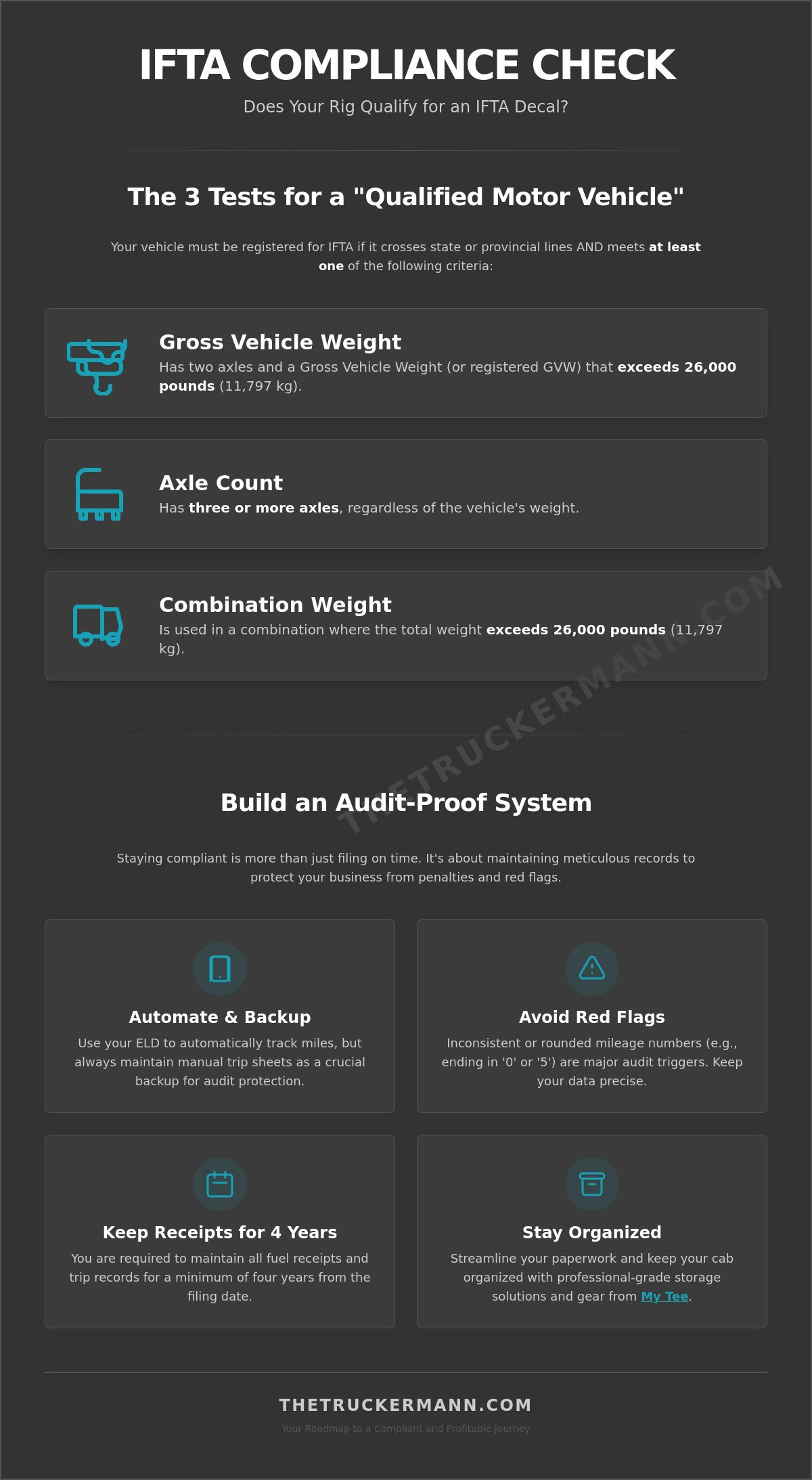
The magic number in our world is 26,000 pounds. If your truck has two axles and a gross vehicle weight or registered gross vehicle weight exceeding that mark, you’re in. The rules get a bit more inclusive when we talk about axles. If your rig has three or more axles, it doesn’t matter what the scale says; you are a qualified vehicle. Many new owner-operators get tripped up by the combination rule. If you’re running a smaller unit but your total combination weight, truck and trailer together, clears 26,000 pounds, you’re officially on the hook for IFTA reporting.
Defining the “Qualified Motor Vehicle”
The operative word here is Interstate. You only need to worry about these requirements if you are crossing state lines or moving between the U.S. and Canada. If you are strictly hauling within your home state, you are likely operating under intrastate rules. If you’re still weighing your options on which route to take, check out the Interstate vs. Intrastate Guide for a deeper look at your career path. For those crossing borders, these three criteria are your North Star:
- Two axles and a GVW or Registered GVW over 26,000 lbs.
- Three or more axles, regardless of the vehicle’s weight.
- A combination weight that exceeds 26,000 lbs.
The Decal and License: Your Legal Shield
Once you’re registered, you’ll receive two decals and a license. You must display one decal on each side of the cab in a visible spot. If you lose a decal mid-route or it gets damaged by road debris, don’t panic. You can usually apply for a temporary trip permit to keep you legal until a replacement arrives. Always keep a copy of your IFTA license in the cab. While many jurisdictions now accept digital copies on a tablet or phone, having a physical backup in a clear organizer from My Tee ensures you’re never at the mercy of a dead battery during an inspection. Being prepared is half the battle. If you want to master the rest of your compliance game, stay updated with the latest field advice at The Truckermann.
Data Collection: Mastering the Paperwork Trail
Let’s be real. Nobody gets into trucking because they love filing receipts. But behind that wheel, your best friend isn’t just a reliable engine; it’s a clean record-keeping system that doesn’t leave you guessing at tax time. If you want to survive an audit, you need a system that captures every mile and every drop of fuel without fail. This ifta fuel tax reporting guide wouldn’t be complete without addressing the messy cab reality that most corporate guides ignore. You’re out there in the elements, and your paperwork needs to be as tough as your rig.
ELD Data vs. Manual Trip Sheets
The Truckermann method relies on using your ELD to automate the heavy lifting, but don’t trust the machine blindly. ELDs are great for tracking movement, but GPS glitches happen. You should cross-check your ELD miles against your physical odometer readings at the start and end of every trip to ensure 100% accuracy. While the digital trail is fast, paper trip sheets remain the gold standard for audit backup because they show the intent and the route in a way a glitchy screen might not. Keeping these documents organized is vital. Take a look at The Best Flatbed Trucking Gear for high-quality logbook organizers that can take a beating on the road.
The “Receipt Ritual” for Long-Haul Drivers
We’ve all seen it: a fuel receipt that’s sat on the dash for three days and turned into a blank piece of white paper. That’s the faded thermal paper trap, and it’s an auditor’s favorite way to disqualify your tax-paid gallons. You need a daily receipt ritual. Before you even pull out of the station, use a mobile app to scan that slip. Every valid receipt must clearly show the date, the number of gallons, the fuel type, and the price per gallon. If it’s missing one of those details, the tax man won’t count it.
To keep your physical copies safe from the sun and spills, invest in durable cab storage solutions from Mytee Products. A dedicated file for your My Tee gear and your paperwork ensures that when you’re facing an inspection, you’re holding all the cards. Remember that regulations require you to maintain these records for four years. That is a long time for a slip of paper to survive, so a digital backup isn’t just a convenience; it’s a necessity for protecting your livelihood and your hard-earned cash.
How to Calculate and File Your IFTA Return
Don’t let the math scare you off. Calculating your return is just a matter of following the ifta fuel tax reporting guide steps until the rhythm becomes second nature. It’s like checking your securement with My Tee gear; you do it the same way every time to make sure nothing slips. Your Average Fuel Consumption, or MPG, is the heartbeat of this whole operation. If that number is off, the rest of your filing is built on sand. You need to understand the difference between total miles and taxable miles to keep your bottom line healthy. Total miles include every inch the tires rotated, while taxable miles are specifically those driven on public roads within IFTA jurisdictions.
The 4-Step IFTA Math Breakdown
To keep your records audit-proof, follow this sequence for every quarter. Accuracy here prevents the DOT from digging deeper into your business than they need to. Here is how you true up the numbers:
- Step 1: Calculate your Total Miles Driven and Total Fuel Purchased across all jurisdictions. This is your foundation.
- Step 2: Determine your fleet-wide Average MPG. Divide your total miles by your total gallons. For example, if you ran 25,000 miles on 4,000 gallons, your MPG is 6.25.
- Step 3: Calculate Taxable Gallons per jurisdiction. Take the miles driven in a specific state, like Illinois, and divide them by your Average MPG.
- Step 4: Subtract Tax-Paid Gallons from Taxable Gallons. This gives you the “Net Taxable Gallons.” If the number is positive, you owe tax; if it’s negative, you’ve got a credit coming your way.
2026 Filing Deadlines: Mark Your Calendar
Missing a deadline is an unforced error that costs you $50 or 10% of the tax due. That is money that should be staying in your truck. For the 2026 calendar year, these are the dates you cannot afford to miss:
- Q1 (Jan-Mar): Due April 30, 2026.
- Q2 (Apr-Jun): Due July 31, 2026.
- Q3 (Jul-Sep): Due October 31, 2026.
- Q4 (Oct-Dec): Due January 31, 2027.
The Truckermann rule is simple: file at least 10 days early. State portals are notorious for crashing on the 30th or 31st when everyone else is trying to squeeze through the digital door. Filing early saves you the stress and the late fees. Most jurisdictions now require you to file electronically through their specific online portal. This ifta fuel tax reporting guide is designed to get you to that portal with clean data and a clear head. If you’re ready to take the next step in professionalizing your operation, master your quarterly filings by setting up a dedicated compliance calendar today.
Audit-Proofing Your Business: Expert Strategy
The road runs through us, driver, but the audit trail stops with you. You’ve done the hard work of hauling the freight and crunching the numbers, but the final step in this ifta fuel tax reporting guide is making sure your business is bulletproof against regulatory overreach. An audit isn’t just a possibility; it’s a reality of the profession that you need to be ready for at any moment. Being prepared is the difference between a quick, professional handshake and a financial disaster that pulls you off the road. You must keep every scrap of evidence, from your GPS logs to those scanned fuel receipts, for at least four years. That is the industry standard that keeps the sentinel off your back and your license in your pocket.
Common Audit Triggers to Avoid
Auditors have a specialized nose for shortcuts and laziness. One of the biggest red flags in any filing is a report full of perfectly round numbers. If every trip you log ends in a zero or a five, it tells the state you’re estimating rather than recording actual odometer readings. Real miles are messy and precise. Another trigger is the “teleporting” truck. This happens when your log shows you ending a haul in Pennsylvania and starting the next in Illinois without any miles recorded for the transit in between. These mileage gaps are an open invitation for an auditor to dig deeper into your records. Inconsistent MPG readings across quarters also draw unnecessary heat. If your rig usually pulls 6.5 MPG but suddenly drops to 4.8 without a clear reason, it looks suspicious. Keeping your truck in peak condition with reliable gear from My Tee helps keep those readings consistent and your business safe.
Leveraging Modern Tools
Taking the grit out of the grind means using technology to your advantage rather than fighting against it. Specialized IFTA automation apps can handle the tracking that used to take hours of manual entry and a bottle of aspirin. These tools cross-check your data in real-time, flagging gaps or math errors before you ever hit the submit button. For the physical side of compliance, keeping your sensors and odometer accurate is non-negotiable. I recommend following the CDL Pre Trip Inspection Master Guide to ensure your rig is always communicating the right data to your ELD. If you need replacement parts or maintenance supplies to keep your fuel efficiency high, head over to Truck n Tow for professional-grade tools. When your equipment is solid and your data is clean, you can roll with confidence. A professional driver uses every tool available, from high-quality My Tee equipment to the latest ifta fuel tax reporting guide, to master the industry and protect their future.
Keep Your Rig Rolling and Your Records Clean
You’ve got the roadmap now, driver. Staying compliant isn’t just about avoiding a $50 fine or a 10% penalty; it’s about protecting the business you’ve worked so hard to build. This ifta fuel tax reporting guide was written by a professional who’s been in the cab and knows that your time is better spent on the asphalt than on a calculator. By following these 2026 regulatory standards and keeping your records tight, you’re building a wall of real-world audit protection around your livelihood. Whether you’re hauling through high-tax states or staying local, your attention to detail separates the veterans from the rookies. Don’t let disorganized paperwork be the thing that pulls you off the road. Keep your rig compliant and your gear ready, and make sure your equipment from My Tee is always in top shape. To stay ahead of the curve, keep your rig compliant and your gear ready by checking out our top securement picks at The Truckermann. Keep those wheels turning and stay safe out there.
Frequently Asked Questions
What happens if I forget to file my IFTA report on time?
You’ll face a penalty of $50 or 10% of your net tax liability, whichever is greater, for missing the deadline. Interest also starts accruing on all late tax payments immediately. This ifta fuel tax reporting guide recommends filing at least 10 days before the quarterly deadline to avoid portal crashes and these avoidable financial hits.
Can I use IFTA to get a refund on fuel tax?
Yes, you can receive a credit or refund if your tax-paid gallons exceed your taxable gallons for the quarter. This often happens when you purchase a large amount of fuel in a high-tax jurisdiction but do most of your actual driving in states with lower rates. The credit is usually applied to your next return, but you can request a check from your base jurisdiction.
Do I need IFTA if I only drive in one state but have a DOT number?
No, you don’t need an IFTA license if your operations are strictly intrastate. Even if you have a DOT number for other compliance reasons, IFTA only applies if you cross state lines or provincial borders. If you never leave your home state, you operate under that state’s specific fuel tax rules rather than the international agreement.
How long do I need to keep my fuel receipts for IFTA?
You are legally required to maintain all fuel receipts and mileage records for a minimum of four years. Since thermal paper receipts often fade to nothing in a warm cab, it’s a veteran move to scan them daily. Keeping these digital records alongside your physical gear from My Tee ensures you’re always ready for an auditor’s knock.
What are “non-taxable miles” and how do they affect my reporting?
Non-taxable miles are distances driven on private property, farms, or off-highway locations that aren’t subject to standard fuel taxes. By accurately tracking these miles, you can reduce your total taxable miles, which lowers the amount of tax you owe. This ifta fuel tax reporting guide highlights that proper documentation of these miles is essential to defend the deduction during an audit.
Is there a penalty for displaying an expired IFTA decal?
Displaying an expired decal is a violation that can result in citations, fines, and increased scrutiny from roadside inspectors. It acts as a visible red flag that tells the DOT your paperwork might be out of date. Always ensure your new decals are applied to both sides of the cab before the first quarter deadline of the new year.
Can I file IFTA for a leased vehicle?
Whether you or the carrier files depends entirely on the language in your lease agreement. Usually, the party that maintains the DOT registration and provides the decals is responsible for the reporting. If you’re an owner-operator leased to a carrier, check your contract to confirm who is handling the quarterly math and payments.
What is the “Average MPG” and why is it so important?
Average MPG is the total miles driven divided by the total fuel purchased across all jurisdictions during the quarter. It’s the heartbeat of your filing because it determines how many gallons you “should” have paid tax on in each state you entered. If your MPG is calculated incorrectly, every other number in your report will be wrong, which often triggers a deeper look from auditors.
Disclaimer
The information provided on The TruckerMann is for general informational and educational purposes only. While every effort is made to ensure the accuracy and reliability of the content, trucking laws, FMCSA regulations, DOT requirements, safety standards, and industry policies can change at any time. Readers are encouraged to verify all information with official government agencies, professional advisors, or qualified industry professionals before making business, legal, financial, safety, or compliance-related decisions.
The content shared on this website reflects personal opinions, experiences, research, and commentary and should not be considered legal, financial, medical, tax, or professional advice. The TruckerMann and its owners, contributors, affiliates, or representatives are not responsible for any losses, damages, violations, penalties, or liabilities resulting from the use or misuse of information found on this website.
Some content on this website may contain affiliate links, sponsored content, or promotional material. This means we may earn a commission at no additional cost to you if you choose to purchase through certain links.
By using this website, you agree that you do so at your own discretion and risk.