You’re 20 miles from a safe haven, the sun is dipping below the horizon, and your HOS clock just hit zero. It’s a situation that turns a profitable run into a high-stakes gamble with your CDL, especially with enforcement officers now authorized to pull you out of service for ELD discrepancies. We’ve all been there, staring at a “No Parking” sign while worrying about the next IFTA filing or the rising $5.35 national average for diesel. Using a solid truck trip planning worksheet is the difference between a stressful week of firefighting and a smooth, profitable journey through the lower 48.
It’s true that the road is more volatile than ever in 2026, but you don’t have to be at the mercy of the next unexpected closure or a sudden regulatory shift. This guide will show you how to build a tactical worksheet that acts as your mission-plan for every single load you haul. We’ll walk through a repeatable system to maximize your take-home pay, ensure you’re ready for the May 12-14 CVSA Roadcheck, and keep your operation running like a well-oiled machine. By the time you finish reading, you’ll have the tools to stay ahead of the clock and turn every mile into a calculated win for your business.
Key Takeaways
- Move beyond reactive logging by treating your trip planning as a proactive tactical mission that keeps you safe from bridge strikes and HOS traps.
- Design a high-efficiency truck trip planning worksheet featuring critical data points like low-tax fuel strategy and verified safe haven stops.
- Protect your profit by integrating 2026 regulatory updates and weather-contingency plans directly into your daily routing.
- Implement a repeatable 5-step system to manage every load from the moment you sign the rate confirmation until you pull the brakes at the receiver.
- Identify the professional-grade gear and organizational tools needed to keep your documentation secure and ready for a stress-free DOT inspection.
Why Every Professional Driver Needs a Truck Trip Planning Worksheet in 2026
In the cab of a truck, your perspective determines your profit. Many drivers treat their daily routine as a series of reactions to whatever the road throws at them. They wait for the GPS to bark a command or for the ELD to start flashing red before they think about their next move. But a professional doesn’t leave their livelihood to chance. A tactical truck trip planning worksheet isn’t just a piece of paper; it’s your offensive strategy. It shifts you from being a passenger in your own career to being a logistics manager who controls the clock.
Relying solely on a consumer-grade GPS is a recipe for disaster. We’ve seen too many bridge-strikes and lost hours because a driver followed a screen into a tight corner or a restricted route. Real-world freight transport requires human intuition backed by hard data. Spend 15 minutes with your worksheet before you ever turn the key. Those few minutes can save you two hours of circling a crowded truck stop at 11 PM, desperately hunting for a legal parking spot.
To better understand this concept, watch this helpful video:
The Truckermann knows that the difference between a seasoned veteran and a mere steering-wheel holder is preparedness. With diesel prices averaging $5.35 per gallon in June 2026, every mile counts. If you aren’t planning your route, you’re burning money. A worksheet keeps you ahead of the game, ensuring you’re the one making the decisions, not the traffic or the dispatcher.
The Difference Between a Logbook and a Trip Plan
Your logbook is a history lesson. It tells the DOT where you’ve been and what you’ve already done. While your ELD is great for compliance, it’s a reactive tool. It won’t tell you that there’s a major road closure 300 miles ahead or that your receiver is known for four-hour wait times. A truck trip planning worksheet dictates what will happen. It allows you to visualize your entire day, from the pre-trip inspection to the final shutdown. By mapping out your hours of service (HOS) against your route, you prevent violations before they even have a chance to start.
Protecting Your CDL and Your Profit
Your CDL is your ticket to a paycheck, and it’s under constant scrutiny. During the 2026 CVSA International Roadcheck from May 12-14, inspectors will be laser-focused on cargo securement and ELD tampering. Using high-quality gear from My Tee Products for your load is only half the battle. You need a plan that keeps you out of high-enforcement hot zones when your clock is tight. A solid worksheet also helps you fight for detention pay. When you have a documented plan showing your arrival and the broker’s requirements, you have the leverage needed to get paid for your time. This level of detail is vital, especially when reviewing your DOT inspection level 1 checklist to ensure every “i” is dotted and “t” is crossed.
The Anatomy of a High-Efficiency Trip Sheet
A generic logbook template from a truck stop shelf isn’t going to cut it in today’s market. To truly master your route, your truck trip planning worksheet needs to account for the physical and financial realities of the 2026 road. It isn’t just about where you’re going; it’s about how you’re getting there without bleeding cash. A professional-grade sheet includes specific blocks for IFTA optimization, safe haven parking, and equipment checks. If you’re hauling flatbed loads, you should also have a dedicated section for securement notes. When you’re using heavy-duty straps or tarps from My Tee Products, documenting your tension check intervals can be the difference between a clean inspection and a costly load shift violation.
Fuel is your biggest variable cost, and with national diesel prices remaining high, you can’t afford to wing it. Your worksheet must include a Fuel Stop Strategy that targets low-tax states. For instance, California’s tax rate sits at a staggering $0.971 per gallon, while Oklahoma and Texas remain near $0.20. Planning your burn so you top off in those low-tax jurisdictions keeps your weekly take-home pay where it belongs. Don’t just plan for your primary stop, either. Every day on your truck trip planning worksheet needs three Safe Haven options. Identify two alternates in case your first choice is full or blocked by an accident. This level of preparedness keeps you legal and relaxed when the sun starts to go down.
Essential Route Details
Your route plan should list every origin, destination, and major interchange. But the real value lies in marking critical points along the way. Critical points are specific locations where time-sensitive decisions must be made, such as choosing between a city bypass or a direct route based on real-time traffic flow. Always include alerts for low-clearance bridges and weight-restricted roads. If you’re looking for a better way to find high-paying freight to fill those routes, you should use 123Loadboard to access real-time market data and freight lanes.
The Time & HOS Management Block
The 14-hour clock is a relentless master. Your worksheet should track on-duty not driving time with extreme precision. If a shipper takes three hours to load, your entire day has shifted, and your worksheet needs to reflect that change immediately. Calculate your 10-hour reset window before you even perform your pre-trip inspection. Always bake in a 1-hour everything went wrong buffer for each day. This buffer accounts for unexpected road closures or flat tires, ensuring you don’t run out of hours 20 miles from your destination.
Factoring in the ‘Profit Killers’: Weather, Traffic, and Compliance
Traffic and weather aren’t just small talk at the fuel island. They’re the silent thieves that steal your clock and your cash. If you aren’t writing down real-time weather alerts and traffic patterns on your truck trip planning worksheet, you’re driving blind. A 20-minute delay in a high-traffic corridor like Atlanta or Chicago can snowball into a missed delivery window, especially with the tightening capacity we’ve seen in the first half of 2026. Your worksheet should have a dedicated “Conditions” block where you note expected wind speeds and precipitation levels before you ever pull the brakes.
In 2026, the regulatory environment has become significantly more aggressive. As of February 7, 2026, enforcement officers have the authority to place you out of service immediately if your device is on the FMCSA’s revoked list. This makes your eld status a top priority on your planning sheet. Beyond the electronics, having the right flatbed trucking gear ready for immediate use is essential. When the sky turns gray, you don’t want to be second-guessing your equipment. A professional driver knows that 15 minutes spent checking securement is cheaper than a cargo claim or a “Nuclear” verdict in a lawsuit.
Weather and Terrain Adjustments
Mountain passes require more than just a lower gear. You need to factor in chain laws and significantly slower ascent speeds. Your truck trip planning worksheet should account for the extra time needed when climbing heavy. Wind is another variable that often goes ignored. High crosswinds can kill your fuel mileage and threaten the safety of light loads. Using high-quality tarps from My Tee Products ensures your cargo stays bone-dry and secure during extreme precipitation. When the weather turns, the durability of your My Tee Products gear provides the peace of mind you need to focus on the road ahead.
DOT Enforcement and Roadside Readiness
Mark every known weigh station on your route. This isn’t about avoiding them; it’s about being ready for them. Use your worksheet to ensure your paperwork is organized and your logs are perfectly synced before you hit the scale. The 2026 CVSA International Roadcheck, scheduled for May 12-14, will focus heavily on cargo securement and false records of duty status. Showing an officer a detailed, handwritten trip plan gives you a massive psychological advantage. It proves you’re a professional who values transparency and preparedness. It tells the inspector that you aren’t just a steering-wheel holder, but a veteran who understands the weight of the job.
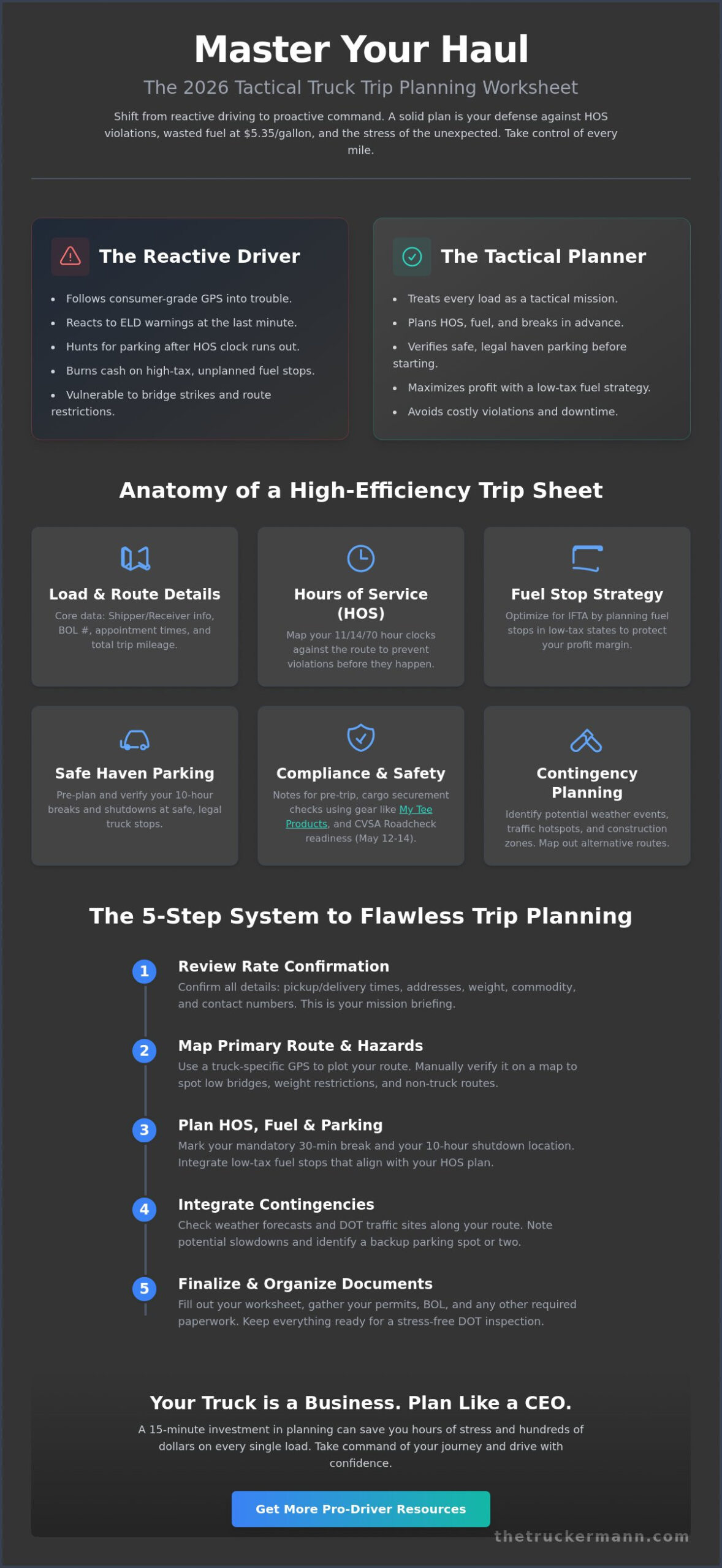
How to Complete Your Trip Planning Worksheet in 5 Steps
Mastering your truck trip planning worksheet isn’t about filling in boxes to satisfy a dispatcher; it’s about building a mental map of your success. This 5-step workflow takes you from the initial rate confirmation to the moment you set the air brakes at the receiver. Professionals don’t just hope things go right. They use a systematic approach to ensure every mile is accounted for and every dollar is protected. If you treat your paperwork with the same respect as your rig, you’ll find that the road becomes a lot less unpredictable.
Step 1 & 2: The Strategic Foundation
Your journey begins the moment that Rate Confirmation hits your inbox. You have to gut that document for the real story, identifying “Hard” deadlines like strict 8 AM appointment times versus “Soft” windows where the facility is first-come, first-served. Once you’ve established your timing, map out your primary route and always write down a “Plan B” alternate. The first 100 miles of a trip are the most critical for your schedule because they establish your momentum and dictate whether you’ll clear the first major traffic bottleneck before the morning rush ruins your clock. Having that secondary route ready means a sudden closure on the I-95 won’t send your profit up in smoke.
Step 3 & 4: The Math of the Road
Next, you need to dive into the numbers that actually move the needle. Calculate the “sweet spot” where your MPG and the $5.35 average diesel price balance out. This means looking beyond the pump price and factoring in IFTA tax rates. For example, California’s $0.971 per gallon tax can bite you if you don’t plan to fuel up in a lower-tax state like Texas or Oklahoma, where rates hover near $0.20. While you’re crunching these numbers, use 123Loadboard to scout for your next backhaul. Finding your next load while you’re still under the current one is the only way to keep your deadhead miles low and your revenue high. Match these stops to your HOS availability, ensuring you align your body’s natural rhythm to the clock to stay sharp and safe.
Step 5: The Final Review
The final step happens on the catwalk during your pre-trip. As you move through your cdl pre trip inspection checklist, give your truck trip planning worksheet one last look. Ensure your cargo securement plan, especially if you’re using heavy-duty tarps and straps from My Tee Products, is fully reflected in your time estimates for the day. This final check ensures your physical equipment and your tactical plan are in perfect sync before you roll. If you’re ready to master the business side of the cab, enroll in professional driver training at DLA Academy to sharpen your logistics skills and maximize your take-home pay.
Essential Gear and Tools to Support Your Flight Plan
A tactical truck trip planning worksheet is only as good as the tools you use to execute it. You can have the most precise route and fuel strategy on paper, but if your load shifts or your digital tools fail, that plan becomes worthless. Bridging the gap between your mental preparation and your physical equipment is what separates the professionals from the amateurs. You need a dedicated organization system, like a heavy-duty aluminum clipboard or a weather-resistant binder, to keep your documents within reach. When you’re facing a roadside inspection during the May 2026 CVSA Roadcheck, having your worksheet and permits organized shows the officer you’re a veteran who values preparedness. This professional image starts with having the right securement gear from My Tee Products to ensure your cargo stays exactly where you put it.
Digital Tools for Modern Planning
In 2026, the best planners use a hybrid approach. Your manual worksheet acts as your primary mission control, but it needs to stay in sync with your tech. Use 123Loadboard to visualize freight lanes and identify the most profitable backhauls before you even leave the shipper’s dock. This allows you to plan multi-stop trips on your sheet with confidence. While your ELD tracks the past, digital tools like 123Loadboard help you secure the future. Combine this with real-time parking apps to verify the “Safe Haven” spots you identified during your morning coffee. This synergy ensures you aren’t just reacting to the road, but actively mastering it.
Physical Gear for the Long Haul
Every stop you make to re-tighten a loose strap is a hit to your HOS clock and your bottom line. Using premium securement tools from My Tee Products significantly reduces these “nuisance stops” because the equipment is built to handle the grit of the field. The Truckermann gear bag always includes high-quality ratchets, edge protectors, and durable tarps from My Tee Products. These items stay in the cab or the side box, ready for immediate deployment when the weather turns or the load requires extra attention.
Your truck trip planning worksheet is your shield against the volatility of the industry. It protects your profit from $5.35 diesel and protects your CDL from aggressive enforcement. Remember, the road is a workplace that demands respect and transparency. By staying observant and keeping your equipment in top shape, you aren’t just surviving the 2026 market; you’re thriving in it. Stay vigilant, keep your paperwork tight, and stay safe out there.
Take Command of Your Miles
Your truck is more than just a rig; it’s a mobile business that requires a tactical offensive strategy to stay profitable. We’ve explored how a professional truck trip planning worksheet allows you to outmaneuver the profit killers of 2026, from volatile fuel costs to tightening DOT enforcement. By mapping your Safe Havens and ensuring your cargo is locked down with gear from My Tee Products, you’re turning every mile into a calculated victory. This level of preparedness is what separates the veterans from those who are just along for the ride.
Success on the road requires the right data at the right time. You can start planning your next high-profit load with 123Loadboard, a platform used by thousands of professional owner-operators. It’s integrated with the latest 2026 freight market data and is endorsed by The Truckermann for its commitment to veteran-level preparedness. When you combine a solid plan with the best digital tools, you aren’t just surviving the industry; you’re owning it. Master your route with The Truckermann and keep your profit margins wide. Stay safe out there.
Frequently Asked Questions
What is the most important field on a truck trip planning worksheet?
The “Safe Haven” parking section is arguably the most critical field on your trip sheet. Identifying three potential parking spots for each day ensures you aren’t forced to violate HOS rules or park on a dangerous shoulder when truck stops are full. This proactive step protects your CDL and prevents the stress of hunting for a spot when your 14-hour clock is winding down.
Can I use a digital spreadsheet instead of a paper trip sheet?
You can certainly use a digital spreadsheet, but many veterans prefer a paper truck trip planning worksheet as a reliable backup. Digital tools are excellent for calculations, but tablets can die or glitch during a roadside inspection. A physical sheet on your clipboard is always ready for an officer and provides a tactile way to track your progress without relying on battery life or a cellular signal.
How do I calculate fuel stops for maximum IFTA savings?
To maximize IFTA savings, you must calculate your fuel stops based on the “net” price after tax rather than just the pump price. In Q2 2026, California’s tax rate is $0.971 per gallon, but Oklahoma and Texas remain near $0.20. Planning your route to top off in these low-tax jurisdictions keeps more profit in your pocket by reducing the quarterly tax bill you’ll owe during the next filing deadline.
Should I include my personal expenses on my trucking trip sheet?
You shouldn’t include personal expenses on your tactical trip sheet. Your worksheet is a professional tool for logistics and DOT compliance, whereas personal spending belongs in your accounting software or a separate ledger. Mixing the two can clutter your plan and make it harder to provide clear documentation if an enforcement officer asks to see your route planning during an inspection.
How often should I update my trip plan during a long-haul run?
You should update your trip plan at every fuel stop, rest break, or change in weather conditions. The road is volatile, and a single traffic jam in a corridor like Atlanta can ruin your original timeline. By adjusting your worksheet throughout the day, you stay ahead of the clock and can communicate accurate arrival times to brokers or shippers before a delay becomes a major problem.
What happens if I deviate from my planned route on the worksheet?
Deviating from your planned route isn’t a legal violation, but it requires an immediate adjustment to your HOS and fuel strategy. If a road closure forces you onto a secondary path, note the change on your worksheet to track the impact on your mileage and ETA. This is also a good time to check your load securement and My Tee Products tarps to ensure nothing shifted during the detour.
Is a trip planning worksheet required by the DOT?
A truck trip planning worksheet is not legally required by the DOT, but it is a professional best practice that can save your career. While the law only mandates that you keep accurate logs, having a detailed plan shows inspectors that you are a prepared professional. This often leads to smoother inspections because it demonstrates that you aren’t just guessing your way across the country.
How do I plan for parking when truck stops are full?
When primary truck stops are full, you must rely on the “Safe Haven” alternates you identified during your morning planning. This might include industrial parks with street parking or smaller independent stops away from the main interstate. Planning these locations ahead of time prevents the panic of hitting a “Full” sign at 11 PM when your ELD is about to put you out of service.
Disclaimer
The information provided on The TruckerMann is for general informational and educational purposes only. While every effort is made to ensure the accuracy and reliability of the content, trucking laws, FMCSA regulations, DOT requirements, safety standards, and industry policies can change at any time. Readers are encouraged to verify all information with official government agencies, professional advisors, or qualified industry professionals before making business, legal, financial, safety, or compliance-related decisions.
The content shared on this website reflects personal opinions, experiences, research, and commentary and should not be considered legal, financial, medical, tax, or professional advice. The TruckerMann and its owners, contributors, affiliates, or representatives are not responsible for any losses, damages, violations, penalties, or liabilities resulting from the use or misuse of information found on this website.
Some content on this website may contain affiliate links, sponsored content, or promotional material. This means we may earn a commission at no additional cost to you if you choose to purchase through certain links.
By using this website, you agree that you do so at your own discretion and risk.