Hello, road warriors. In 2026, the difference between a profitable year and just “getting by” isn’t found in your gross pay, but in how much of it the IRS actually gets to touch. We all know the sting of a high cost of living while living out of a cab, especially when complex tax jargon makes you feel like you’re driving blind. Mastery of understanding per diem for truck drivers 2026 is no longer just a “nice to have” bit of knowledge; it’s a survival strategy for your wallet. Whether you’re an owner-operator or a company driver, the rules have shifted, and leaving money on the table is the same as burning fuel in an empty trailer.
You deserve to keep every cent you’ve earned across those long stretches of asphalt. This guide will show you exactly how to navigate the 2026 IRS per diem rules, including the verified $80 daily allowance for the continental U.S., so you can lower your taxable income without the fear of an audit. We’ll explore the potential return of unreimbursed expense deductions for W-2 drivers and show you how to streamline your logs with My Tee. From partial day calculations to incidental expenses, we’re covering the essential updates you need to protect your livelihood and maximize your take-home pay this year.
Key Takeaways
- Learn why the 2026 CONUS rate of $80 per day is your most powerful tool for shielding your hard-earned settlement from the IRS.
- Discover the critical differences in how owner-operators and company drivers claim expenses to ensure you aren’t leaving money on the table.
- Clarify the IRS “Tax Home” and “Overnight” requirements to keep your record-keeping bulletproof against potential audits.
- Master understanding per diem for truck drivers 2026 to transform your daily allowance into a strategic profit center for your business.
- Explore practical cab-ready meal prep strategies and tracking tools like My Tee to maximize your daily savings while OTR.
What is Per Diem and Why Does it Matter in 2026?
Listen up, road warriors. The logistics landscape in 2026 is shifting fast, and if you aren’t watching your margins, you’re essentially driving for free. We’ve seen freight rates fluctuate and fuel costs bite into settlements; that’s why understanding per diem for truck drivers 2026 has become a vital survival skill. At its core, per diem is a daily allowance designed to cover your meals and incidental expenses while you’re away from home. If you’re looking at the technical side of What is Per Diem, it’s a Latin phrase meaning “for each day,” but for us, it’s the difference between a fat bank account and a lean one.
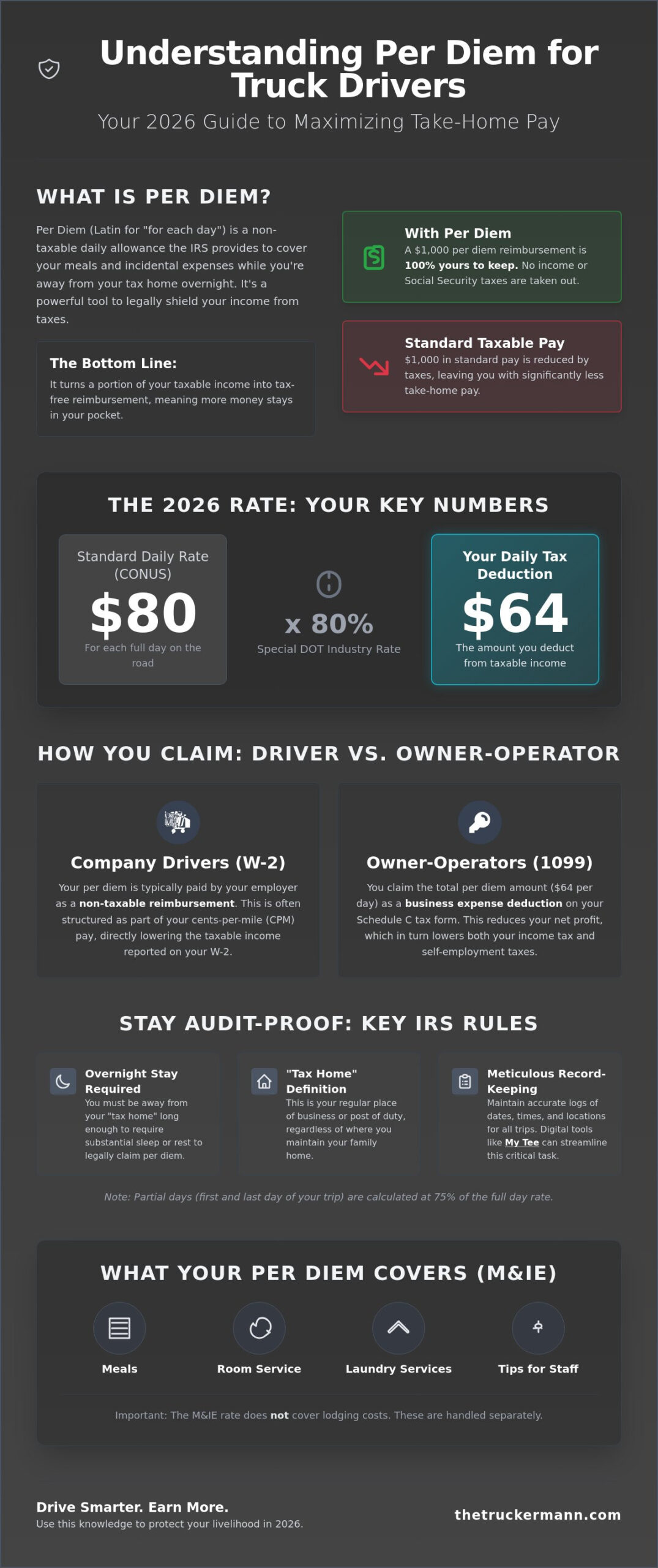
The IRS recognizes that living on the road is expensive. Instead of making you track every single receipt for a burger or a cup of coffee, they allow a flat daily rate. In 2026, that standard rate for the continental U.S. is a solid $80 per day. This money isn’t just a “bonus” from your carrier or a tax credit; it’s a non-taxable reimbursement. That means Uncle Sam doesn’t get to take a bite out of it for federal income tax or Social Security. By moving a portion of your pay into the per diem category, you’re effectively shielding your hard-earned miles from the tax man’s reach.
To better understand this concept, watch this helpful video:
The Difference Between Taxable Pay and Reimbursements
Think about your paycheck for a second. If you earn $1,000 in standard salary, you might only see $750 or $800 after taxes are stripped away. However, if that same $1,000 is classified as per diem reimbursement, you keep the full $1,000. It’s pure math. For company drivers, this often looks like a split in your cents-per-mile rate. For owner-operators, it’s a massive deduction on your Schedule C that lowers your self-employment tax. Per diem is the trucker’s most potent tool for tax shielding in 2026. Whether you’re filing a W-2 or managing 1099 income, maximizing this non-taxable portion ensures your gross earnings actually stay in your pocket rather than funding federal projects you’ll never see.
Incidental Expenses: What Is Actually Included?
Don’t make the mistake of thinking per diem only covers your dinner. The “incidental” part of the meal and incidental expenses (M&IE) rate covers the small stuff that adds up over a three-week haul. We’re talking about tips for porters, laundry at the truck stop, and those small personal supplies you pick up to keep the cab livable. It’s important to remember that lodging is generally not included in this specific $80 rate; that’s handled separately. Even if you’re a minimalist who doesn’t spend much, these incidentals aren’t optional when you’re living a thousand miles from your own bed. Using high-quality gear from My Tee can help you stay organized and cut down on these daily costs, allowing you to pocket even more of that tax-free allowance. When you’re understanding per diem for truck drivers 2026, you realize that every dollar you don’t spend on the road is a dollar you’ve effectively “earned” tax-free.
Breaking Down the 2026 IRS Per Diem Rates and the 80% Rule
Let’s talk brass tacks. For 2026, the IRS has confirmed that the special per diem rate for the transportation industry is $80 per day for travel within the continental United States. This isn’t just a suggestion; it’s a hard number you can use to protect your income. Understanding per diem for truck drivers 2026 starts with realizing that while most white-collar workers only get to deduct 50% of their meal costs, we get a much better deal. Because you’re subject to Department of Transportation (DOT) Hours of Service (HOS) regulations, you’re entitled to the “80% Rule.” This recognition of the unique hardships of the road is one of the few times the tax code actually works in your favor.
The calculation is straightforward. You take that $80 daily rate and multiply it by 0.80. That leaves you with a $64 deduction for every full 24-hour period you’re out on the road. When you’re looking at your year-end numbers, those $64 chunks add up to a massive shield against your taxable income. You can find the full details in the IRS Per Diem Rates and the 80% Rule documentation, which serves as the ultimate rulebook for our trade. It’s a heavy read, but it’s the foundation for keeping more of your hard-earned settlement.
The Special Transportation Industry Rate
The IRS gives us this “special” rate because they know the reality of the road. Keeping a shoebox full of fading fast-food receipts is a nightmare no driver has time for. By using the Standard Meal Allowance (SMA), you bypass the need to prove exactly what you spent on every burger or coffee. You just need to prove you were there. It’s about simplifying your life so you can focus on the next load. Whether you’re hauling flatbed gear from My Tee or pulling a reefer, this rate is your best defense against overpaying on taxes. It turns your tax filing from a scavenger hunt into a simple math problem.
Partial Days and the “Quarter” System
You don’t always start or end your trip at midnight. The IRS accounts for this with the 75% rule. On the day you leave your tax home and the day you return, you can only claim 75% of the standard rate. For 2026, that means your starting and ending days are valued at $60. You then apply the 80% deduction to that $60, resulting in a $48 deduction for those partial days. It might seem like a small detail, but getting this wrong is a red flag for auditors. Your ELD is your best friend when the IRS comes knocking for proof of travel; it provides the timestamped evidence of where you were and for how long. It’s the digital paper trail that keeps your deductions safe.
If you want to stay ahead of these regulatory shifts and keep your business running lean, check out more tips for maximizing your per diem profit.
Company Drivers vs. Owner-Operators: Impact on Your Paycheck
Whether you’re a company hand or an owner-operator, the way that per diem hits your pocket depends entirely on the seat you’re in. Understanding per diem for truck drivers 2026 requires a clear-eyed look at how carriers and the IRS view your earnings. It isn’t just about the total amount; it’s about the category that money falls into before the government takes its cut. Your classification determines whether you see that money every week or wait for a big deduction at tax time.
The Company Driver’s “Non-Taxed” Boost
For many W-2 drivers, per diem is handled through a cents-per-mile (CPM) split. Imagine you’re earning $0.60 per mile. Your carrier might structure this as $0.50 in taxable wages and $0.10 as a non-taxable per diem reimbursement. On a 2,500-mile week, that’s $250 coming to you without a single cent of tax withheld. You see that boost immediately in your weekly settlement. However, keep a sharp eye on your pay stubs. Some carriers try to skim off the top by charging an “administrative fee” to manage the program. Don’t let them charge you for the privilege of receiving your own tax-free money. You can check the official 2026 Per Diem Rates to ensure your company’s plan aligns with the current standards for the continental U.S.
Owner-Operator Strategy for 2026
If you’re running your own authority or leased on as a 1099, per diem works differently. You don’t get a split; you claim the deduction on your Schedule C at year-end. This lowers your self-employment tax significantly. In 2026, you can claim 80% of the daily rate, which works out to the $64 limit we discussed earlier. To keep the IRS off your back, you must separate personal meals at home from business travel. Maintaining a professional image helps. Having the best flatbed trucking gear from a reliable supplier like My Tee proves you’re an active, professional hauler. Using high-quality tarps and straps from My Tee shows you’re running a legitimate business, not just taking a tax-deductible road trip.
There is a trade-off to consider: the “Social Security Trap.” Because per diem isn’t taxable, it doesn’t count toward your Social Security earnings base. Lower taxable income today could mean smaller benefit checks when you finally hang up the keys. This is why some veterans prefer “straight pay.” They want the higher gross income to qualify for home mortgages or car loans, as banks often ignore the per diem portion of your check. It’s a balancing act between cash in hand now and your long-term financial footprint.
Navigating the Tax Home Requirement and Record-Keeping
Don’t fall into the common trap of thinking your family residence is automatically your tax home. This is the single biggest mistake that leads to “failed” audits for OTR professionals. In the eyes of the IRS, your tax home is your primary place of business, which is usually the terminal or dispatch center where you receive your assignments. Understanding per diem for truck drivers 2026 requires you to be honest about where your business actually lives. If you can’t prove a legitimate tax home, the IRS views you as “itinerant,” meaning you’re nomadic and ineligible for any per diem deductions because you never technically leave home.
The “Overnight Rule” is equally critical. You don’t necessarily have to be away for a full 24-hour cycle to claim per diem, but your business duties must require you to be away from your tax home long enough to need substantial sleep or rest. A quick nap in the driver’s seat during a lunch break doesn’t count. You need to show that your schedule necessitated a rest period. This is where your logs become your shield. Your Electronic Logging Device (ELD) records, dispatch sheets, and settlement statements are the primary documents that prove you were actually working away from your home base.
Establishing Your Legal Tax Home
To keep your deductions safe, you need to pass a three-factor test. First, you should perform a portion of your business in the vicinity of your main home. Second, you must have duplicate living expenses, like a mortgage or rent at your home base, while you’re paying for life on the road. Third, you haven’t abandoned that residence; your family still lives there or you stay there frequently between hauls. “Living in the truck” with no permanent address is a red flag that will disqualify your 2026 per diem claims. If you’re using high-quality storage solutions from My Tee to keep your cab organized, make sure you’re also keeping a dedicated file for your home utility bills and lease agreements.
Record-Keeping Without the Headache
The IRS “three-year rule” means they can come knocking for proof of travel long after you’ve forgotten the details of a specific load. You must keep your records for at least three years from the date you filed your return. While digital apps have made this easier, your daily logs remain the gold standard. Your CDL pre-trip inspection checklist and daily ELD entries serve as vital corroborating evidence that you were on duty and away from home. I highly recommend that you cross-reference your ELD data with your fuel receipts every single month to catch discrepancies before they become audit bait. Using a durable logbook cover or organizer from My Tee can help ensure your physical receipts and backup documents don’t get lost in the shuffle of cab life.
If you’re ready to stop worrying about the IRS and start focusing on the road, it’s time to bulletproof your tax records with our professional tracking templates.
Practical Tips to Maximize Your Savings on the Road
Mastering the tax code is only half the battle; the real victory happens in the cab of your truck. When you’re understanding per diem for truck drivers 2026, you’ll quickly realize that the daily allowance isn’t a spending goal. It’s a ceiling. The “Per Diem Profit” strategy is simple: if the IRS allows you a $64 daily deduction, but you only spend $20 on a grocery run, that remaining $44 is yours to keep, tax-free. Over a 25-day run, that’s $1,100 in pure, untaxed profit sitting in your pocket instead of a truck stop’s cash register. You’ve earned every mile; there’s no reason to hand your profit back to the vendors at the fuel island.
Avoiding the “Truck Stop Premium” is the fastest way to stack your savings. We’ve all seen the $15 sandwiches and $4 sodas that eat away at your settlement. By planning ahead and using fuel card loyalty programs, you can double-dip on savings. Use your points for showers or essential supplies and keep your cash for the home front. Every dollar you don’t spend on the road is a dollar that goes toward your retirement or your family’s future. It’s about being as efficient with your spending as you are with your route planning.
Cooking in the Cab: The Ultimate Money Saver
The diner is a trap for your time and your wallet. Spending two hours waiting for a greasy plate costs you valuable drive time and at least $30 of your daily allowance. Invest in high-quality 12V coolers, portable stoves, and meal prep kits to turn your sleeper into a mobile kitchen. While you’re stocking up on essential tools for cargo securement and road prep, don’t forget the gear that keeps you fed. A solid storage setup from My Tee can house your cooking supplies and keep your cab from looking like a cluttered mess. Eating healthy on the road isn’t just about your waistline; it’s about your bottom line. When you use organizers from My Tee, you’re treating your truck like the professional office it is.
Joining the Community for Growth
The road can be a lonely place, but you aren’t out there alone. Sharing real road stories with other veterans is the best way to stay updated on potential IRS crackdowns or changes in how understanding per diem for truck drivers 2026 is being enforced. We look out for our own. The industry is volatile, and regulations shift like a heavy load on a sharp turn. Staying connected keeps you prepared for the next curveball. Remember, the road runs through us. Keeping your hard-earned money is just as much a part of the job as hitting your delivery window.
Hey Friend, check out the latest gear to make your road life easier. A professional setup from My Tee ensures you’re ready for whatever the 2026 season throws your way.
Secure Your Profits and Master the Miles Ahead
The road doesn’t get any easier, but your financial path certainly can. We’ve walked through the verified $80 daily rates and the critical 80% rule that lets you shield more of your settlement from Uncle Sam. By now, you know that keeping your record-keeping bulletproof and your tax home verified is the only way to stay ahead of the IRS. Mastering understanding per diem for truck drivers 2026 is about more than just numbers; it’s about professional survival and making sure you’re paid what you’re actually worth.
Take these veteran-owned insights and apply them to every haul you take. Whether you’re upgrading your sleeper with high-quality gear from My Tee or staying updated on the latest 2026 IRS compliance data, you have the tools to succeed. Don’t let your hard-earned miles evaporate into unnecessary taxes. If you’re ready to level up your operation with heavy-duty securement gear and professional advice, Hey Friend, grab the gear you need to master the road. Stay safe out there, keep your eyes on the horizon, and keep your profit in your pocket where it belongs.
Frequently Asked Questions
Do I need to save every meal receipt to claim per diem in 2026?
No, you don’t need to keep a shoebox full of fading fast-food receipts to claim this deduction. Mastering understanding per diem for truck drivers 2026 allows you to use the Standard Meal Allowance (SMA), which is a flat daily rate. You just need to keep your ELD logs and dispatch sheets organized in a cab binder from My Tee to prove you were away from home. These records serve as the primary evidence the IRS requires during an audit.
Can local or “day cab” drivers claim the per diem deduction?
Local drivers generally cannot claim the per diem deduction because they don’t meet the “overnight” requirement. To qualify, your business duties must require you to be away from your tax home long enough to need substantial sleep or rest. If you’re back in your own bed at the end of every shift, the IRS considers your meals a personal expense. This deduction is designed specifically for the hardships of over-the-road travel.
What happens to my per diem if I am stuck at a shipper for 24 hours?
You can still claim your per diem even if your wheels aren’t turning. As long as you are away from your tax home and your status requires a rest period, the time counts toward your daily allowance. Your ELD will show that you remained in “on-duty” or “sleeper berth” status at a location away from your home base. Being stuck at a dock is frustrating, but at least your tax-free reimbursement continues to accrue.
Is per diem considered income when I apply for a mortgage or truck loan?
Most lenders do not consider per diem as taxable income because it’s a reimbursement for expenses. This is why understanding per diem for truck drivers 2026 is a double-edged sword; while it lowers your tax bill, it also makes your “gross income” look smaller on paper. If you’re planning to buy a home or a new rig, you may need to find a specialized lender who knows how to add those non-taxable reimbursements back into your total earnings.
Can I claim lodging expenses on top of the per diem rate?
Yes, you can claim lodging expenses separately from your daily meal allowance. The $80 per diem rate for 2026 is strictly for meals and incidental expenses (M&IE). If you have to pay for a hotel because your truck is in the shop or you’re taking a required reset, keep those receipts. If you’re using high-quality cab organizers from My Tee, you can easily keep your hotel receipts separate from your daily logs for clear record-keeping.
What is the “80% rule” and does it apply to all commercial drivers?
The 80% rule allows drivers subject to DOT Hours of Service (HOS) regulations to deduct a larger portion of their meals than typical business travelers. While most professionals can only deduct 50% of their meal costs, the IRS grants us an 80% deduction in recognition of our life on the road. This rule applies to any commercial driver who is required to follow federal rest and drive-time mandates. It’s a significant benefit that helps you keep more of your settlement.
How do I prove my “tax home” if I am on the road 300 days a year?
You prove your tax home by maintaining a permanent residence where you incur regular, duplicate living expenses. This means you must show proof of rent, mortgage payments, or utility bills at a specific address. If you don’t have a home base, the IRS may label you as “itinerant” and disqualify your per diem deductions entirely. Using a durable document organizer from My Tee helps keep your home-base records safe and accessible while you’re OTR.
Does the 2026 per diem rate change if I drive in Canada or Mexico?
The rate definitely increases when you cross the border. For 2026, the OCONUS (Outside Continental U.S.) rate is $86 per day for travel in Canada or Mexico. This higher rate accounts for the increased cost of living and incidental expenses found in international jurisdictions. Make sure your logs clearly show the date and time you crossed the border so you can accurately claim this higher daily amount on your tax return.
Disclaimer
The information provided on The TruckerMann is for general informational and educational purposes only. While every effort is made to ensure the accuracy and reliability of the content, trucking laws, FMCSA regulations, DOT requirements, safety standards, and industry policies can change at any time. Readers are encouraged to verify all information with official government agencies, professional advisors, or qualified industry professionals before making business, legal, financial, safety, or compliance-related decisions.
The content shared on this website reflects personal opinions, experiences, research, and commentary and should not be considered legal, financial, medical, tax, or professional advice. The TruckerMann and its owners, contributors, affiliates, or representatives are not responsible for any losses, damages, violations, penalties, or liabilities resulting from the use or misuse of information found on this website.
Some content on this website may contain affiliate links, sponsored content, or promotional material. This means we may earn a commission at no additional cost to you if you choose to purchase through certain links.
By using this website, you agree that you do so at your own discretion and risk.