Did you know that during a recent inspection blitz, over 20 percent of vehicles were pulled off the road with out-of-service orders? Your driver vehicle examination report is far more than just a roadside receipt; it’s a permanent digital record that follows your CDL everywhere you go. With the FMCSA now hitting drivers with fines up to $19,000 for falsified records as of February 2026, the stakes for your livelihood have never been higher. We know the frustration that comes with confusing a roadside DVER with your daily DVIR, and the anxiety of seeing CSA points stack up against your name.
You shouldn’t have to worry about a single inspection ruining your reputation or your paycheck. We’re here to help you master the paperwork so you can stay focused on the white lines. In this guide, we will walk you through every line of the report, explain the 2026 shift toward electronic record-keeping, and show you exactly how to challenge an incorrect violation to protect your professional future.
Key Takeaways
- Learn to distinguish your daily inspection reports from the official roadside record to avoid critical compliance gaps.
- Discover how to decode FMCSR violation codes on your driver vehicle examination report so you can spot and challenge inaccuracies immediately.
- Understand how the CSA “Time Weight” factor impacts your career and why recent violations carry the heaviest penalties for your CDL record.
- Master the mandatory 24-hour protocol for reporting inspections to your carrier and ensuring all defects are legally certified for a “closed-loop” repair.
- Implement proactive pre-trip habits and cab organization strategies that keep inspectors satisfied and your truck moving.
What is a Driver Vehicle Examination Report (DVER)?
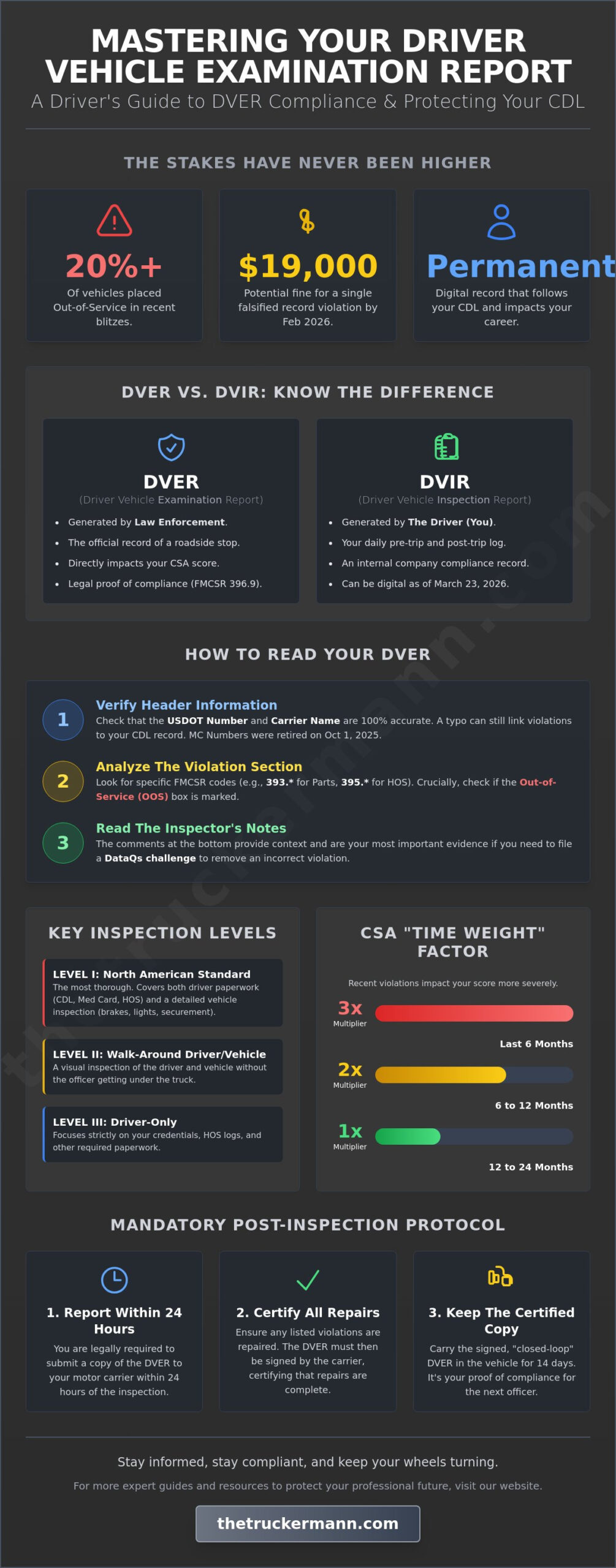
Think of the driver vehicle examination report as the officer’s final grade on your professional performance. It is the official record of a roadside inspection conducted by law enforcement or FMCSA agents, and it carries the weight of federal law behind it. Authorized under FMCSR Section 396.9, this document serves as the legal proof that your vehicle and your credentials meet the safety standards required to operate on public roads. It isn’t a suggestion; it’s a formal testimony of your compliance at a specific moment in time. Since October 1, 2025, the FMCSA has transitioned to using the USDOT number as the sole federal identifier on these reports, so you’ll no longer see the old MC numbers listed in the carrier section.
There is a critical distinction you need to understand between an “examination” and an “inspection.” The driver vehicle examination report is the officer’s report, not yours. While you perform inspections, the DOT conducts examinations. You should never roll away from a scale house or a roadside stop without a copy of this report in your cab or a verified digital confirmation on your tablet. If there’s a discrepancy later or if your carrier claims they never received the results, that document is your only shield against a tarnished CDL record.
DVER vs. DVIR: Clearing the Confusion
We see drivers mix these up all the time, and that’s a mistake that can cost you during an audit. A DVER (Examination) is generated by an officer during a roadside stop. A DVIR (Inspection) is the daily report you generate during your pre-trip or post-trip routines. As of March 23, 2026, the FMCSA explicitly allows these daily DVIRs to be maintained in a digital format to improve accuracy. However, if an auditor asks for your roadside records and you hand over your daily logs instead, you’re signaling that you don’t know the regs. This confusion leads to missing document violations, which now carry much heavier civil penalties under the 2026 fine increases that can reach up to $19,000.
The 8 Levels of Roadside Inspections
Not all stops are created equal. A Level I “North American Standard” inspection is the most thorough, covering everything from your brake adjustments to your medical certificate verification. Since January 10, 2026, carriers must verify your medical status exclusively through MVRs, so expect officers to be extra diligent here. Level II is a walk-around vehicle inspection, while Level III focuses strictly on your credentials and administrative paperwork. If an officer finds a critical violation during any of these levels, your rig could be declared out of service on the spot. These levels are the primary source of CSA points, especially during high-intensity events like the International Roadcheck scheduled for May 12-14, 2026, which will focus heavily on ELD tampering and cargo securement. To make sure you’re fully prepared for the most rigorous stop of all, review our ultimate DOT inspection Level 1 checklist before your next run.
Breaking Down the Data: How to Read Your DVER
When you’re standing on the shoulder of the interstate or sitting in a scale house office, that driver vehicle examination report can look like a mess of bureaucratic jargon. Don’t let the wall of text intimidate you. This document is your professional scorecard, and you need to know how to read it before you pull back onto the asphalt. Start with the header. Since the FMCSA officially retired MC numbers in October 2025, your USDOT number is now the sole identifier for your carrier. Verify that this number and the carrier name are 100 percent accurate. If the officer fat-fingers a single digit, those violations might end up on the wrong company’s profile, but the “driver” portion of the data will still follow your CDL record like a shadow.
The core of the report is the violation section. This is where the officer lists specific citations tied to the Federal Motor Carrier Safety Regulation 396.9. Look for the Out-of-Service (OOS) indicator. It’s usually a dedicated column or a checkbox next to the violation code. If that box is marked, your wheels are legally locked until the issue is resolved. Finally, read the inspector’s notes at the bottom. These comments often provide the “why” behind the “what,” and they’re vital if you ever need to file a DataQs challenge to get a bogus mark removed from your record.
Understanding Violation Codes and Severity
Every violation on your driver vehicle examination report starts with a numeric string. Codes in the 393 range generally deal with parts and accessories, like a cracked windshield or a leaky air line. Codes in the 395 range usually flag Hours of Service (HOS) errors. It’s vital to distinguish between vehicle-related issues, which often fall on the shop, and driver behavior violations, which are entirely on you. The severity weight of a violation is determined by its potential to cause a crash.
Checking for Accuracy Before You Sign
Clerical errors are more common than you think. Officers work in high-stress, fast-moving environments, and mistakes happen. Before you sign that report, double-check the trailer number and the VIN. If you spot a mistake, point it out immediately. Keep your tone professional and fraternal; you’re two professionals doing a job, not enemies. If you’re looking for more ways to stay ahead of the regs and keep your record clean, consider browsing the resources at thetruckermann.com for veteran-level industry insights. Catching a wrong trailer number now is much easier than trying to fix it three months down the road through a state agency.
Consequences of Violations: Points, Fines, and OOS
A bad driver vehicle examination report is more than just a headache at the scale house; it is a direct hit to your wallet and your professional reputation. When an officer checks that “Out-of-Service” box, the immediate costs start piling up before you even leave the shoulder. You’re looking at potential tow bills, emergency roadside repair fees, and the loss of revenue from a missed delivery. As of February 2026, the FMCSA has raised civil penalties for willful falsification or OOS violations to a staggering $19,000 per occurrence. That’s a life-changing amount of money for any independent operator or fleet driver.
Beyond the immediate cash drain, every violation feeds into the Compliance, Safety, Accountability (CSA) system. The system uses a “Time Weight” factor that makes fresh mistakes hurt the most. For the first six months, a violation carries a multiplier of three. It drops to a multiplier of two from six to twelve months, and finally down to a multiplier of one until it falls off after two years. This means a single high-point violation on your driver vehicle examination report today can sink your “CDL Ranking” and make you a liability for high-paying carriers who demand clean safety records for their insurance renewals.
Out-of-Service (OOS) Orders and Immediate Impacts
If you get hit with an OOS order, the law is clear: do not move that rig. Moving a vehicle before the violation is corrected is one of the fastest ways to lose your CDL for good. You must document the repair through a “closed-loop” process, where a technician certifies the fix before you return to service. If you’re feeling anxious about a potential stop, you should check out these Truck Inspections DOT Myths to separate fact from fiction. Remember, 20.7 percent of vehicles were placed out of service during the 2024 Roadcheck; don’t let yourself become part of that statistic because you believed a truck stop rumor.
CSA Scores and the SMS System
The Safety Measurement System (SMS) is the FMCSA’s digital magnifying glass. While your carrier cares about their overall score, you need to care about your individual driver profile. Carriers use these scores to determine who gets the best routes and who gets the pink slip. A clean inspection is your best tool for career growth. It proves to every potential employer that you’re a professional who values vigilance over “pencil whipping” your logs. In a volatile market, a clean record is the only real job security we have left.
Post-Inspection Protocol: What Happens After the Exam?
The flashing lights are finally in your rearview mirror and the officer has moved on to the next rig. You’re left with a driver vehicle examination report that dictates your next moves. Don’t just shove that paper into the door pocket and forget about it. Your first priority is getting that report to your motor carrier within 24 hours. Federal law requires this timeline so the carrier can begin the certification process for any repairs. If the officer found defects, those issues must be fixed and certified by a technician before the vehicle returns to service. This creates the “closed-loop” compliance trail that auditors look for during a safety review.
Once the repairs are done, you might need to return a signed copy of the report to the issuing agency. Check the fine print on the DVER to see if the state requires a physical or digital “return of service” confirmation. Even after the carrier has the original, you need to keep a personal copy for at least 12 months. Having your own archive is your insurance policy if a carrier “loses” the paperwork or if a violation is incorrectly attributed to your CDL record months down the road. If you need a step-by-step on keeping your compliance tight and your record clean, check out our latest guides for professional drivers.
Driver and Carrier Responsibilities
The motor carrier is legally obligated to certify that all listed repairs were completed. However, the responsibility for advocacy often falls on you. Use that driver vehicle examination report as leverage to demand better maintenance on your assigned rig. If you’ve been complaining about a soft brake pedal for weeks and the DOT finally caught it, that report is your proof that the shop needs to step up. Never toss a clean report, either. A “no-violation” inspection is a gold star for your professional profile and helps balance out your carrier’s CSA scores.
Challenging a Wrongful Citation via DataQs
Officers are human and they make mistakes. If you’re cited for a violation that didn’t happen, the DataQs system is your only path to justice. This is a federal portal where you can challenge the data on your report. You’ll need hard evidence to win. Photos taken at the scene, ELD logs, or a clean inspection from a private shop performed immediately after the stop are your best friends here. You have to act fast. While you technically have up to three years to challenge, waiting more than a few weeks makes it nearly impossible to overturn a violation once the trail goes cold.
Proactive Compliance: Passing Your Next Roadside Inspection
The goal is always a clean sheet. Walking away with a “no violations” result on your driver vehicle examination report is the ultimate badge of honor in this industry. It proves you’re a professional who values vigilance over shortcuts. This level of success starts long before you see the flashing lights of a scale house. It begins with your pre-trip. If you’re “pencil whipping” your logs and skipping the light check, you’re rolling the dice with your career. Officers have a sixth sense for neglect. A messy cab with trash on the dash or loose papers in the footwell is a neon sign that says “inspect me.” It suggests a lack of discipline that an officer assumes extends to your brakes and tires. Clean your dash, organize your permits, and present yourself as the seasoned veteran you are.
The 2026 regulatory landscape has moved toward total digital transparency. With the March 23, 2026, rule explicitly allowing DVIRs to be maintained in electronic formats, there’s no excuse for illegible or missing records. Use digital documentation apps to keep your maintenance history at your fingertips. When an officer sees you can produce a clean, timestamped digital record in seconds, it sets a tone of competence. This often leads to a faster, smoother examination because you’ve already proven you’re on top of your compliance. High-quality gear and a sharp mind are your best tools for keeping that driver vehicle examination report spotless.
Maintenance Gear and Inspection Readiness
Cargo securement is a top priority for enforcement this year. During the upcoming blitzes, inspectors will be crawling over trailers looking for frayed straps, cracked boards, and rusted chains. Your securement gear is your first line of defense against an expensive OOS order. We recommend investing in professional-grade equipment from trusted sources like Mytee Products, where you can find DOT-compliant tools built for the grit of the field. For a deeper breakdown on the specific hardware that keeps you legal, check out our guide on The Best Flatbed Trucking Gear.
Staying Current with 2026 Regulations
The CVSA has scheduled the 2026 International Roadcheck for May 12-14. This 72-hour blitz will focus heavily on ELD tampering and falsification. With the FMCSA now closely examining the timestamps between ELD data and DVIR submissions to catch falsified reports, your data synchronization must be perfect. If you want to walk away with a clean report, you need to be prepared for the intense scrutiny of a Level I inspection. To understand how enforcement trends have evolved and what the CVSA Roadcheck 2024 dates and results reveal about what inspectors will prioritize in 2026, reviewing last year’s data is essential preparation. Dive into our Roadside Inspection Prep guide to ensure you’re ready for the blitz. Stay vigilant, keep your gear tight, and protect your livelihood one mile at a time.
Master the Roadside and Protect Your Livelihood
You now have the tools to decode every line of your driver vehicle examination report with the confidence of a seasoned veteran. We’ve walked through the high stakes of the 2026 regulatory shift, from the $19,000 fines for OOS violations to the mandatory digital synchronization between your ELD and inspection records. Understanding the difference between a roadside exam and your daily logs isn’t just about compliance; it’s about job security in a volatile market. Expert advice from those who’ve spent decades in the sleeper berth shows that preparedness is the only way to beat the “pencil whipping” trap and keep your CSA score clean.
Don’t wait for a Level I inspection to find out your securement gear isn’t up to code. We’ve provided direct links to industry-standard straps and chains to ensure you’re always ready for the next blitz. Check out the latest DOT-compliant gear at Truck n Tow to stay inspection-ready and keep your wheels turning. This profession is a lifestyle, and we’re here to make sure you master it. Stay vigilant, keep your cab organized, and we’ll see you out on the high road.
Frequently Asked Questions
What is the difference between a DVER and a DVIR?
A DVER is the official record an officer generates during a roadside stop. Your DVIR is the daily inspection report you create for your carrier. Since March 23, 2026, the FMCSA explicitly allows these daily reports to be electronic to ensure accuracy and prevent “pencil whipping.” Confusing these two during an audit can lead to missing document violations and heavy fines.
Do I have to sign the Driver Vehicle Examination Report?
You are generally required to sign the report to acknowledge you’ve received a copy. This signature doesn’t mean you agree with the officer’s findings or admit guilt. It simply closes out the administrative part of the stop. If you refuse, you’re likely just inviting more scrutiny and a longer delay on the shoulder while the officer documents your refusal.
How long do violations stay on my Driver Vehicle Examination Report?
Violations remain on your personal driver profile for three years. For your carrier, they stay on the SMS profile for two years. The “Time Weight” multiplier makes fresh violations count for triple points during the first six months. This means your most recent driver vehicle examination report has the biggest impact on your current employability and insurance rates.
Can a DVER result in a fine for the driver personally?
Yes, an officer can issue a personal citation along with the inspection report. While many equipment violations fall on the carrier, HOS errors or moving violations are your responsibility. With the 2026 fine increases, willful falsification of records can now cost you up to $19,000. Officers have the authority to hold you personally accountable for safety shortcuts.
What should I do if I lose my copy of the examination report?
You should check with your safety department first because carriers usually get a digital copy within 24 hours. If they don’t have it, you can pull your records through the FMCSA’s portal or the DataQs system. It’s a smart habit to snap a clear photo of the report with your phone the moment the officer hands it to you at the scale.
Does a “Clean” DVER help my CSA score?
A clean driver vehicle examination report is one of the best ways to improve a carrier’s CSA score. By adding violation-free inspections to the record, you help dilute the impact of any previous mistakes. For a driver, a history of clean inspections is a powerful resume builder. it proves to future employers that you’re a low-risk professional who takes maintenance seriously.
How do I know if a violation on my DVER is an Out-of-Service order?
Look for a specific “Out-of-Service” column or a checkbox next to the cited violation code. If that box is marked “Yes” or checked, you are legally grounded. This means you cannot move the truck until the defect is repaired and certified. In the case of a driver OOS order, you must remain off-duty until your required rest period is over.
Can I continue driving if I have a vehicle violation on my DVER?
You can typically keep rolling to your next stop if the violation isn’t marked Out-of-Service. However, you still have a legal obligation to get that defect fixed and the report signed and returned within 15 days. Ignoring a “fix-it” violation is a fast way to turn a minor issue into a major legal headache during your next roadside stop. Knowing exactly what officers check during a DOT inspection Level 1 checklist review can help you address those defects before they ever become a citation.
Disclaimer
The information provided on The TruckerMann is for general informational and educational purposes only. While every effort is made to ensure the accuracy and reliability of the content, trucking laws, FMCSA regulations, DOT requirements, safety standards, and industry policies can change at any time. Readers are encouraged to verify all information with official government agencies, professional advisors, or qualified industry professionals before making business, legal, financial, safety, or compliance-related decisions.
The content shared on this website reflects personal opinions, experiences, research, and commentary and should not be considered legal, financial, medical, tax, or professional advice. The TruckerMann and its owners, contributors, affiliates, or representatives are not responsible for any losses, damages, violations, penalties, or liabilities resulting from the use or misuse of information found on this website.
Some content on this website may contain affiliate links, sponsored content, or promotional material. This means we may earn a commission at no additional cost to you if you choose to purchase through certain links.
By using this website, you agree that you do so at your own discretion and risk.