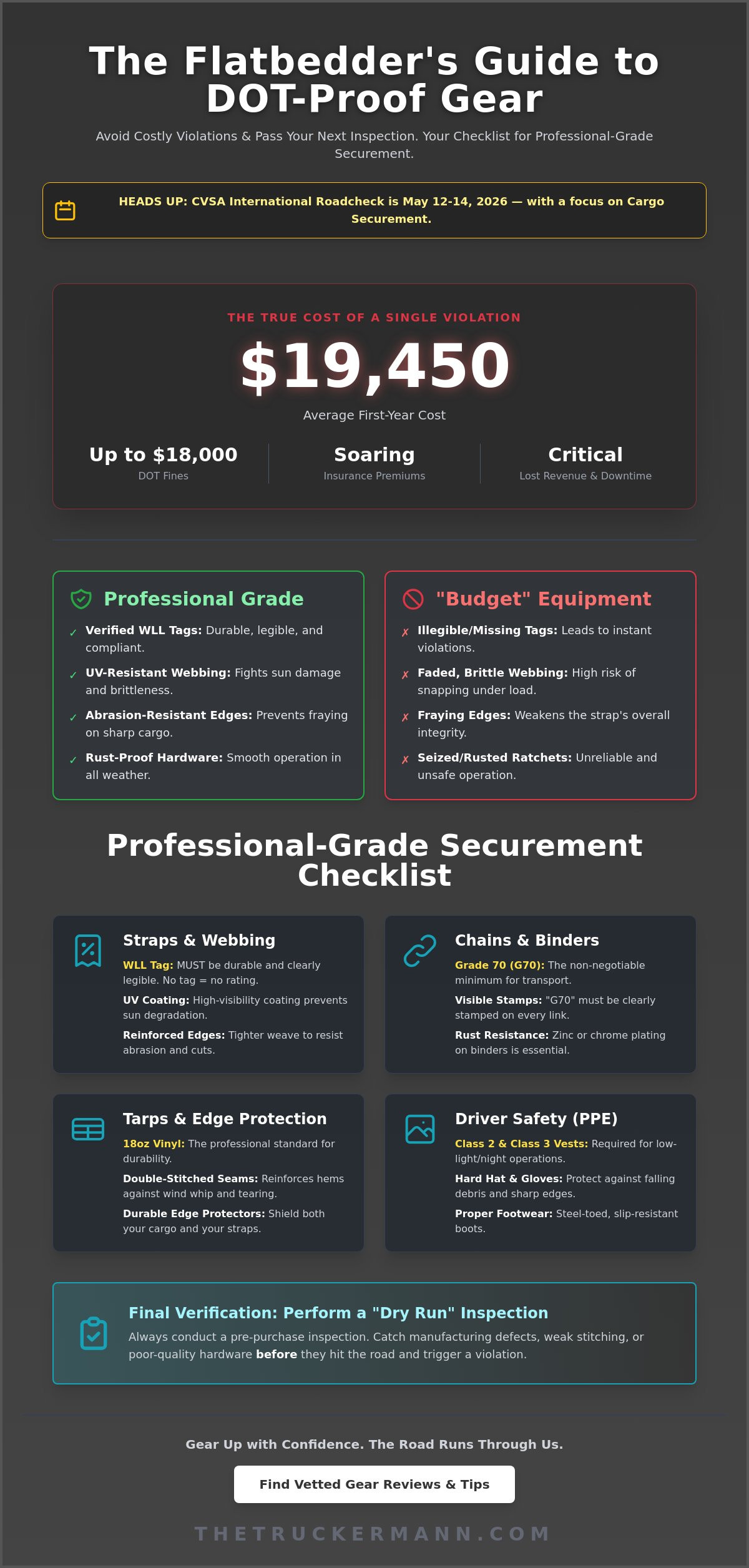
A single cargo securement violation can cost you an average of $19,450 in the first year alone. Between the heavy fines, surging insurance premiums, and lost revenue while your truck is sidelined, one bad strap is a debt you just can’t afford. Hey Friend, I know the pressure of keeping that load tight while the DOT is breathing down your neck, especially with the CVSA International Roadcheck focusing specifically on cargo securement from May 12 to 14, 2026.
Most flatbed product reviews you find online don’t tell the full story of how gear actually performs after three months of road salt and freezing rain. You need equipment that doesn’t just look good out of the box but maintains its Working Load Limit through every mile. I’ve put together a professional-grade checklist to help you evaluate securement gear like a seasoned veteran, ensuring you stay compliant with 49 CFR Part 393 and avoid those $18,000 maximum fines. We will look at the criteria for abrasion resistance, cold-weather flexibility, and WLL verification so you can pass your next Level 1 inspection with total confidence. The road runs through us, and it’s time we make sure our gear is as tough as the drivers using it.
Key Takeaways
- Learn how to spot the difference between “budget” equipment and professional-grade gear that survives extreme weather and heavy road use.
- Master the essential checklist for evaluating flatbed product reviews, focusing on Working Load Limit (WLL) tag durability and UV-resistant webbing.
- Discover why 18oz vinyl and double-stitched reinforcements are the non-negotiable standards for protecting both your cargo and your profit margins.
- Identify the Class 2 and Class 3 high-visibility PPE requirements you need to stay safe and compliant during low-light securement operations.
- Get a step-by-step guide for conducting “dry run” inspections to catch manufacturing defects before they trigger a DOT violation.
The Flatbedder’s Pre-Purchase Inspection: Why Gear Quality Matters
Your securement gear isn’t just a collection of straps and chains; it’s the thin line between a profitable haul and a career-ending disaster. When you’re out there watching miles roll, your equipment is the only thing keeping a 40,000-pound steel coil from becoming a lethal projectile. This is why we hold ourselves to the “Truckermann Standard.” It’s a commitment to quality that refuses to cut corners because we know the grit of the highway doesn’t forgive mistakes. Relying on honest flatbed product reviews from fellow drivers is more than just smart shopping. It’s a fraternal responsibility. We share what works and what fails so that every member of this brotherhood makes it home safe with their CDL intact.
The True Cost of Cheap Equipment
Saving twenty dollars on a pack of winch straps might feel like a win at the fuel island, but the math doesn’t add up on the shoulder of the interstate. A single cargo securement violation can drain $19,450 from your pocket in the first year when you factor in fines, insurance hikes, and lost revenue. With DOT fines reaching up to $18,000 for severe violations, that “budget” gear becomes the most expensive mistake you’ll ever make. Beyond the money, these failures tank your CSA score, making you a target for every roadside inspection blitz. Seasoned veterans live by a simple rule: buy once, cry once. Investing in high-quality gear from trusted sources like Mytee Products ensures you’re following the fundamental principles of load securing without worrying about a strap snapping in a January crosswind.
What to Look for in a Professional Review
Not all flatbed product reviews are created equal. You’ll see plenty of five-star ratings on massive marketplaces from people who used a strap once to move a lawnmower. That isn’t the data a professional needs. A real review must evaluate equipment based on FMCSA and WSTDA (Web Sling & Tie Down Association) compliance. Look for reviews that focus on “real road” testing. You need to know how a strap handles UV exposure after a month in the desert or if a binder’s ratchet mechanism freezes up in the Midwest. We need technical details on Working Load Limits (WLL) and abrasion resistance. If a reviewer hasn’t checked for manufacturing defects or verified that the tags can survive a high-pressure wash, they aren’t giving you the full story. Real expertise comes from the drivers who have seen gear fail and lived to tell the story.
Essential Securement Gear Checklist: Straps, Chains, and Binders
When you’re standing on the deck of your trailer at 4:00 AM, you need to know your gear is going to hold. Our flatbed product reviews focus on a simple truth: if the gear isn’t stamped, tagged, or stenciled, it doesn’t exist in the eyes of a DOT officer. The first item on your checklist must be the Working Load Limit (WLL) tag. These tags need to be made of durable material that won’t shred after two weeks of flapping in the wind. Under the FMCSA cargo securement rules, any tie-down without a legible marking is often rated at the lowest possible capacity during a roadside inspection. This can lead to an immediate out-of-service order, especially during the May 12 to 14, 2026, CVSA Roadcheck where cargo securement is a primary focus.
- Webbing Integrity: Inspect your straps for a high-visibility UV coating. The sun is a slow killer for nylon and polyester webbing; if your straps look faded, they’re likely brittle and prone to snapping under tension.
- Abrasion Resistance: Look for reinforced edges. High-quality flatbed product reviews will highlight brands that use a tighter weave to prevent fraying against sharp cargo corners.
- Mechanical Smoothness: Your ratchet mechanisms should operate without a fight. Check for zinc or chrome plating to resist the rust that comes from winter road salt.
- Chain Grade: For heavy hauling, Grade 70 Transport chain is the bare minimum. Every link should have the “G70” stamp clearly visible to pass a Level 1 inspection.
Winches and Straps: The Soft-Side Essentials
Choosing between 2-inch and 4-inch straps depends entirely on your freight, but the quality standards remain the same. While 2-inch straps are great for lighter loads, 4-inch straps are the workhorses of the flatbed world. Look for straps with stenciled WLL ratings directly on the webbing in addition to the tag. This provides a backup if the tag gets ripped off during a rough unload. For a deeper dive into specific brands that survived our stress tests, check out our guide on the Best Flatbed Trucking Gear for 2026. It’s about finding gear that stays flexible when the temperature drops below freezing.
Chains and Binders: For the Heavy Haul
When you’re moving steel or machinery, chains are your best friend. In the world of binders, the debate between ratcheting and lever styles is settled by safety and precision. Ratcheting binders provide more controlled tensioning and don’t have the “snap-back” danger of lever binders that has caused countless injuries. Our testing shows that ratcheting models are far superior in cold weather because they don’t require the same brute force to lock down when your hands are cold. Make sure your binders have ergonomic handles that won’t slip out of your grip when covered in grease or ice. You can find high-strength G70 chains and reliable binders over at Truck n Tow to ensure your heavy-haul setup is bulletproof. The road runs through us, so don’t settle for gear that might quit before you do.
Tarping and Edge Protection: Shielding Your Load and Your Wallet
Hey Friend, if you’ve ever spent two hours wrestling a frozen tarp in a North Dakota blizzard, you know that your gear is either your best friend or your worst enemy. Tarping is arguably the most physically demanding part of the job, but it’s also where your profit margin goes to die if you buy the wrong equipment. When you’re digging through flatbed product reviews, the weight of the vinyl is the first thing you should look for. 18oz vinyl is the industry standard for a reason. It’s heavy enough to resist the constant buffeting of the wind at 70mph but flexible enough to fold when the mercury drops. If a review mentions a tarp “shredding” within the first six months, it usually means the manufacturer skimped on the base fabric or the UV coating.
Reinforcement is the next non-negotiable on your checklist. Every D-ring and grommet must be double-stitched into a heavy-duty webbing tail. Single-stitching is a recipe for a “tarp-flap” disaster that can lead to cargo damage and a massive claim. You also need to verify the cold-crack rating. For those of us running northern routes, a tarp with a -40 degree cold-crack rating is the difference between a successful delivery and a pile of shattered plastic in your trailer box. Following the FMCSA cargo securement rules isn’t just about straps; it’s about ensuring your entire load is contained and protected from the elements.
The Tarp Selection Checklist
Your choice between steel tarps and lumber tarps should be dictated by the freight you haul most often. Steel tarps are shorter and easier to handle for low-profile loads, while lumber tarps have the “drops” needed to cover tall stacks of wood. Be wary of reviews for “lightweight” tarps. While they save your back, they often sacrifice tear resistance. If you’re going the lightweight route, look for reviews that specifically mention “parachute material” or high-strength ripstop weaves. To keep your investment in top shape, check out our Flatbed Gear Maintenance Guide to learn how to patch small holes before they become major problems.
Edge Protection: The Unsung Heroes
Edge protectors are the smallest items in your kit, but they do the heavy lifting of protecting your straps from sharp edges. In your flatbed product reviews, look for mentions of “strap-saver” features. These are grooves or raised edges that keep the webbing centered and away from the cut-zone. Plastic V-boards are great for shingles and crates because they’re light and stackable. However, for machinery or steel plate, you need the durability of steel edge protectors. They won’t crush under the immense pressure of a ratcheted-down winch. I always recommend checking Mytee Products for a wide range of protective accessories that have been tested in real road conditions. The road runs through us, and we don’t let a sharp corner ruin a good day’s work.
The Driver’s Safety Kit: PPE and Personal Gear Essentials
Securing a load is only half the battle. If you aren’t protecting yourself while you’re working the winch bar or pulling tarps, you’re one slip away from a forced retirement. Hey Friend, I’ve seen too many good drivers sidelined because they prioritized their cargo over their own skin. As we approach the CVSA International Roadcheck on May 12 to 14, 2026, remember that inspectors aren’t just looking at your straps. They’re looking at you. Being visible and protected on a dark shoulder or a busy job site is a non-negotiable part of the professional standard we live by. The best flatbed product reviews don’t just talk about the truck; they talk about the gear that brings the driver home in one piece.
Your high-visibility vest is your first line of defense. For night-time securement, you need Class 2 or Class 3 compliance to ensure you’re seen from a distance by tired four-wheelers. When you’re reading flatbed product reviews for safety apparel, look for comments on wash durability. Reflective tape that peels off after three cycles in a truck stop laundry is a waste of your hard-earned money. You also need a flashlight that does more than just glow. Look for a minimum of 1,000 lumens and a long-lasting lithium-ion battery. You need that piercing beam to spot hairline cracks in your header board or frayed webbing during your 2:00 AM pre-trip inspections.
Personal Protective Equipment (PPE) Checklist
Comfort is a safety feature when you’re working 14-hour days. Your vest needs to be sized large enough to fit over a heavy winter parka without restricting your movement. If it’s too tight, you won’t wear it, and that’s when accidents happen. When it comes to gloves, the “Truckermann Standard” requires a balance between protection and dexterity. You need a grip that holds firm in oily or icy conditions but still allows you to feel the tension in a winch line. For more detailed breakdowns on what keeps us safe, check out the Ultimate Guide to Professional Trucking Gear. We also look for glove reviews that mention touchscreen compatibility so you can log your status without exposing your hands to the elements.
Tools for the Toolbox
Every flatbedder needs a reliable winch bar. The debate in most reviews usually settles on hollow versus solid steel. Hollow bars are lighter and easier on your back during a long day of multi-stop loads, but solid steel bars offer the peace of mind that they’ll never bend under extreme leverage. Don’t forget a high-quality tire thumper and a versatile multi-tool for those quick roadside adjustments. These small investments prevent big headaches when you’re 500 miles from the nearest terminal. The road runs through us, and being prepared is how we keep it moving. For a comprehensive look at the best trucking tools every professional driver needs in 2026, make sure your side box is stocked before the next CVSA blitz. Grab your essential safety tools and high-vis gear at Truck n Tow to stay compliant and protected on every haul.
Putting Your Gear to the Test: Final Verification and Compliance
Hey Friend, you’ve done the heavy lifting of researching and reading the flatbed product reviews, but the real work starts when that gear hits your trailer deck. Before you hit the pavement for a long-haul run, conduct a “dry run” securement with your new equipment. It’s better to find a slipping ratchet or a defective hook in the safety of your yard than to discover it while you’re battling crosswinds on a mountain pass. Check every mechanism for smooth operation and ensure every chain link is free of hairline fractures. Documentation is your best defense. Start a maintenance log for your gear; knowing exactly when a strap went into service helps you retire it before it becomes a liability. Verify that every WLL tag on your gear matches the requirements for your specific load manifest. If your total WLL doesn’t equal at least 50% of the cargo weight, you’re inviting a violation before you even clear the yard gate.
Passing the DOT Blitz
With the CVSA International Roadcheck scheduled for May 12 to 14, 2026, the focus on cargo securement is going to be intense. In 2025, inspectors issued 18,108 violations for cargo not being properly secured to prevent leaking, spilling, or falling. High-quality gear makes these Level 1 inspections stress-free because you aren’t hiding worn webbing or rusted binders. When you’re looking at flatbed product reviews, pay close attention to which brands are cited for “tag failure.” A missing or illegible tag is a common gear-related violation that can result in an immediate out-of-service order. For a complete breakdown of what else the DOT will be looking for during your walk-around, keep our CDL Pre Trip Inspection Master Guide handy in your cab.
The Truckermann’s Final Word
At the end of the day, trust your gut. If a piece of gear feels “light” or the stitching looks thin compared to what you’re used to, it probably isn’t up to the Truckermann Standard. We’ve seen it all on the road, and we know that the cheapest option usually costs the most in the long run. Don’t keep your experiences to yourself. Share your own real road stories and gear failures with the community; your insight might save a fellow driver from a costly claim or a dangerous situation. Join the brotherhood, stay vigilant, and keep your equipment in top shape. The road runs through us, and together, we’ll make sure it stays that way.
Master the Deck and Secure Your Future
Hey Friend, the difference between a smooth haul and an $18,000 DOT fine often comes down to the split-second decision you make when buying equipment. We’ve laid out the checklist for everything from G70 chains to Class 3 high-visibility vests so you can navigate the May 2026 CVSA Roadcheck with zero anxiety. Trusting expert-vetted flatbed product reviews and real-world testing by professional drivers is how you avoid the budget gear trap that leads to cargo claims. Our community relies on direct links to trusted suppliers like Mytee Products because we know those tools have survived the grit of the highway. It’s about preparedness, transparency, and the fraternal bond we share behind the wheel.
Don’t wait for an inspection blitz to realize your straps are fraying or your tags are fading. Take the lead, audit your toolbox, and gear up for the road at Truck n Tow to ensure you stay compliant and profitable. The Truckermann is always here as your sentinel on the shoulder, filtering the noise into actionable advice. Keep those loads tight and your eyes on the horizon. The road runs through us.
Frequently Asked Questions
What is the most important factor in a flatbed strap review?
The legibility and durability of the Working Load Limit (WLL) tag is the most critical factor because it determines your legal compliance. If a review doesn’t mention how the tag holds up after 10,000 miles of wind and rain, it isn’t giving you the full picture. You need tags made from heat-sealed polyester or similar weather-resistant materials that won’t shred or fade before the season ends. A strap with a missing tag is legally rated at zero during an inspection.
How do I know if a flatbed product is truly DOT compliant?
True DOT compliance is verified by markings that meet FMCSA 49 CFR Part 393 and WSTDA standards. Look for a permanent, legible label that lists the manufacturer’s name and the rated capacity. While reading flatbed product reviews, check if drivers mention passing Level 1 inspections with that specific brand. A reputable manufacturer will always provide a certificate of compliance or have the ratings clearly stenciled on the equipment to satisfy roadside inspectors.
Should I trust reviews for ‘lightweight’ lumber tarps?
Trust reviews for lightweight tarps only if they provide data on ripstop technology or parachute-style materials. Lightweight tarps are easier on your back, but they often lack the 1,000-denier strength of standard 18oz vinyl. Look for reviewers who have hauled sharp-edged loads like crated machinery or shingles. If the review doesn’t mention how the tarp handles high-speed wind buffeting at 70mph, the weight savings might not be worth the risk of a catastrophic tear.
What is the difference between Grade 70 and Grade 80 transport chains?
Grade 70 (G70) is the industry standard for cargo securement and is made from heat-treated carbon steel. Grade 80 is a higher-strength alloy chain that offers a roughly 20% increase in Working Load Limit for the same diameter. While G70 is sufficient for most flatbed applications, heavy-haul drivers often prefer Grade 80 for its superior strength-to-weight ratio. Always ensure the links are stamped with the correct grade to pass the May 2026 CVSA Roadcheck inspection blitz.
How often should I replace my securement gear based on reviews?
You should replace gear immediately when you see nicks, burns, or 10% wear on chain links, regardless of the purchase date. Flatbed product reviews often show that high-quality 4-inch straps last about 12 to 18 months under professional use, while budget versions might fail in 90 days. Keep a maintenance log and perform a dry run inspection every 30 days to catch fraying webbing or seized ratchet mechanisms before they trigger a violation.
What are the red flags to look for in a gear manufacturer?
A major red flag is a manufacturer that fails to list specific WLL ratings or WSTDA compliance on their product pages. If the gear is marketed as all-purpose rather than specifically for professional transport, it likely hasn’t undergone the rigorous testing required for a CDL holder’s needs. Avoid companies that don’t have a physical address or a history of serving the logistics industry. Real road stories often highlight these fly-by-night brands that disappear when a claim arises.
Can I use edge protectors with any brand of strap?
You can use edge protectors with any brand of strap as long as the protector is wider than the webbing. A standard 4-inch strap requires a protector that is at least 5 inches wide to prevent the strap from shifting and contacting the cargo edge. High-quality reviews will note if a protector has strap-saver grooves that keep the webbing centered. Using protectors is a mandatory requirement under 49 CFR 393.104 when a tie-down is subject to abrasion.
Why do some flatbed binders have better reviews for winter use?
Ratcheting binders consistently get better winter reviews because they don’t require the dangerous snap-back force of lever binders in freezing conditions. Look for models with sealed grease fittings and zinc-plated threads that resist road salt corrosion. When the temperature drops below zero, a binder with an ergonomic, non-slip handle is a lifesaver. Drivers in the northern states prefer these because they can be operated safely while wearing heavy gloves without losing essential leverage.
Disclaimer
The information provided on The TruckerMann is for general informational and educational purposes only. While every effort is made to ensure the accuracy and reliability of the content, trucking laws, FMCSA regulations, DOT requirements, safety standards, and industry policies can change at any time. Readers are encouraged to verify all information with official government agencies, professional advisors, or qualified industry professionals before making business, legal, financial, safety, or compliance-related decisions.
The content shared on this website reflects personal opinions, experiences, research, and commentary and should not be considered legal, financial, medical, tax, or professional advice. The TruckerMann and its owners, contributors, affiliates, or representatives are not responsible for any losses, damages, violations, penalties, or liabilities resulting from the use or misuse of information found on this website.
Some content on this website may contain affiliate links, sponsored content, or promotional material. This means we may earn a commission at no additional cost to you if you choose to purchase through certain links.
By using this website, you agree that you do so at your own discretion and risk.